An advanced how-to guide to using the U.S. military’s most powerful strategic tool.
“This is Spearhead 6, execute FRAGPLAN 7,” the division command radio net crackled.
It was the evening of February 25, 1991 – Operation Desert Storm – and we in “Spearhead” 3rd Armored Division were deep into Iraq on the second day of the attack as part of 7th Corps, the main attack force. “Six” is the call sign of the commander, and a “FRAG” (short for “fragmentary”) plan is Army speak for a contingency plan. The order to switch to FRAGPLAN 7 meant that the enemy didn’t do what we expected they would, and we thus needed to change to a predesignated contingency plan.
“I guess the enemy didn’t get the memo,” my radio man jokingly muttered. 7th Corps primary plan was to attack from Saudi Arabia into Iraq to the west of the main enemy positions, deep into the enemy’s rear. Doing so, we expected that our primary objective, Saddam Hussein’s elite Republican Guard (RG) Divisions, would retreat to the north, abandoning their defensive positions and occupation of Kuwait, given the threat we imposed of encircling them and cutting off the resupply and communications lines to their rear. After taking away their advantage of being in a fixed defense, we could then engage them in open battle.
Instead, they decided to stand and fight. Defeating these RG Divisions were what the corps commander LTG Fred Franks designated as the enemy’s “center of gravity” – defined in U.S. Army doctrine as the core focal factor that the success of a plan hinges on. LTG Franks knew that the RG provided the Iraqis their strategic flexibility and that if we defeated the elite RG, the rest of the less proficient Iraqi Army would begin to crumble.
FRAGPLAN 7 was based on the “what if” occurrence that the RG stayed in place, and entailed that 7th Corps and its five divisions and other assets abandon the attack north and instead swing to the east and launch an attack against their positions – what the press later labeled the “hail Mary” or “right hook,” depicted by the darker blue arrows on the map below.
How do you get a force totaling a massive 150,000 soldiers in strength to execute a substantially changed plan in stride, maneuvering divisions into new positions and directions of attack across an approximately 100-mile front, while maintaining coordination, synchronization, logistical support and effective performance? Every artillery and bombing target had to shift; attack routes, resupply points and medical stations all had to shift; communications antennas had to relocate; new maneuver control points had to be established, etc. To be so adaptable, organizations need to enact “possibilistic” thinking, analyzing the potential need to change ahead of time and have developed, socialized and rehearsed a responsive contingency plan across the organization. That foresight and associated contingency plan was, in this case, FRAGPLAN 7 and it ensured the overwhelming defeat of the enemy’s center of gravity in Desert Storm.
Does your organization proactively plan to “shift right”?
The U.S. Army operates in volatile, uncertain, complex, and ambiguous (VUCA) contexts where changes to plans are not only likely but is expected. General Eisenhower stated, “Plans are nothing – planning is everything,” conveying that the plan itself is less important than the process you go through to create that plan, wherein wisdom is gained. As VUCA often demands that plans change, it is thus critical that through a robust planning process the organization has created deep knowledge and understanding of the threats and opportunities to a plan and created a series of contingency plans. Gaining such wisdom requires a process to fully understand all of the plan’s internal and external stakeholders (business partners, competitors, employees, government actors, and other stakeholders, etc.), the operating environment, the competitive market dynamics, and all the ‘what if’ factors and events that might positively or negatively affect your plan during execution.
To do this, the Army has honed over many years a process called “red teaming.” Red teaming is just one step in a broader planning process but is arguably the most important. Red teaming occurs after planners develop potential courses of action (COA) to accomplish the leader’s intent or vision for a given plan, strategy, or initiative. Creating a minimum of two potential COAs is advised so that they can be compared for their relative strengths and weaknesses after each is thoroughly “red teamed” to determine which is best. In the case of Desert Storm, before selecting the primary plan, planners initially looked at alternate COAs of attacking from the west part of Saudi Arabia due north into Kuwait, an amphibious assault from the Persian Gulf, and numerous other potential COAs. Each were red teamed prior to settling on the final intended plan. I say intended for as Prussian Field Marshall von Moltke famously stated in the 1800’s, “No plan survives contact with the enemy.”
Research shows that leaders and their planning teams are plagued by numerous psychological limitations and biases, and they also tend to not look at their plans fully through the eyes of all stakeholders nor take into account all potential contextual and market factors. Planners also tend to become advocates for their plans and thus tend, often unknowingly, to seek or see as more important information that supports their plan while not seeking or discounting the validity or importance of information that doesn’t support their plan. Red teaming helps break through these and other limitations to increase objectivity.
The Army’s Red Team Handbook states, “‘Red teaming is largely an intellectual process…. more an art than a science…. requiring Red Team members to possess superb critical and creative thinking skills.” Red Teaming can be defined as:
A process of providing objective assessment and exploring alternatives, opportunities, and weaknesses in plans and operations from the perspective of adversaries (competitors), other stakeholders (e.g., suppliers, customers, employees), and potential positive and negative (Murphy’s Law) events.
As former Secretary of Defense Donald Rumsfeld said, “There are known knowns. These are things we know that we know. There are known unknowns. That is to say, there are things that we know we don’t know. But there are also unknown unknowns. There are things we don’t know we don’t know.” The purpose of red teaming is to ensure you objectively maximize the organization’s understanding of the known-knowns, validating and refining your facts. That you analyze, create assumptions for, and develop contingency plans for the known-unknowns. And that you ideate and create wisdom and flexible plans as best possible to ready the organization to respond to the many unknown-unknowns that may occur.
The red teaming process has been successfully implemented across many corporate enterprises of all sizes. Chris Calio, President of Pratt & Whitney says “We’ve widely adopted red teaming as a tool to support critical decision making, on topics ranging from investments to financial plans to customer proposals. It’s become especially valuable in the current VUCA environment, when leaders often are required to make swift decisions while facing a host of unknowns. Our leaders recognize that using red teaming to challenge our assumptions and understand different stakeholder perspectives results in better quality decisions and improved team alignment.”
Setting the conditions:
Effective red teaming first requires a transparent culture that encourages ideating outside the box, and ‘speaking truth to power’ by openly expressing thoughts and concerns about plans. Everyone needs to remain objective, not allowing personality, belief of “what COA the leader wants” or other factors to limit ideation or defending a COA just because you developed it. There should be “no rank in the room” – everyone participates and has a chance to raise ideas, issues, and concerns transparently. Indeed, often those employees closest to the point of execution or that interact more regularly with stakeholders have the best insights.
Red team members must also be sufficiently selfless and willing to put the organization first. Such selflessness is shown by providing outside perspectives to help others red team their plans, avoiding politics and ‘silo thinking’ and being open to recognize when during red team analysis your unit’s/team’s plans negatively affect other units/teams and be willing to adjust your plans as needed.
Effective red teaming also requires balance. Planning teams too often focus red teaming on the potential threats to the plan, but you should equally look to identify opportunities that may emerge during plan execution. You should ask yourself ‘how can we be ready to seize this opportunity if it presents itself’? and create corresponding contingency plans. In Desert Storm, for example, we didn’t adequately consider or plan for the potential that the enemy would surrender in droves once met with overwhelming force, and thus we were not adequately prepared to receive the deluge of 57,000 prisoners taken by 7th Corps during the conflict.
The Red-Teaming Process:
Red teaming is typically best done by breaking a plan into logical phases and then red teaming one phase at a time as shown in the example in the above Figure. Thus, structure the red teaming session to walk participants through each phase in turn from start to finish of plan execution. Prepare synchronization matrices, schematics, models, maps or other products to guide conduct of the session and give participants an understanding of the events happening in each phase and provide a sense of sequence, space and time. There are many techniques and approaches organizations can take to red-team plans. Some key components inherent in any effective red-team session would involve the following seven steps:
1: Do a stakeholder audit: Conduct a thorough analysis to identify all internal and external stakeholders that your plan will affect and/or that could affect implementation of your plan (competitors, business partners, government regulators, clients/customers, community members, your own employees, etc.). When possible, assign knowledgeable individuals to role play those stakeholders to ensure all stakeholder perspectives and potential actions are illuminated and addressed.
2: Conduct stakeholder analysis: Walk through each phase of execution in turn, assessing the potential actions and reactions of each stakeholder group. In each execution phase, ask questions such as “what will be the desires, needs, fears, and positions of each stakeholder?” “What actions might they take or fail to take that could positively or negatively affect the plan?” “What threats and/or opportunities might they impose?” What if, for example, the Republican Guard retreats, holds in defense, counter attacks, etc.
3: Conduct Murphy’s law and Yhprum’s law analysis: After analyzing all stakeholders in a given phase, before moving to the next phase, assess what other possible ‘what ifs’ may occur in addition to specific stakeholder actions. Identify potential Murphy’s law (“if it can go wrong it will go wrong”) events, considering things like “What if a pandemic hits?, What if the prime rate shifts? What if we experience a product recall? What if our employees strike? Yet in each phase also conduct Yhprum’s law (“Murphy” spelled backwards) analysis, whereby you consider “anything that can go right, will go right”. In this case, look for potential opportunities that may arise: What if interest rates or cost of capital decline? What if our major competitor has supplier issues, product recall or government injunction? What if we get unexpected orders that require us to double production? As part of this analysis, challenge all the facts, assumptions, and hypotheses you generated during planning. Ask yourself. Are these really facts (known-knowns) or just assumptions? What if our assumptions we made concerning the known-unknowns (e.g., what the expected sales orders, or cost of labor will be) are wrong? Have we adequately brainstormed potential unknown-unknowns?
4: Identify and list known critical events and decision points. Steps #1-3 will identify a series of critical events that will or could occur and positively or negatively influence mission accomplishment, whether by stakeholders, natural events, etc. In this fourth step, list and describe each critical event, then for those deemed to have sufficient probability of occurring, and are of sufficient importance, identify them as key decision points – points at which the leader may have to decide whether to launch a contingency plan, alter the strategy, allocate additional resources, etc. Decision points are events, locations, or points in time where decisions are estimated to be required during mission execution dues to VUCA (e.g. continue or abort a product launch, apply more resources to marketing, launch Plan B). When red-teaming the primary COA in Desert Storm, the Republican Guard holding in defensive positions was just one of many potential critical events identified, and it served as one of many decision points for LTG Franks – if the event were to occur he had already identified that he would have to make a critical decision at his level, to continue the primary plan or execute a contingency plan.
5: Create contingency plans. Contingency plans should then be created for each decision point. The amount and depth of contingency plans is a leader decision – based on factors such as how much time the team can allocate to planning, how likely each critical event is to occur, and how dangerous or opportune each possible key event might be. As Prussian general Carl von Clausewitz proffered in his famous 1800’s book, On War, and as depicted in the Figure below, contingency plans can be branches or sequels. Sequels are decisions such as whether to launch the next phase of or abort a plan, or slightly alter or infuse additional capital into the plan at key points. Branches entail doing something different than the original main plan (e.g. FRAGPLAN 7). In Desert Storm, there were numerous such contingency plans created.
6: Create a list/matrix of leader’s critical information requirements (LCIR). LCIR is simply the list of information the senior leader wants to be informed of during execution relative to each decision point so that they have the information needed to drive those decisions. Specifically, a matrix should identify and describe each potential critical event, the associated decision point, and list the associated LCIR that the senior leader needs from their team to inform that key decision. LCIR specifies to the team what metrics, market intelligence, internal status factors (e.g., cost or equipment readiness factors) to track and inform the senior leader. Implicitly however, it also communicates what the leader doesn’t need to know – thus it limits followers’ reporting requirements to that information needed to drive decisions at the higher leader’s level. In an empowered organization, other information that drives decisions at lower levels can be maintained at those lower levels.
This also allows senior leaders time to free their minds to think more strategically, knowing they will be ‘brought into the loop’ when needed to make key decisions. In Desert Storm, LTG Franks established a series of LCIR associated with each key decision point identified during the Corp’s red-teaming, which his staff was assigned to track, to include factors that would provide leading indicators of the battle disposition and movements of the Republican Guard. When one of his LCIR was ‘triggered’ he was provided the information, equipping him to decide, based on that information which, if any, FRAGPLAN to initiate. Like any senior leader, LTG Franks could not, nor would want to stay abreast of all information occurring across his 150,000 force – only that which required decisions at his level. His division, brigade, battalion, and other lower level commanders could handle the rest, and each had their own LCIR, developed from their own red teaming, for the potential decisions at their levels.
7: Refine the COA: Red teaming produces great wisdom. Thus, as you red team, you are not just identifying contingencies to the primary plan but gaining knowledge of the primary plan. Thus, also take time to refine the products you created in earlier parts of the planning process (during your market analysis, COA development, etc.) as new knowledge emerges. This may include refining the specified, implied, and key tasks for the plan; the facts and assumptions; SWOT analyses; constraints and risks, resource requirements, event timing, assignments to sub-organizations, etc.
Remember that at least two COAs should be identified for any potential plan to provide the senior leader distinct choices. Red team each COA in isolation and avoid comparing one COA with another during red teaming. Accurately record the advantages and disadvantages of each COA as they arise in red teaming so that they can later be compared based on their relative feasibility, acceptability, suitability, and effectiveness, to guide you to select the best COA.
The red-teaming process can be used in any industry. Latham & Watkins is one of the largest law firms in the world. LeeAnn Black, Chief Operating Officer of Latham & Watkins describes the use of red teaming: “We recently utilized red teaming in our firm’s return-to-office planning for over 6,000 people worldwide. Our core planning team developed protocols focused on minimizing risk in our offices and a proposed framework for communicating to our personnel in the event of possible exposure to COVID-19 in our space. A cross-section of our office leaders from around the world served as our red team. The red team challenged our viewpoints, raised new perspectives and highlighted areas for improvement in our proposal. The red team exercise ultimately resulted in a more robust framework that we implemented shortly thereafter. I believe red teaming enabled us to get to a significantly better decision on a much faster timeline. This is an incredibly valuable tool in the current environment, as leaders are required to make decisions more rapidly and with more agility than ever before.”
Parting Comments
Red teaming can be as formal and exhaustive as you want and need it to be but can also be done more informally or quickly. I have been in formal 15-hour red team sessions and in impromptu 15-minute ones. Regardless of length or formality, when red teaming we are asking everyone to take off their proponent/champion/advocate ‘hat’ for a plan and put on a more critical antagonist/adversary/challenger ‘hat’. Once instilled in the culture, this tool can be used at any time – even impromptu “let’s stop and red team this” in the middle of a meeting or planning discussion to stop and informally scrutinize the team’s thinking.
Further, just as planning should occur at each of the strategic, operational, and tactical levels of the organization, so should red teaming to improve those plans at each level. In the end, leaders at each level should have identified key events, decision points, contingency plans, and LCIR designated to drive execution and decision-making for plans at their level.
Finally, while red teaming takes precious time, we have a saying in the Army to “go slow to go fast” by taking the time to adequately plan up front. Imagine in Desert Storm if we didn’t have FRAGPLAN 7, and the comparatively larger time, resource and performance loss we would have experienced if we had to stop and develop a new plan from scratch, and communicate that new plan to subordinate units who would have had no prior preparation for the new orders, not to mention the debilitating loss of tempo in the attack. I encourage you to go slow to go fast.
Written by Dr. Sean T. Hannah
Original Content Posted by Chief Executive Group, LLC.

 Eileen Dowse Ph.D. CMF & MCEC is a recognized global business consultant and Organizational Psychologist specializing in organizational health and effectiveness through; education, consulting, facilitation and executive coaching. She helps foster productive relationships for organizations and strengthens employee commitment for ensuring greater collaborative impact.
 Catherine Carr, PCC, RCC, MCEC is a Leadership and team coach, Master coach trainer and author. She is the co-author of 50 Tips for Terrific Teams! and High Performance Team Coaching, several peer reviewed journal articles, book chapters, and magazine articles on team coaching. She has a particular interest in coaching professionals to make their life and work wonderful and in building resilient teams.
 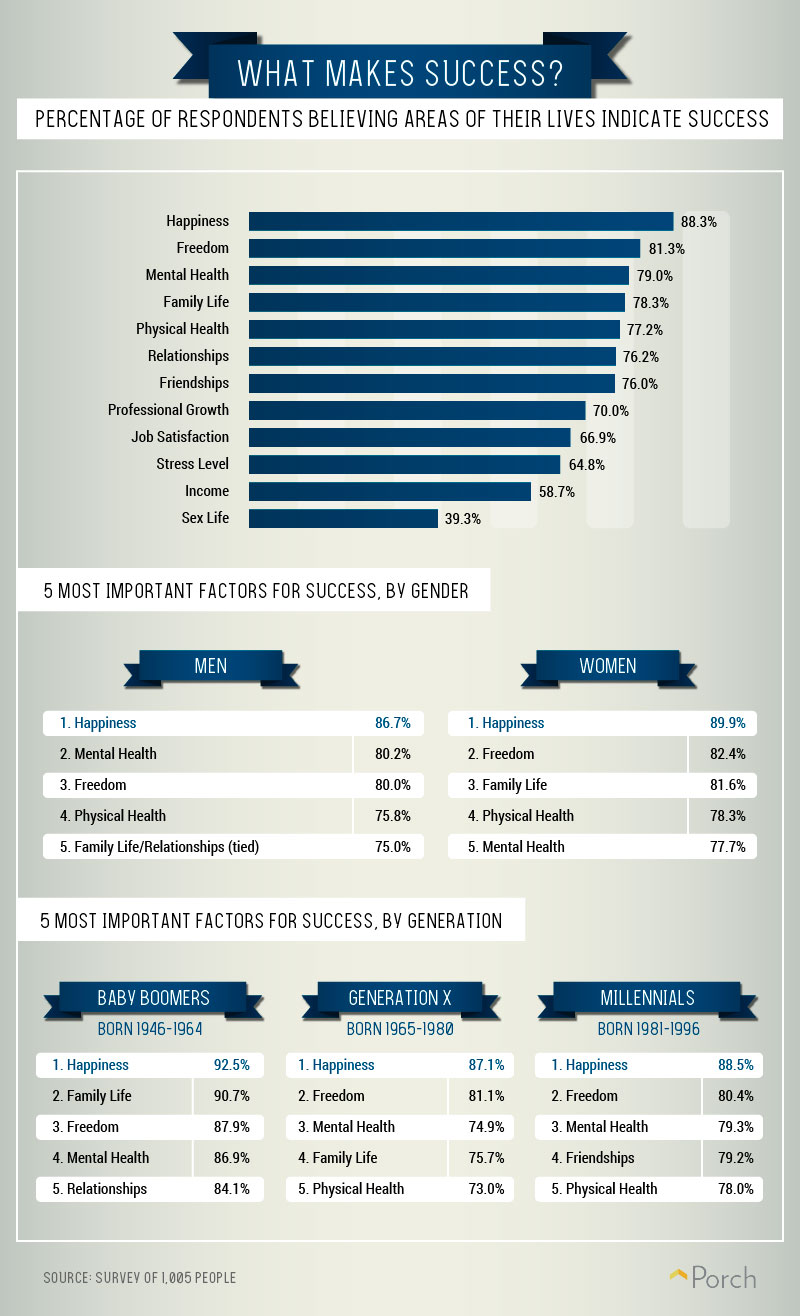 Before we explore any particular habits, it’s helpful to learn how people define success more specifically. After all, it’s something of an abstract concept, although most participants agreed on its major components: More than 80 percent identified happiness and freedom as essential parts of success. Fulfilling family life and good physical and mental health were also popular selections. Interestingly, a smaller percentage said success could be defined regarding professional growth, one’s job, or one’s income. Even fewer said a great sex life was an integral part of succeeding, with less than 40 percent of respondents saying this kind of passion was a part of their vision for fulfillment. Some compelling differences cropped up among men and women, however. Women were slightly more likely to emphasize freedom, family life, and physical health. Conversely, men were more likely to associate success with mental health instead. Generational contrasts included a drop off in focus on family life with each successive generation. Over 90 percent of baby boomers said family was essential to success, whereas only 75.7 percent of Gen Xers said the same. Among millennials, family life didn’t even crack the top five success characteristics.
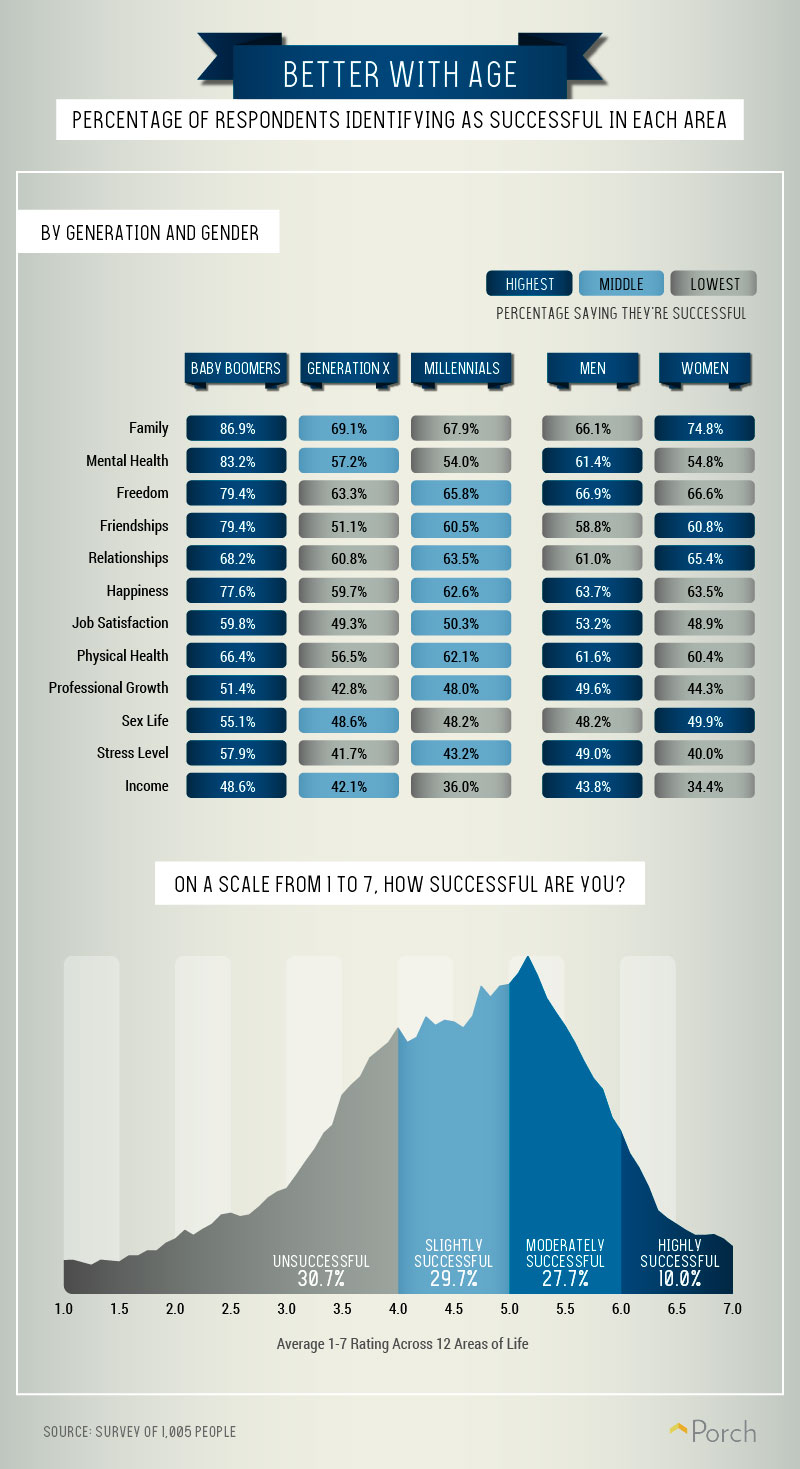 In every life area we designated, baby boomers were most likely to claim success. Call them boastful, but bear in mind they’ve had more time to succeed––and appraise their experiences with more gratitude in retrospect. In many ways, younger generations were dramatically behind in self-reported success, such as in the realms of family, friendships, and mental health. Interestingly, however, millennials were more likely to call themselves successful than Gen Xers in most categories. Perhaps these findings reveal Gen Xers
 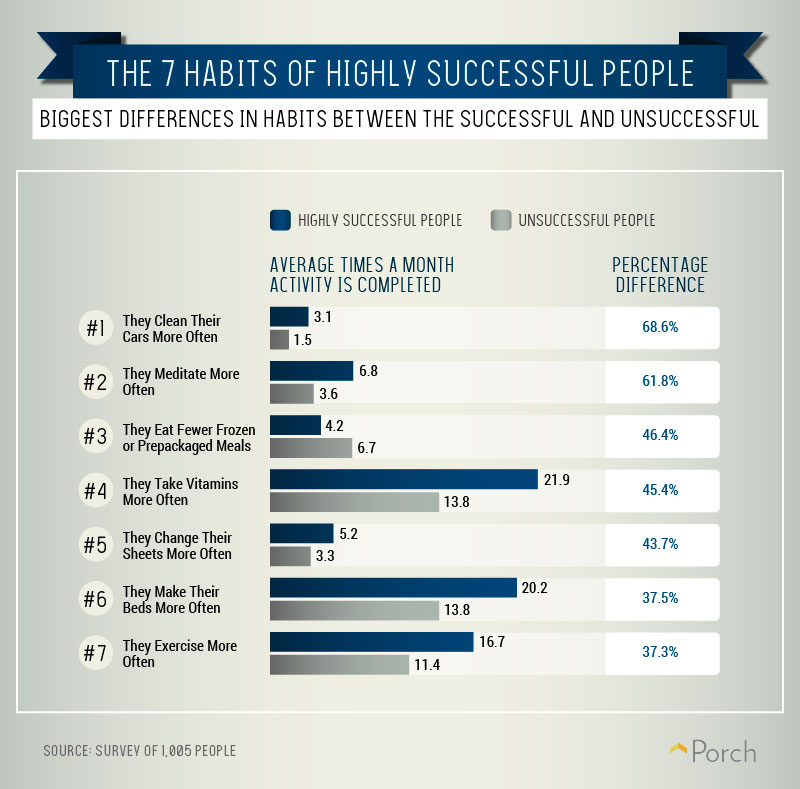 When we considered which
 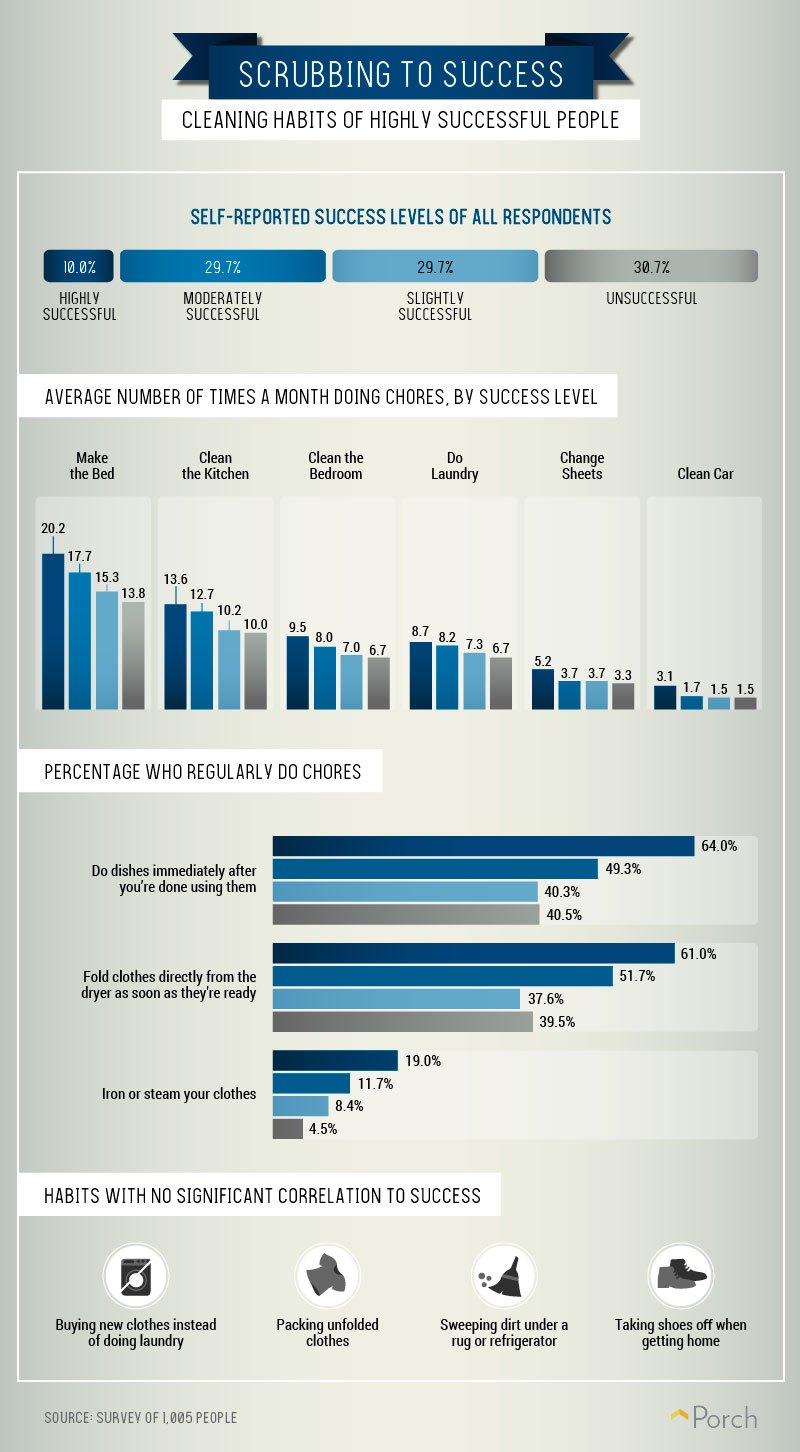 Let’s take a closer look at how cleanliness might correlate with success, comparing the frequency with which different groups tackle household chores. In every specific cleaning activity studied, those who felt the highest degree of success tidied up most often. This positive correlation continued at every level of self-professed success: Those who felt moderately successful cleaned up more often than those who felt only slightly successful, who did so more frequently than unsuccessful respondents. Sometimes, the immediacy of cleaning seemed relevant as well. Nearly two-thirds of highly successful people did the dishes right after they were done using them. Similarly, 61 percent of highly successful people folded clean laundry as soon as the dryer was finished. Then again, some orderly habits did not correlate with success according to our data. Packing unfolded clothes in one’s suitcase or sweeping dirt out of sight rather than into the trash didn’t seem to hurt anyone in the long run, nor did buying new clothes instead of doing laundry.
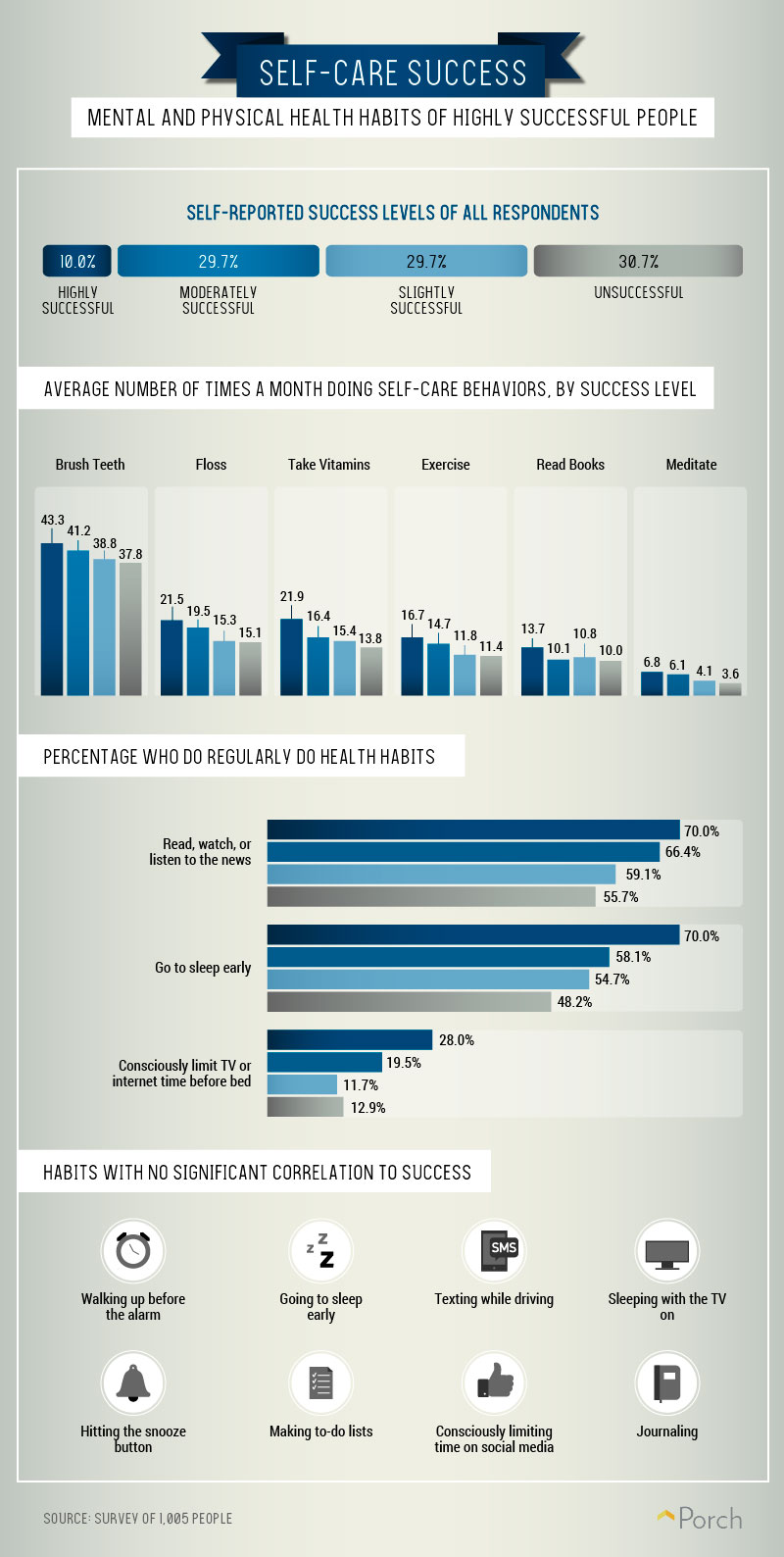 Self-care should pay off in obvious ways: You don’t need to be a dentist to understand the benefits of flossing. But our findings indicate highly successful people were quite disciplined in this regard and feelings of success were correlated with the frequency of these self-care efforts. This connection extended to measures aimed at maintaining physical health, such as exercise and dental care regimens, but highly successful people also read and practiced meditation more often, suggesting intellectual well-being is also paramount. Successful respondents were also more likely to consume news regularly, a finding that contradicts recent research suggesting
 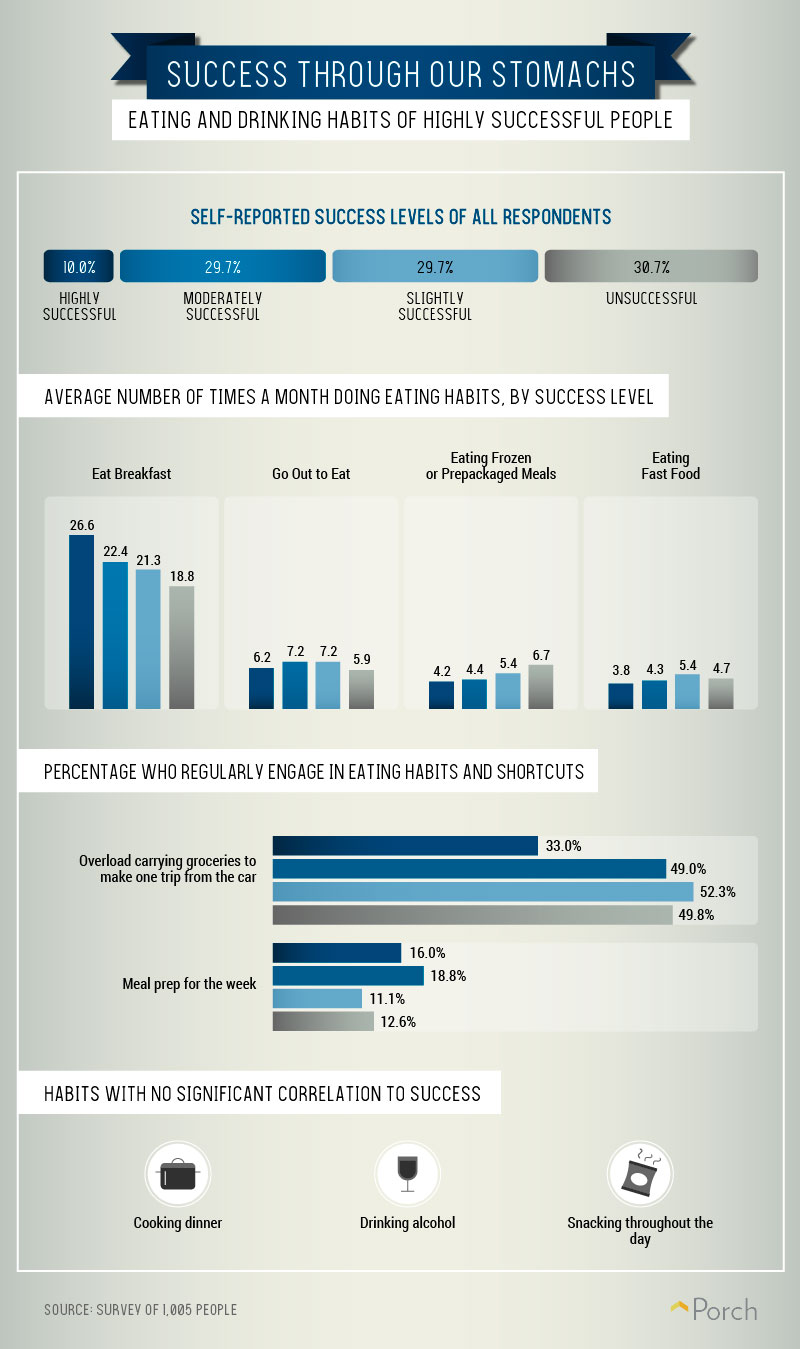 In a victory for parents everywhere, breakfast really does seem to be the most important meal of the day––or at least essential to those who feel highly successful. Conversely, frozen or prepackaged meals negatively correlated with success. On other questions of consumption, however, our results were more varied. Interestingly, highly successful participants ate out less often than moderately and slightly successful peers, although unsuccessful folks dined out least of all. Similarly, highly successful people were actually less likely to conduct meal prep than moderately successful respondents, suggesting a complex relationship between this habit and success. We did find a strong connection related to groceries, however. Only a third of highly successful people tried to take as many bags in at once as possible to avoid multiple trips. Among all other groups, about half attempted this “overload” method.
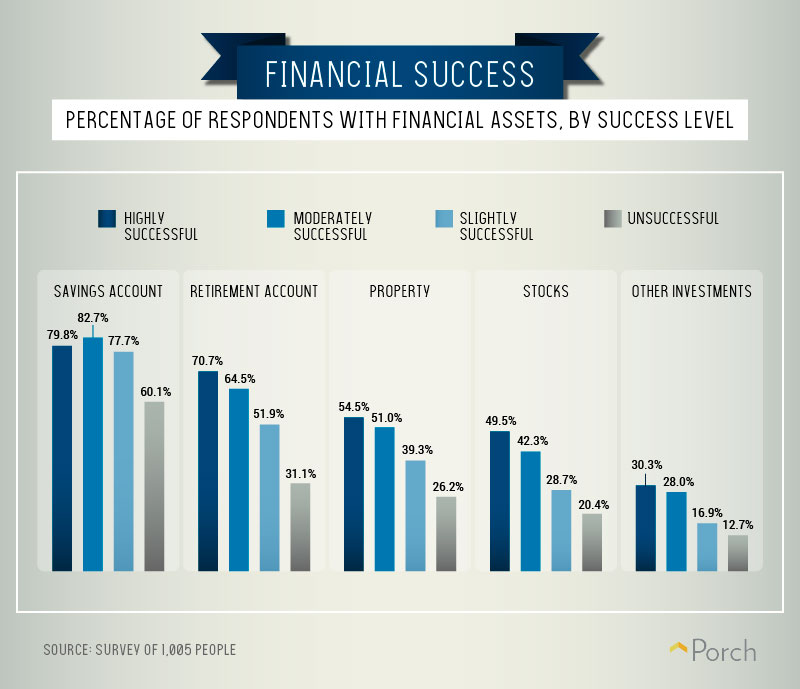 However much we resist materialism, financial concerns arise at many points in our lives and may shape our understanding of success. We found people who identified as moderately or highly successful were quite likely to have a range of investments, especially savings and retirement accounts. Conversely, less than a third of people who felt unsuccessful had a retirement account, and only a fifth were invested in stocks. These data resonate with broader concerns about