Category: Blog

  • How do we Manage, Measure, Motivate?

    Cellene HoogenkampLeadership Talks Episode 2

    Following our first episode of GlobalLeadership Talks, this second episode of our first series continues our conversation with our global panel of HR experts on the evolution of the workplace during a pandemic – How do we Manage, Measure, Motivate?

    Kathleen Procario – Head of HR Bacardi N-America
    Nicole Barrow – Head of HR DP DHL Group Americas
    Kathleen Halligan – Organizational psychologist with People Performance Ireland
    Co-host : Jordan Goldrich – Author of WorkPlace Warrior
    HOW DO WE MANAGE, MEASURE, MOTIVATE? – KEY TAKE AWAYS
    Performance measurements systems: Key is through a more frequent dialogue to adjust people’s commitments and goals, e.g. weekly team conversations with goal adjustments – keep it flexible.

    Motivating: performance goals & measurements are created by the individual and become part of their performance profile – not a top down approach. This ensures ownership, accountability, and clarity in conversations with their managers.

    Managing the performance of your team: ask “How would I like to be managed?” Become more deliberate about your conversations. Listen to the cues of employees: “How can we work together better?” and, “What level of support do I need to provide?”

    Measurements: it’s about managing the outcome. Trust your people to make decisions and be prepared to be delighted by the outcome. Press the “Pause” button if editing is needed.

    Stress: often caused by the fear of the unknown. Being addressed by managers with more empathy, more flexibility, supportive of new working conditions – we are seeing an increase in the EQ coefficient.

    Connecting is paramount: have multiple touch points to communicate messages, formally and informally. Town halls were found to be effective – don’t assume people know.

    Strategic decision making – needs to be swift – a more dynamic environment supports this, versus hierarchical structure. Gather decision makers around the table. Trust & Empower. Cultivate & share best practice – enable freedom within a framework.

    Global and Regional approaches – key is freedom within a giving framework and being empowered to act.

    Preventing burn-out: improving Wellness offers to support the employees – e.g. Virtual Yoga and meditation classes.

    Advice from the Panel:
    Stay connected to customers & employees with more diligence and a personal touch – Trust and empower.

    Transparency throughout all communications, with honesty and humility.

    Put on your own oxygen mask first: Ask yourself, “How do I want to be managed?”

    Will we see a decline in old hierarchical structures into more partnership approaches enabling the motivation to work faster and with more transparency?
    Stay tuned for Episode 3 – How do we help people Thrive in this environment?

  • Beware Of The Halo Effect: Choose Coaches For The Best ROI In The Digital New Normal

    John Reed PhD, MBA, MCEC, PCC Forbes Councils Member Forbes Coaches Council COUNCIL POST| Paid Program Leadership

    John Reed has multiple master coaching certifications, a Dartmouth MBA, a University of Georgia PhD and psychologist licensure.

    GETTY

    Nobel Prize winner Daniel Kahneman studied how we often make important decisions by overrelying on intuitive hunches without the benefit of detailed data and a sensible, consistent process. Dr. Kahneman, a psychologist, described this problem in his book Thinking, Fast and Slow as “what you see is all there is.” Its more common name is the halo effect.

    Think of the halo effect as our tendency to like or dislike everything about someone — including things we don’t know or haven’t observed — based on a single experience with the person. A perfect example is executive coach evaluation and selection. A “chemistry” meeting between an executive and various coaches supposedly clarifies who the most effective coach will be. In person, these meetings are anything but accurate and reliable, and now, held by video or phone, they reveal even less about coaches.

    Since we primarily communicate nonverbally, video meetings can be more useful than phone meetings. Eye movement and contact, facial expressions, and related head movement are noticeable. While more informative than phone meetings, video meetings still miss important dynamics (e.g., posture, most body movements, social distancing, overall appearance, etc.). 

    Halo Effect Victims

    Professionals who could have selected coaches more effectively — for an ROI and results that could have been better — ask these two questions most in seeking advice:

    • As an intelligent buyer, what did I miss in making this suboptimal choice? 

    • If I consider coaching again, what selection steps will improve my expected results and ROI?

    Avoiding The Traps

    Remember first that biases limit everyone’s decision-making skills. Three elements can help us anticipate and guard against bias. 

    First, pay attention to your intuition and sense of chemistry with a potential coach. While this is just one of many evaluation criteria, don’t ignore it.

    Second, review published information about the coach. A LinkedIn profile, website and resume are a good start but not all you need (more on this in a minute). 

    Third, use a thorough, reliable decision process. Research on business decision making shows rational analysis is more effective than intuition, and a sound decision process is six times as effective as rational analysis.

    A good evaluation and decision process helps us step back and, for example, notice faulty logic. If an executive is presented with coaching candidates by the human resources department or an external coaching organization, the executive may assume — incorrectly — that the coaches are all prescreened and comparably qualified so a chemistry session is all that’s left to make a smart choice. Actually, unless we specify in advance for HR or the coaching organization the criteria to use and require of potential coaches, who knows how qualified the presented coaches will be? The following guidance and criteria help us distinguish between coaches and improve decision outcomes.

    A Process For Results And ROI

    The process suggested here is straightforward and goes beyond public information available or presented to us about coaches. With it, we can avoid two classic decision-making dangers in coach selection: confirmation bias and overconfidence. 

    Confirmation bias — related to the halo effect — is our tendency to look for evidence confirming a conclusion (that we jumped to prematurely without a good process) and ignore evidence challenging or contradicting our premature conclusion. Overconfidence is having unjustified faith in our guesses, predictions or intuitions. We don’t know what we don’t know, so without a process to remind us to apply the right evaluation criteria, we’re prone to errors.

    What criteria should we apply, then? There are four well-known disciplines that together fuel executive coaching performance: business, psychology, coaching and ethics. Unfortunately, in the fragmented and disorganized coaching field, these four selection criteria are somehow not always applied. My book Pinpointing Excellence: The Key to Finding a Quality Executive Coach includes the following guide to help ensure that coaches have the key foundational skills and training you expect.

    In addition to using publicly available data about coaches, ask these four questions to uncover information that may not be public.

    1. What coaching organization certified you and at what level, and how many documented hours of coaching experience and training do you have? A number of certifying organizations offer fine training in general coaching, though without business and psychology content needed for executive coaching. The International Coach Federation, for example, has three certification levels. Becoming an associate certified coach requires 100-plus hours of experience and 60-plus hours of training. A professional certified coach designation demands 750-plus hours of experience and 125-plus hours of training, and a master certified coach involves 2,500-plus hours of experience and 200-plus hours of training.

    2. What is your business education, training and experience? Ask if the coach has an MBA, and research the quality of the program. Learn about the scope, level and years of their leadership and management experience. 

    3. What is your education, training and experience in psychology or a related science (e.g., psychiatry)? See if the coach is licensed or board-certified with a doctoral degree. Confirm skills in behavior change, emotional intelligence, adult development, neuropsychology, assessment, etc.

    4. What ethics code(s) are you governed by? Examples are codes from the American Psychological Association, the International Coach Federation, the MBA Oath, etc.

    The more bias-free, consistent and thorough our evaluation and decision process, the better our expected ROI, results and satisfaction with executive coaching. This is particularly true now with Covid-19 because our preselection contact with coaches is limited to video at best or the phone.

    John Reed PhD, MBA, MCEC, PCC

    John Reed has multiple master coaching certifications, a Dartmouth MBA, a University of Georgia PhD and psychologist licensure.

  • Special Edition: For This, We Are Grateful

    Gary Burnison
    Korn Ferry CEO

    While at the grocery store yesterday, I watched shoppers navigating the aisles, hoping to get everything on their Thanksgiving lists. Instantly, I was brought back to an earlier time, in the first days of the pandemic, and a much different scene in this store. Back then, shoppers were frantically combing half-empty aisles, trying to stock up amid growing anxiety and fears of scarcity.

    On one particular day last March, my wife, Leslie, and I waited in the checkout line behind an elderly woman. I’ll never forget what she had in her cart: six cans of Progresso minestrone soup—and nothing else.

    “I’m sorry,” the cashier said to her. “We have a limit. You can only get four.”

    Overhearing the conversation, Leslie spoke up. “Don’t worry. I’ll buy the other two for her.”

    Immediately, the man behind us said loudly, “Count me in for four more!”

    Leslie pointed to the woman’s nearly empty shopping cart. “Are you sure that’s all you need? We can help.”

    As a group of us made our way to the paper goods aisle, another shopper was just taking the last packages of toilet paper. When Leslie asked her if we could have one, the shopper declined, saying she needed the supplies for her family. Then Leslie pointed to the elderly woman standing at the end of the aisle. “It’s not for us. It’s for her.”

    Immediately, the shopper reached into her cart. “Of course. Take both—I have enough at home.”

    It was a profound moment for me this year, a powerful illustration that shared interest truly does defeat self-interest. I can still picture the face of the elderly woman—her worried expression erased by a smile for everyone who helped her. It was gratitude, pure and simple—and all because of some extra cans of soup and toilet paper.

    Indeed, abundance is not measured in material things, but in the stories that define and guide us. At the center of these stories, we find our loved ones, friends, colleagues, and others who have touched and changed our lives.

    One of these people for me was Bob McNabb, a dear friend and one of our firm’s leaders, who fought bravely against terminal cancer and passed away a few years ago. I’ll never forget our last conversation, which began with his usual greeting, “How are you doing, my friend?” His entire focus—remarkably, but characteristically—was on me, not him. Then he signed off as he did at the end of every conversation with almost everyone: “Love you, babe.” And I said, “I love you, Bob.” My memories of Bob inspire me. Thinking of his grace and dignity, his compassion and extraordinary love for and focus on others, with gratitude I strive to do the same.

    As we reflect on this year like no other, when we’ve all ridden the rollercoaster known as the Emotion Curve, we are reminded of what truly matters most. Here is my gratitude list of what I’ve come to appreciate more deeply this year than ever:

    • Empathy. This is the one word that has taken on more meaning this year than in any other. Empathy is all about meeting people where they are, in midst of their hopes and fears; to try to walk in their shoes. As we have learned this year, when people are overwhelmed, they respond to empathy—they feel seen, heard, and understood.
    • Conversation. More real, more emotional, and often happening for the first time. Like one colleague who told me, “I wanted to share my story, which I have never shared with anyone in the corporate world before…” These are the kinds of conversations—about obstacles, adversity, perseverance, inclusiveness, and triumphs—that have moved me deeply.
    • Listening. This year it became more important than ever to listen twice as much as we speak. I can remember, early in the pandemic, making 50 calls a day to clients and colleagues at all levels. This is also the year when “how are you?” has been raised to a whole new level: “How are you feeling, today?” This simple question sparks genuine connection among people who want to share their thoughts—with someone willing to listen.
    • Vulnerability. Early in my CEO career, I would have described a great leader as someone with vision, a growth mindset, authenticity, confidence, charisma, courage… But vulnerability? That didn’t make it into my top 10. This year, vulnerability has become a real strength, helping us admit that finding tomorrow’s answers will take all of us—together.
    • Authenticity. The more we open up and share, the more authentic we become and the more relatable we are to others. As we’ve found this year, being authentic is the only way to bridge the barriers—physical distance, emotional separation, social divides, and even those not-so-intimate Zoom calls. We must show who we truly are, what motivates us, and what we believe about the future.
    • Selflessness. If there’s one thing we’ve learned from the chronic shortage of toilet paper, it’s that self-preservation is the strongest of human instincts. With greater self-awareness, though, we can move from pure self-interest to shared interest. We need to look no further than the healthcare workers—selfless heroes who every day put their own health and wellbeing on the line for others. 
    • Passion. My favorite professor in college taught geology—writing obsessively on the blackboard until he practically consumed chalk. And whenever he said, “metamorphic rock,” white dust showered the first row of students. But he was passionate—with a real talent for bringing the past alive. That’s what we need today. When we’re passionate, we’re motivated; and when we’re motivated, we have the drive to move forward.
    • Purpose. We all need a sense of purpose—why we do what we do. This comes from being connected to something bigger than ourselves—knowing that what we do really does matter. When we become purpose-driven, we generate more meaning—to motivate ourselves and each other.
    • People. Where there is purpose, we also find other people. So it’s no surprise that, when I asked our leadership team what they were grateful for this year, every response I received mentioned others: “…the wonderful people I get to work with every day.” “…having great friends at work.” “…my team and the hard work they have put forth.” “…the entrepreneurial resilience of our people.” And so many more. Since the beginning of time, people have been the ultimate differentiator.
    • Love. It is a timeless truth that resonates more deeply in challenging times. When we tell people, “We couldn’t have done it without you,” what we’re really saying is, “You are loved.” Intrinsic motivators are more important than ever. Love wins out every time.

    Two of the most powerful words anyone can say are, “Thank you.” So easy to say, but so often overlooked. In this year like no other, we have a lot to be grateful for—starting with each other. To all our colleagues, clients, friends, and those we met along the way this year, I wish you an abundance of joy, love, and renewal. And to those of you in the U.S., a very Happy Thanksgiving. Indeed, for all of you, we are grateful.

    Gary Burnison
    Korn Ferry CEO

  • How To Practice Self-Compassion In Trying Times

    Rebecca Zucker Contributor.

    Careers I write about career and leadership development topics.

    Heart in barbwire frames flock of birds in cloudscape background
    Getty

    This year has been a year like no other. A global pandemic, racial injustices, and political uncertainty have created a perfect storm of upheaval and uncertainty. Many people have been feeling an unwelcome cocktail of anxiety, depression, grief, and even trauma. Nearly eight out of ten executives have reported poor mental health during this time and 70% of working professionals report that they have never felt more stressed or anxious throughout their careers as they do now. For those who are trying their best, but may not be at their best, it’s ok to give yourself a break, take care of yourself, and show yourself some compassion.

    I recently spoke with Kristin Neff, author of Self-Compassion: The Proven Power of Being Kind to Yourself and The Mindful Self-Compassion Workbook, about the importance of self-compassion in these trying times and how to practice it. Neff describes in her book that compassion, by definition, is relational. It’s something we offer others, but we can also offer it to ourselves. Moreover, self-compassion is a muscle we can build that makes us more resilient over time and allows us to be more optimistic. It encompasses three main components.

    Being Mindful. Practicing self-compassion first requires that we notice our suffering. It’s not avoiding, rejecting, or suppressing it, which can make things worse – the axiom “What we resist persists” is quite true here. Mindfulness involves the nonjudgmental awareness and acceptance of our current experience. We can’t show ourselves compassion if we don’t acknowledge what we’re feeling. Instead of unconsciously being in the thick of our emotions, mindfulness allows us to step back and say, “I’m going through a really hard time right now.” Neff says, “Recognize that this is hard for you. Call attention to it. Be aware of it instead of shoving it away or being lost in it….the first thing has to be to become aware that you’re suffering.”

    Often, unpleasant emotions will register first in the body, and we may notice a physical sensation before we recognize exactly what we are feeling. It might be that our heart starts racing, our muscles tighten, or we feel “a pit in our stomach.” Naming the associated emotion can help raise our awareness about what it is that we’re experiencing. Your body will never lie to you. It will tell you exactly what you are feeling. You just need to listen to what it is saying and put it into words. Like tuning into a clear signal on a radio dial, tuning into exactly what message your body is sending you can take some practice, but becomes easier over time.

    Being kind to ourselves. This is not about self-pity or self-indulgence – it’s about being kind and understanding with ourselves versus self-critical and judgmental. We all have some version of an inner critic that causes us to beat ourselves up and demand, “Why can’t you just get it together?!” Being kind to ourselves when we’re having a hard time involves showing ourselves the same care, concern, and desire to help as you would with a good friend, colleague or loved one. Neff describes that showing kindness to ourselves, “actually helps us feel safe…and that sense of safety helps us feel less overwhelmed.” It’s asking ourselves, “What do I need in this moment to take care of myself?” It might be taking a day off, taking a nap (one of the perks of working from home) or going on a walk.

    To be clear, this doesn’t preclude you from reaching out to others for support. Neff adds that “actual support [from others] is also good…That’s part of caring for ourselves is helping ourselves get the support we need from others.” Neff also explained that “We still need to give ourselves that warmth and sense of worthiness ourselves. Our friends aren’t with us at three in the morning when we wake up and thoughts are going through our heads.” It’s in these times that we can ask ourselves what we would say to a good friend who is in the same situation.

    Reminding ourselves of our common humanity. When we are struggling in some way it can often feel like we are the only one, which leads to feelings of isolation and even envy of those who seem to be doing well, and can create a downward spiral of despair. Our perspective can become myopic, creating what Neff calls “a type of emotional tunnel vision,” making us feel even more disconnected. By broadening our lens to see ourselves as part of the human race, in which everyone is imperfect and fallible, we help to normalize our painful experience. It’s recognizing that at one point or another in life, we all experience difficulty, frustration, challenge, and even failure. It’s what she called “the wisdom of remembering we aren’t alone.” Developing this wisdom and seeing our common humanity allows us to feel more connected to others and not so alone in the world. Neff shared that in her workshops, one of the most powerful ways she helps to build a sense of common humanity is by having people talk in small groups where they invariably say, “Oh, really? You do that, too?”

    I asked what might get in the way of self-compassion – both practicing it and actually “letting it in.” Neff shared two main barriers – one physiological and the other cultural. Whenever we detect something negative (like a pandemic, for example), or we fail in some way, our brain perceives this negative information as a threat. Our sympathetic nervous system is activated and we go into reactive mode – fight, flight, or freeze – to try to make ourselves feel safe. Neff explained, “We’re less thoughtful. We’re less able to see the big picture, like ‘Oh wow, everyone suffers in this way.’”

    A key cultural barrier to self-compassion is the belief that self-compassion will undermine our motivation; that we need to be hard on ourselves to be motivated to do our best, when in fact, self-encouragement is shown to be a more effective motivator than self-criticism. The other cultural barriers are gender-related. Women, who tend to be socialized to put others first, are more prone to the fallacy that practicing self-compassion is selfish. Neff explains that “It’s not a zero-sum game…It’s just including ourselves in the circle of compassion.” For men, the obstacle tends to be viewing self-compassion as a type of weakness.

    Practicing self-compassion is not about letting ourselves off the hook or making excuses. People who are self-compassionate still set high goals for themselves – but they aren’t as rattled if they fall short of these goals, as they are more likely to adopt a growth mindset and learn from their failure or difficulty. Moreover, they continue to set high goals for themselves after a set-back. Self-compassion also doesn’t make our suffering automatically go away, but it allows us to deal with our negative thoughts and feelings more directly – and in a caring way. It creates the space for them to run their natural course, so we can restore our sense of equilibrium and build our resilience so we can weather the next storm that passes through.

    Take this short test to see how self-compassionate you are.

    Follow me on Twitter or LinkedIn. Check out my website

    Rebecca Zucker

    I am an Executive Coach and founding Partner at Next Step Partners, a global leadership development firm that provides Career Transition Services, Executive Coaching, Group Leadership Development and Team Development Programs. Follow me on Twitter @rszucker and download my tips on “How To Get The Most Out Of Coaching” at https://nextsteppartners.com/10tips/.

    https://www.forbes.com/sites/rebeccazucker/2020/10/15/how-to-practice-self-compassion-in-trying-times/?sh=2a46c8f67049

  • 6 Questions To Ask Instead Of ‘How Are You?’, According To Therapists

    Between the pandemic and hellscape that is 2020, “How are you?” just doesn’t cut it anymore. Here are some alternatives to try instead.

    By Kelsey Borresen 11/05/2020 05:35pm EST

    When you ask a friend “How are you?” you usually get a short, surface-level response, some variation of:

    I’m fine.

    Eh, tired.

    Hangin’ in there.

    Rarely does the recipient reveal much, if anything, about how they’re actually doing — even if we sincerely want to know the answer. Why is that? As journalist Ashley Fetters wrote for The Atlantic in April, it’s because the question often “functions as a perfunctory greeting and nothing more.”

    Therapists share tweaks to the generic "how are you" question that are more likely to elicit an honest answer. 
    DELMAINE DONSON VIA GETTY IMAGES
    Therapists share tweaks to the generic “how are you” question that are more likely to elicit an honest answer. 

    In other words, humans are savvy social creatures who understand that “how are you” is generally employed as a “well-intended nicety,” said San Francisco psychotherapist Kathleen Dahlen deVos — not a genuine inquiry about their well-being.

    “As such, we usually supply an answer that’s of equivalent depth and on par with what’s expected by the greeter: ‘Fine, thanks,’” she said.

    So if it’s an honest answer you’re after, you’re probably asking the wrong question. By changing up your phrasing, you can send the message that you’re looking to have a deeper conversation — not just exchange pleasantries.

    “People not only need to feel that the other person truly wants to know how they are doing,” said Los Angeles marriage and family therapist Abigail Makepeace, “But they also need to know that confiding in someone else will not scare them away.”

    What To Ask Instead Of ‘How Are You?’

    Between the ongoing pandemicloved ones lost to COVID-19financial hardshipspolice violenceracial unrest and a tense election season on top of other everyday stressors, this year has been a particularly challenging one. It’s fair to say that a great many of us are nowhere near “fine.” So how can we check in on each other in more meaningful ways? Below, some alternatives to the generic “how are you” that are more likely to elicit a candid answer.

    1. How are you today?

    When one of deVos’ dear friends was going through a difficult loss, someone in her life would always ask, “How are you today?” Adding that one word made such a difference.

    “It changed the nature of this whole question from something that felt hollow, overwhelming and nonspecific, to a question she felt more safe and sure of answering,” deVos said. “‘How are you today’ is an inquiry into what is true for someone in this moment, in the past few hours and can feel more approachable because it’s specific.”

    2. How are you holding up?

    Posing the question this way acknowledges that things are hard right now and implies that you don’t expect the other person to say they’ve been well.

    “The slight modifications signal to us that it’s OK to shift a bit away from the standard ‘good’ or ‘fine’ answers, and acknowledge, perhaps, that we are not ‘good’ or ‘fine’ in general right now,” deVos said.

    3. I’ve been thinking about you lately. How are you doing?

    Telling this person they’ve been on your mind shows you do care, which may make them feel more comfortable opening up.

    “Prefacing the question [this way] signals to the other person that you’re truly invested in their reply and that you’re eager to hear whatever it is that they feel comfortable sharing,” Makepeace said.

    “People not only need to feel that the other person truly wants to know how they are doing, but they also need to know that confiding in someone else will not scare them away.”

    – ABIGAIL MAKEPEACE, MARRIAGE AND FAMILY THERAPIST

    4. What’s been on your mind recently?

    As Fetters, The Atlantic writer, put it, this question “suggests openness to a deeper conversation.”

    “You might also follow up on a worry or concern they’ve mentioned before, and check in on how they’re feeling about it now,” she added.

    5. Is there any type of support you need right now?

    “This not only telegraphs to your loved one that you are interested in what they may be struggling with, but reinforces that you care about that struggle and are eager to help,” Makepeace said.

    6. Are you anxious about anything? Are you feeling down at all?

    If the suggestions above aren’t getting much of a response, try asking a more pointed question about what you suspect this person might be feeling.

    “Providing ‘feeling state phrases’ can help your friend begin the process of verbalizing their experiences,” Makepeace said. “Also, wording your questions in this manner lets your friend know that their answer won’t catch you off guard and that you’re seeking truly intimate and honest communication.”

    Another way to encourage them to open up? Lead by example: By being vulnerable about your own mental or emotional state, you may prompt your loved one to talk more openly about theirs.

    “When you speak truthfully about your own experience, you give the other person permission to share without fear or risk,” Makepeace said.

    And if they’re still not opening up to you, that’s OK. Just checking in shows your deep care and concern — and that alone is powerful. Let them know that when they’re ready to talk, you’ll be there to listen.

    By: Kelsey Borresen

  • How to Improve Your Performance with Nerdy Brain Tricks

    by Liz Guthridge | Nov 7, 2020

    What’s one of the biggest winners of 2020? Video games.

    Already a popular form of entertainment, video game playing has been surging since March. According to a recent Wall Street Journal article, spending on video games and equipment has been hitting all-time monthly highs for the past eight months. The trend of video games over other forms of entertainment is expected to outlast the pandemic.

    Are you one of the 244 million people in the US who play video games?

    Not me. I don’t play many traditional games either since I don’t have a natural game partner. My husband would rather cook and clean than take the time to play a board game or solve a puzzle. (Go figure!)

    Yet, I’m a big player of tricking my brain. This is the concept of challenging yourself with simple ploys, stunts and plots to achieve a particular outcome.

    Whether you fool yourself on purpose or by chance, these brain games can be a powerful way to get things done. And even better, you also can improve the quality or quantity of your work or both at the same time.

    My three favorite brain games are:

    1. Do it better: Before you start a project – or an aspect of it – ask yourself how you’re going to do it better. How you define “better” is up to you. “Better” could be more customer-focused, more efficient, better use of technology, more collaborative, or whatever. You then need to determine how to make yourself accountable and measure your progress.
    2. Race against the clock: When you’ve got just a few minutes (10 or so) between Zoom meetings, figure out how to make the most of this found time. You decide what’s best to do. Do you send a quick email or text? Stretch your shoulders or other muscles? Drop to the floor and do some pushups? Open the door or window and breathe some fresh air? Check your to-do list? You choose. And whatever you decide, you’re the winner!
    3. Reappraise the situation: When you are annoyed, anxious or discouraged about a situation, make an effort to turn it around and view it from another perspective, preferably as positively as possible. For example, let’s say you were looking forward to meeting colleagues for lunch around Thanksgiving but with COVID-19 cases spiking in your area, you realize it’s not safe. Rather than feeling sorry for yourself, you try to look for the positive benefits.

    For instance, what can you be grateful for and how can you and your colleagues celebrate that in new, different and fun ways? Who knows? You may come up with an idea that consumes fewer calories, costs less money, and takes less time and is more enjoyable!

    By re-framing the situation or event to reduce the negative emotions you feel, you can see things in a more positive light (or at least less negative), decrease your stress level, and reduce wear and tear on both your mental and physical health.

    Keep in mind that for some people, these brain games, especially reappraisal, don’t come naturally. You may either have to learn the methods from a coach or work with a coach to help you refine your technique.

    And even when you do learn to play them, it helps to practice regularly, which can be hard to remember to do.

    However, when you position these brain tricks as simple games you can play that help you, you’re more likely to use them and reap benefits, based on the experiences of my clients and me.

    And while brain games may seem nerdy, you have to admit they require minimal investments of money, screen time and other resources. Plus, you can still play video games after work with friends.

    Are you ready to play?

    liz.guthridge@connectconsultinggroup.com

    Liz Guthridge
    Connect Consulting Group
    10 Nassau St.,
    Charleston, SC 29403

  • Challenges of the C-Suite: Guest – Susan Curtin, MCEC

    Challenges of the C-Suite
    Special Guest – Susan Curtin, MCEC
    Tuesday, Oct 27th @ 12pm MDT

    Susan Curtin, MCEC, is President & Owner at Insights4Results, LLC., Executive Coach & Consultant who partners with clients in igniting new insights, innovations & increased results.

    Susan started a coaching/consulting firm after 20 years of experience training & coaching internal/external personnel in San Diego County & City organizations. Soon after, she noticed gaps in coaching provided to individuals and teams that were not being addressed by existing coaching models & programs. 

    • The first gap was that there was no coaching to hire the right individual for the job in the first place. 
    • Approaches of existing coaching programs tended to coach everyone the same & didn’t account for each individual having a unique set of skills, challenges or their current performance State.
    • Then there was no support to coach leaders when they were in the Slipping State. 
    • After coaching leaders to become better managers, there was no plan to coach these developed leaders to succession.

    The gaps led to the creation of Managing4Results™ a successful, comprehensive management program that incorporates development of a department managers’ role as a coach for ongoing employee engagement and increased retention. This program helps managers learn: “How to be, What to do and When to do” in order to build stronger relationships with their direct reports through giving constructive feedback, coaching, and communicating in ways that truly motivate and enable teams to achieve greater results. Managing4Results™ provides a certification program for coaches, consultants and trainers interested in utilizing this proven training program for their current and future client organizations. 

    Susan’s coaching includes leadership development, transition to the next stage of leadership, succession management & work on key competencies including interpersonal savvy/EQ & political acumen. She specialize in utilizing Managing4Results™ program to facilitate managers & leaders in developing personnel while building their own capacity to coach their teams ensuring greater employee engagement. “Behind Every Good Result Is a Great Insight.”

    Susan is a member of the Association of Corporate Executive Coaches https://www.acec-association and is a certified Master Corporate Executive Coach with the MEECO Leadership Institute.


    #cbBowmanLIVE, #LinkedInLive, #WRE, #MG100, #ACEC, #leadership

    To Join LinkedIn Live
    Follow These Simple Steps:

    Step 1: “Link” with and “follow” CB Bowman on LinkedIn  https://www.linkedin.com/in/cbbowman/

    Step 2: The day and time of the show go to my “Activities Section” and select “See All”

    Step 3: Next go to the “post” tab

    Step 4: Search for the event. 

    Step 5: Click on “join” at the start time for the event

    Step 6: While watching the show please select a reaction i.e. clapping hands or thumbs up repeatedly during the event to boost our rankings:)!

    Next Thursday on
    WORKPLACE RACIAL EQUALITY 
    Special Guest: Liz Gutheridge, MCEC
    Managing Director at Connect Consulting Group
  • ACEC Live Webinar: Being a Captivating Facilitator in a Virtual World

    Having skills in virtual facilitation has become an essential competency. Successful facilitation occurs when you develop interpersonal relationships to inspire commitment, form collaborative partnerships and develop strategic operations by creating dialogue and running effective meetings.


    If you want participants to say, “Wow, that was so much better from what we’ve had before,” then this webinar will take you to that next level. You will learn the competencies of being a master facilitator and what is needed to be a certified virtual facilitator.

    Objectives:

    • Assess your facilitation skills.
    • Adapt your services from in person to online.
    • Try new virtual tools and techniques.

    Pre-work:

    Speakers:
     

    Eileen Dowse Ph.D. CMF & MCEC is a recognized global business consultant and Organizational Psychologist specializing in organizational health and effectiveness through; education, consulting, facilitation and executive coaching. She helps foster productive relationships for organizations and strengthens employee commitment for ensuring greater collaborative impact.

    Eileen has extensive practical experience in the field of, global leadership and cross-cultural competency development. She works with key industries including, high-tech, manufacturing, non-profit and government agencies throughout North America, Europe, Australia, Africa and Asia. Eileen is a co-founder and current Chair of INIFAC. She is a member of the UN Peace Coalition to help develop leaders for promoting peace.

    Catherine Carr, PCC, RCC, MCEC is a Leadership and team coach, Master coach trainer and author. She is the co-author of 50 Tips for Terrific Teams! and High Performance Team Coaching, several peer reviewed journal articles, book chapters, and magazine articles on team coaching. She has a particular interest in coaching professionals to make their life and work wonderful and in building resilient teams. 


    Catherine leads the North American Chapter for Resilience@Work and is Faculty and a Supervisor for the International Systemic Team Coaching Diploma Program and Global Team Coaching Institute. Catherine is also a Master Trainer for Conflict Dynamics. Catherine volunteers 5-10% of her coaching time with Ted Talks, Starting Bloc, and local and global environmental organizations.

    Join us Thursday, October 29th!

    PST
    Pacific  Time
    MDT
    Mountain Time
    CST
    Central Time
    EST
    Eastern Time
    11am – 12:30pm 12pm – 1:30pm 1pm – 2:30 pm 2pm to 3:30pm
  • To Prepare For Every Possible Outcome, Try Red Teaming

    An advanced how-to guide to using the U.S. military’s most powerful strategic tool.

    “This is Spearhead 6, execute FRAGPLAN 7,” the division command radio net crackled.

    It was the evening of February 25, 1991 – Operation Desert Storm – and we in “Spearhead” 3rd Armored Division were deep into Iraq on the second day of the attack as part of 7th Corps, the main attack force. “Six” is the call sign of the commander, and a “FRAG” (short for “fragmentary”) plan is Army speak for a contingency plan. The order to switch to FRAGPLAN 7 meant that the enemy didn’t do what we expected they would, and we thus needed to change to a predesignated contingency plan.

    “I guess the enemy didn’t get the memo,” my radio man jokingly muttered. 7th Corps primary plan was to attack from Saudi Arabia into Iraq to the west of the main enemy positions, deep into the enemy’s rear. Doing so, we expected that our primary objective, Saddam Hussein’s elite Republican Guard (RG) Divisions, would retreat to the north, abandoning their defensive positions and occupation of Kuwait, given the threat we imposed of encircling them and cutting off the resupply and communications lines to their rear. After taking away their advantage of being in a fixed defense, we could then engage them in open battle.

    Instead, they decided to stand and fight. Defeating these RG Divisions were what the corps commander LTG Fred Franks designated as the enemy’s “center of gravity” – defined in U.S. Army doctrine as the core focal factor that the success of a plan hinges on. LTG Franks knew that the RG provided the Iraqis their strategic flexibility and that if we defeated the elite RG, the rest of the less proficient Iraqi Army would begin to crumble.

    FRAGPLAN 7 was based on the “what if” occurrence that the RG stayed in place, and entailed that 7th Corps and its five divisions and other assets abandon the attack north and instead swing to the east and launch an attack against their positions – what the press later labeled the “hail Mary” or “right hook,” depicted by the darker blue arrows on the map below.

    How do you get a force totaling a massive 150,000 soldiers in strength to execute a substantially changed plan in stride, maneuvering divisions into new positions and directions of attack across an approximately 100-mile front, while maintaining coordination, synchronization, logistical support and effective performance? Every artillery and bombing target had to shift; attack routes, resupply points and medical stations all had to shift; communications antennas had to relocate; new maneuver control points had to be established, etc. To be so adaptable, organizations need to enact “possibilistic” thinking, analyzing the potential need to change ahead of time and have developed, socialized and rehearsed a responsive contingency plan across the organization. That foresight and associated contingency plan was, in this case, FRAGPLAN 7 and it ensured the overwhelming defeat of the enemy’s center of gravity in Desert Storm.

    Does your organization proactively plan to “shift right”?

    The U.S. Army operates in volatile, uncertain, complex, and ambiguous (VUCA) contexts where changes to plans are not only likely but is expected. General Eisenhower stated, “Plans are nothing – planning is everything,” conveying that the plan itself is less important than the process you go through to create that plan, wherein wisdom is gained. As VUCA often demands that plans change, it is thus critical that through a robust planning process the organization has created deep knowledge and understanding of the threats and opportunities to a plan and created a series of contingency plans. Gaining such wisdom requires a process to fully understand all of the plan’s internal and external stakeholders (business partners, competitors, employees, government actors, and other stakeholders, etc.), the operating environment, the competitive market dynamics, and all the ‘what if’ factors and events that might positively or negatively affect your plan during execution.

    To do this, the Army has honed over many years a process called “red teaming.” Red teaming is just one step in a broader planning process but is arguably the most important. Red teaming occurs after planners develop potential courses of action (COA) to accomplish the leader’s intent or vision for a given plan, strategy, or initiative. Creating a minimum of two potential COAs is advised so that they can be compared for their relative strengths and weaknesses after each is thoroughly “red teamed” to determine which is best. In the case of Desert Storm, before selecting the primary plan, planners initially looked at alternate COAs of attacking from the west part of Saudi Arabia due north into Kuwait, an amphibious assault from the Persian Gulf, and numerous other potential COAs. Each were red teamed prior to settling on the final intended plan. I say intended for as Prussian Field Marshall von Moltke famously stated in the 1800’s, “No plan survives contact with the enemy.”

    Research shows that leaders and their planning teams are plagued by numerous psychological limitations and biases, and they also tend to not look at their plans fully through the eyes of all stakeholders nor take into account all potential contextual and market factors. Planners also tend to become advocates for their plans and thus tend, often unknowingly, to seek or see as more important information that supports their plan while not seeking or discounting the validity or importance of information that doesn’t support their plan. Red teaming helps break through these and other limitations to increase objectivity.

    The Army’s Red Team Handbook states, “‘Red teaming is largely an intellectual process…. more an art than a science…. requiring Red Team members to possess superb critical and creative thinking skills.” Red Teaming can be defined as:

    A process of providing objective assessment and exploring alternatives, opportunities, and weaknesses in plans and operations from the perspective of adversaries (competitors), other stakeholders (e.g., suppliers, customers, employees), and potential positive and negative (Murphy’s Law) events.

    As former Secretary of Defense Donald Rumsfeld said, “There are known knowns. These are things we know that we know. There are known unknowns. That is to say, there are things that we know we don’t know. But there are also unknown unknowns. There are things we don’t know we don’t know.” The purpose of red teaming is to ensure you objectively maximize the organization’s understanding of the known-knowns, validating and refining your facts. That you analyze, create assumptions for, and develop contingency plans for the known-unknowns. And that you ideate and create wisdom and flexible plans as best possible to ready the organization to respond to the many unknown-unknowns that may occur.

    The red teaming process has been successfully implemented across many corporate enterprises of all sizes. Chris Calio, President of Pratt & Whitney says “We’ve widely adopted red teaming as a tool to support critical decision making, on topics ranging from investments to financial plans to customer proposals. It’s become especially valuable in the current VUCA environment, when leaders often are required to make swift decisions while facing a host of unknowns. Our leaders recognize that using red teaming to challenge our assumptions and understand different stakeholder perspectives results in better quality decisions and improved team alignment.”

    Setting the conditions:

    Effective red teaming first requires a transparent culture that encourages ideating outside the box, and ‘speaking truth to power’ by openly expressing thoughts and concerns about plans. Everyone needs to remain objective, not allowing personality, belief of “what COA the leader wants” or other factors to limit ideation or defending a COA just because you developed it. There should be “no rank in the room” – everyone participates and has a chance to raise ideas, issues, and concerns transparently. Indeed, often those employees closest to the point of execution or that interact more regularly with stakeholders have the best insights.

    Red team members must also be sufficiently selfless and willing to put the organization first. Such selflessness is shown by providing outside perspectives to help others red team their plans, avoiding politics and ‘silo thinking’ and being open to recognize when during red team analysis your unit’s/team’s plans negatively affect other units/teams and be willing to adjust your plans as needed.

    Effective red teaming also requires balance. Planning teams too often focus red teaming on the potential threats to the plan, but you should equally look to identify opportunities that may emerge during plan execution. You should ask yourself ‘how can we be ready to seize this opportunity if it presents itself’? and create corresponding contingency plans. In Desert Storm, for example, we didn’t adequately consider or plan for the potential that the enemy would surrender in droves once met with overwhelming force, and thus we were not adequately prepared to receive the deluge of 57,000 prisoners taken by 7th Corps during the conflict.

    The Red-Teaming Process:

    Red teaming is typically best done by breaking a plan into logical phases and then red teaming one phase at a time as shown in the example in the above Figure. Thus, structure the red teaming session to walk participants through each phase in turn from start to finish of plan execution. Prepare synchronization matrices, schematics, models, maps or other products to guide conduct of the session and give participants an understanding of the events happening in each phase and provide a sense of sequence, space and time. There are many techniques and approaches organizations can take to red-team plans. Some key components inherent in any effective red-team session would involve the following seven steps:

    1: Do a stakeholder audit: Conduct a thorough analysis to identify all internal and external stakeholders that your plan will affect and/or that could affect implementation of your plan (competitors, business partners, government regulators, clients/customers, community members, your own employees, etc.). When possible, assign knowledgeable individuals to role play those stakeholders to ensure all stakeholder perspectives and potential actions are illuminated and addressed.

    2: Conduct stakeholder analysis: Walk through each phase of execution in turn, assessing the potential actions and reactions of each stakeholder group. In each execution phase, ask questions such as “what will be the desires, needs, fears, and positions of each stakeholder?” “What actions might they take or fail to take that could positively or negatively affect the plan?” “What threats and/or opportunities might they impose?” What if, for example, the Republican Guard retreats, holds in defense, counter attacks, etc.

    3: Conduct Murphy’s law and Yhprum’s law analysis: After analyzing all stakeholders in a given phase, before moving to the next phase, assess what other possible ‘what ifs’ may occur in addition to specific stakeholder actions. Identify potential Murphy’s law (“if it can go wrong it will go wrong”) events, considering things like “What if a pandemic hits?, What if the prime rate shifts? What if we experience a product recall? What if our employees strike? Yet in each phase also conduct Yhprum’s law (“Murphy” spelled backwards) analysis, whereby you consider “anything that can go right, will go right”. In this case, look for potential opportunities that may arise: What if interest rates or cost of capital decline? What if our major competitor has supplier issues, product recall or government injunction? What if we get unexpected orders that require us to double production? As part of this analysis, challenge all the facts, assumptions, and hypotheses you generated during planning. Ask yourself. Are these really facts (known-knowns) or just assumptions? What if our assumptions we made concerning the known-unknowns (e.g., what the expected sales orders, or cost of labor will be) are wrong? Have we adequately brainstormed potential unknown-unknowns?

    4: Identify and list known critical events and decision points. Steps #1-3 will identify a series of critical events that will or could occur and positively or negatively influence mission accomplishment, whether by stakeholders, natural events, etc. In this fourth step, list and describe each critical event, then for those deemed to have sufficient probability of occurring, and are of sufficient importance, identify them as key decision points – points at which the leader may have to decide whether to launch a contingency plan, alter the strategy, allocate additional resources, etc. Decision points are events, locations, or points in time where decisions are estimated to be required during mission execution dues to VUCA (e.g. continue or abort a product launch, apply more resources to marketing, launch Plan B). When red-teaming the primary COA in Desert Storm, the Republican Guard holding in defensive positions was just one of many potential critical events identified, and it served as one of many decision points for LTG Franks – if the event were to occur he had already identified that he would have to make a critical decision at his level, to continue the primary plan or execute a contingency plan.

    5: Create contingency plans. Contingency plans should then be created for each decision point. The amount and depth of contingency plans is a leader decision – based on factors such as how much time the team can allocate to planning, how likely each critical event is to occur, and how dangerous or opportune each possible key event might be. As Prussian general Carl von Clausewitz proffered in his famous 1800’s book, On War, and as depicted in the Figure below, contingency plans can be branches or sequels. Sequels are decisions such as whether to launch the next phase of or abort a plan, or slightly alter or infuse additional capital into the plan at key points. Branches entail doing something different than the original main plan (e.g. FRAGPLAN 7). In Desert Storm, there were numerous such contingency plans created.

    6: Create a list/matrix of leader’s critical information requirements (LCIR). LCIR is simply the list of information the senior leader wants to be informed of during execution relative to each decision point so that they have the information needed to drive those decisions. Specifically, a matrix should identify and describe each potential critical event, the associated decision point, and list the associated LCIR that the senior leader needs from their team to inform that key decision. LCIR specifies to the team what metrics, market intelligence, internal status factors (e.g., cost or equipment readiness factors) to track and inform the senior leader. Implicitly however, it also communicates what the leader doesn’t need to know – thus it limits followers’ reporting requirements to that information needed to drive decisions at the higher leader’s level. In an empowered organization, other information that drives decisions at lower levels can be maintained at those lower levels.

    This also allows senior leaders time to free their minds to think more strategically, knowing they will be ‘brought into the loop’ when needed to make key decisions. In Desert Storm, LTG Franks established a series of LCIR associated with each key decision point identified during the Corp’s red-teaming, which his staff was assigned to track, to include factors that would provide leading indicators of the battle disposition and movements of the Republican Guard. When one of his LCIR was ‘triggered’ he was provided the information, equipping him to decide, based on that information which, if any, FRAGPLAN to initiate. Like any senior leader, LTG Franks could not, nor would want to stay abreast of all information occurring across his 150,000 force – only that which required decisions at his level. His division, brigade, battalion, and other lower level commanders could handle the rest, and each had their own LCIR, developed from their own red teaming, for the potential decisions at their levels.

    7: Refine the COA: Red teaming produces great wisdom. Thus, as you red team, you are not just identifying contingencies to the primary plan but gaining knowledge of the primary plan. Thus, also take time to refine the products you created in earlier parts of the planning process (during your market analysis, COA development, etc.) as new knowledge emerges. This may include refining the specified, implied, and key tasks for the plan; the facts and assumptions; SWOT analyses; constraints and risks, resource requirements, event timing, assignments to sub-organizations, etc.

    Remember that at least two COAs should be identified for any potential plan to provide the senior leader distinct choices. Red team each COA in isolation and avoid comparing one COA with another during red teaming. Accurately record the advantages and disadvantages of each COA as they arise in red teaming so that they can later be compared based on their relative feasibility, acceptability, suitability, and effectiveness, to guide you to select the best COA.

    The red-teaming process can be used in any industry. Latham & Watkins is one of the largest law firms in the world. LeeAnn Black, Chief Operating Officer of Latham & Watkins describes the use of red teaming: “We recently utilized red teaming in our firm’s return-to-office planning for over 6,000 people worldwide. Our core planning team developed protocols focused on minimizing risk in our offices and a proposed framework for communicating to our personnel in the event of possible exposure to COVID-19 in our space. A cross-section of our office leaders from around the world served as our red team. The red team challenged our viewpoints, raised new perspectives and highlighted areas for improvement in our proposal. The red team exercise ultimately resulted in a more robust framework that we implemented shortly thereafter. I believe red teaming enabled us to get to a significantly better decision on a much faster timeline. This is an incredibly valuable tool in the current environment, as leaders are required to make decisions more rapidly and with more agility than ever before.”

    Parting Comments

    Red teaming can be as formal and exhaustive as you want and need it to be but can also be done more informally or quickly. I have been in formal 15-hour red team sessions and in impromptu 15-minute ones. Regardless of length or formality, when red teaming we are asking everyone to take off their proponent/champion/advocate ‘hat’ for a plan and put on a more critical antagonist/adversary/challenger ‘hat’. Once instilled in the culture, this tool can be used at any time – even impromptu “let’s stop and red team this” in the middle of a meeting or planning discussion to stop and informally scrutinize the team’s thinking.

    Further, just as planning should occur at each of the strategic, operational, and tactical levels of the organization, so should red teaming to improve those plans at each level. In the end, leaders at each level should have identified key events, decision points, contingency plans, and LCIR designated to drive execution and decision-making for plans at their level.

    Finally, while red teaming takes precious time, we have a saying in the Army to “go slow to go fast” by taking the time to adequately plan up front. Imagine in Desert Storm if we didn’t have FRAGPLAN 7, and the comparatively larger time, resource and performance loss we would have experienced if we had to stop and develop a new plan from scratch, and communicate that new plan to subordinate units who would have had no prior preparation for the new orders, not to mention the debilitating loss of tempo in the attack. I encourage you to go slow to go fast.

    Written by Dr. Sean T. Hannah

    Original Content Posted by Chief Executive Group, LLC.

  • The Habits of Highly Successful People

    Forget “The 7 Habits of Highly Effective People.” These days, gurus across the internet claim dozens of routines will put you on the path to fulfillment. In one camp, there are the evangelists of wholesome habits: Get up early, make your bed, and exercise, and you’ll inevitably encounter success. Then you have the mindfulness contingent, who says daily meditation will deliver clarity to even the most frazzled capitalists. Other habit-based programs take consistency to the extreme, suggesting eating and wearing the same things each day. If you’re skeptical of these well-intentioned suggestions, don’t kick yourself for your cynicism. It’s hard to know if any of these habits truly work for you––or anyone. That’s why we experimented on our own, surveying over 1,000 people on how successful they feel in several major life areas. We then asked them about their habits to gain a statistical view of the practices that correlate most closely with fulfillment. If you’ve wondered which habits allow other people to achieve their purpose and prosperity, you won’t want to miss our results. Read on to see how successful people consistently spend the one resource they can’t replenish: their time.

    Defining success, by demographic

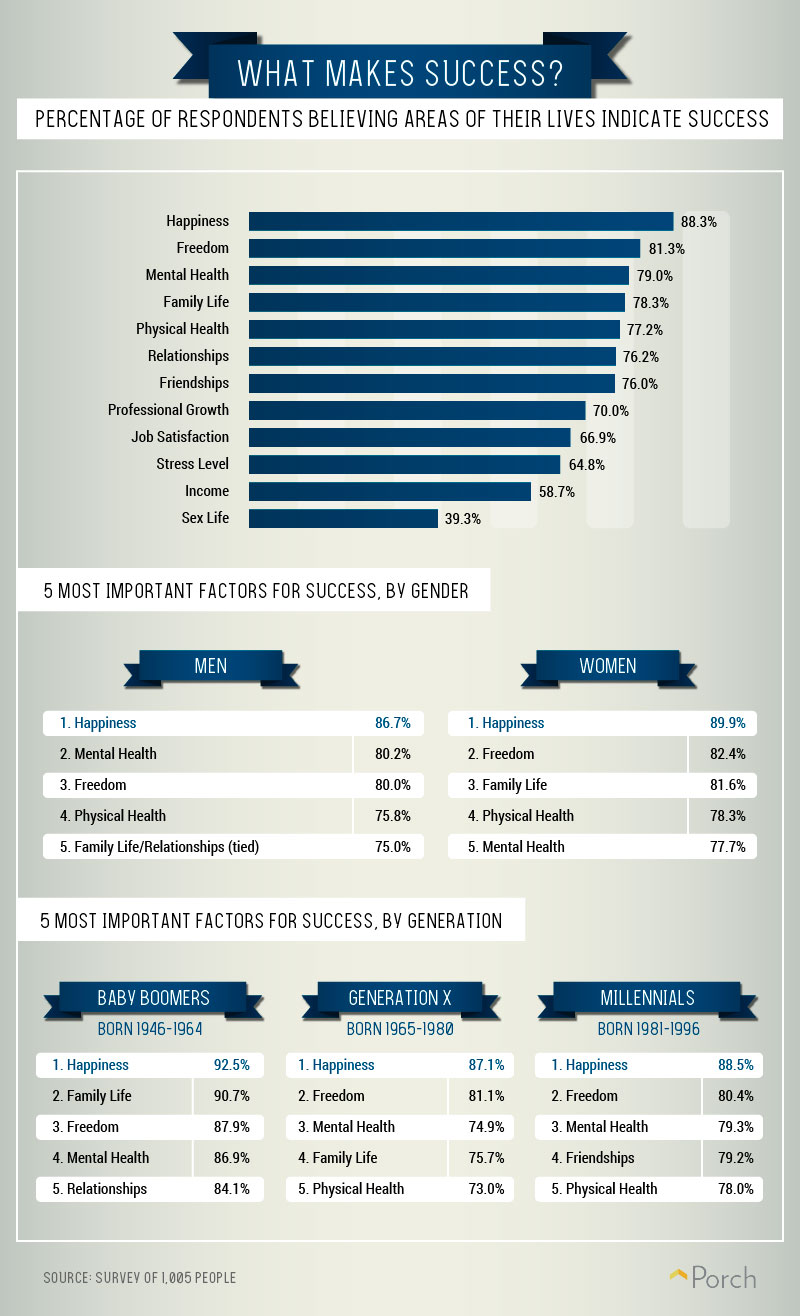
    Defining success, by demographicBefore we explore any particular habits, it’s helpful to learn how people define success more specifically. After all, it’s something of an abstract concept, although most participants agreed on its major components: More than 80 percent identified happiness and freedom as essential parts of success. Fulfilling family life and good physical and mental health were also popular selections. Interestingly, a smaller percentage said success could be defined regarding professional growth, one’s job, or one’s income. Even fewer said a great sex life was an integral part of succeeding, with less than 40 percent of respondents saying this kind of passion was a part of their vision for fulfillment. Some compelling differences cropped up among men and women, however. Women were slightly more likely to emphasize freedom, family life, and physical health. Conversely, men were more likely to associate success with mental health instead. Generational contrasts included a drop off in focus on family life with each successive generation. Over 90 percent of baby boomers said family was essential to success, whereas only 75.7 percent of Gen Xers said the same. Among millennials, family life didn’t even crack the top five success characteristics.
    Calling ourselves a success

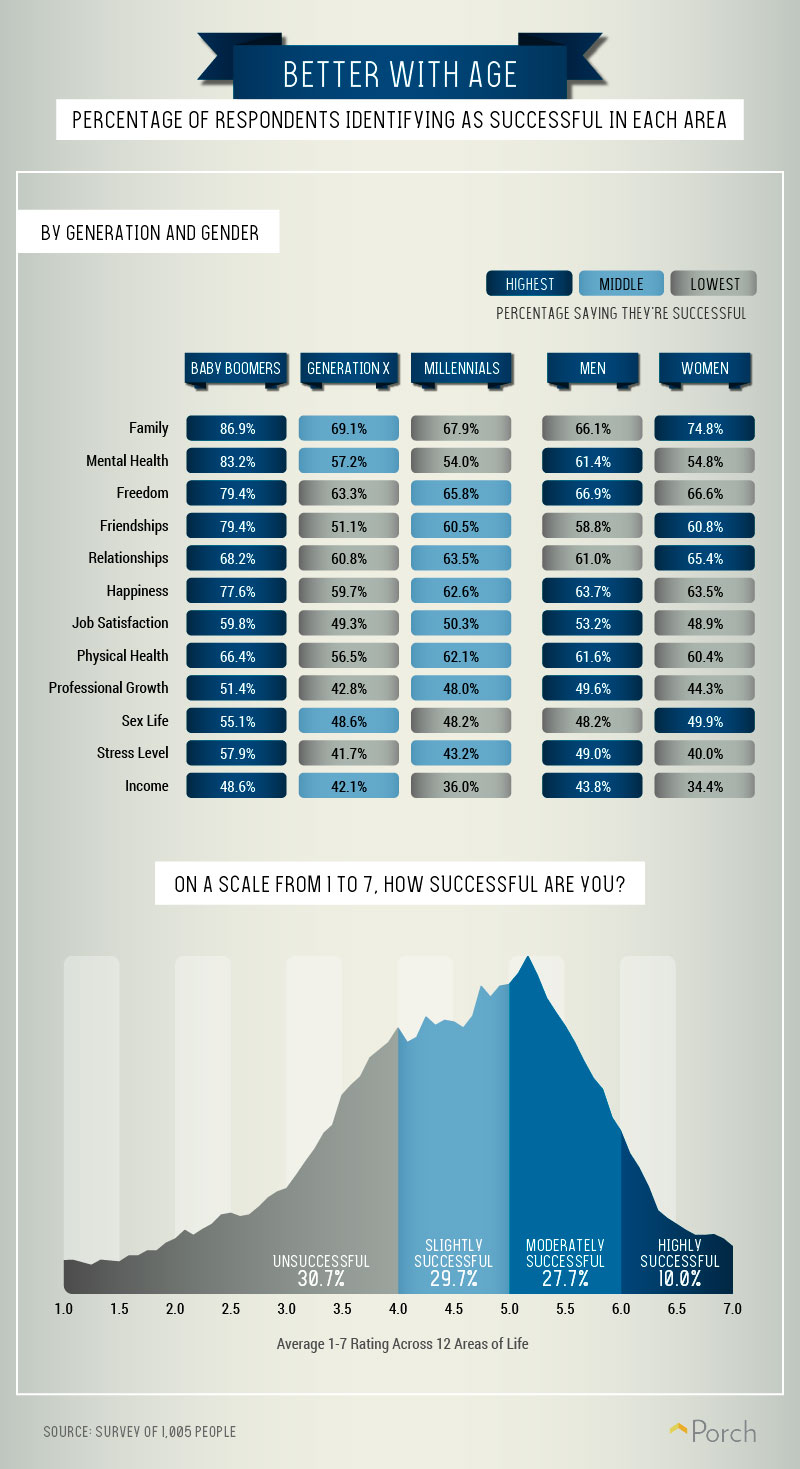
    Calling ourselves a successIn every life area we designated, baby boomers were most likely to claim success. Call them boastful, but bear in mind they’ve had more time to succeed––and appraise their experiences with more gratitude in retrospect. In many ways, younger generations were dramatically behind in self-reported success, such as in the realms of family, friendships, and mental health. Interestingly, however, millennials were more likely to call themselves successful than Gen Xers in most categories. Perhaps these findings reveal Gen Xers in the throes of a midlife crisis or the hubris of youth among the millennial crowd. Contrasts among men and women yielded interesting insights as well, with female respondents more likely to feel successful in their family lives, friendships, and relationships. Meanwhile, men had the distinct upper hand concerning mental health and stress level. In what could be interpreted as a grim indication of workplace inequalities, men were also more likely to feel successful regarding their professional growth, jobs, and incomes. Given the lingering pay gap in America, there may be good reason nearly two-thirds of women feel thwarted on the subject of earnings. Overall, however, roughly three times as many people called themselves “unsuccessful” versus “highly successful.” That statistic may speak volumes about human nature and self-esteem, but we have a more pressing question to consider: What do these folks who feel highly successful do differently?
    Habits successful people share

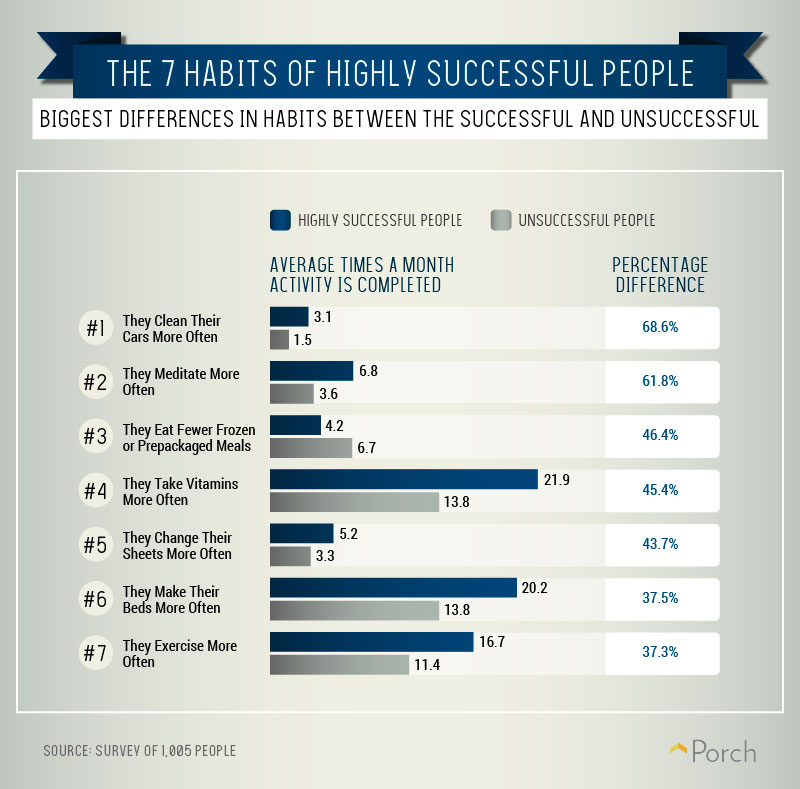
    Habits successful people shareWhen we considered which habits highly successful people practice to a much greater extent than unsuccessful individuals, two major themes emerged: cleanliness and healthy choices. In the category of tidy practices, we found highly successful people cleaning their cars, changing their sheets, and making their beds far more often. Some suggest completing these tasks can help us feel accomplished and in control, so we face the rest of our days with some momentum. The same could perhaps be said for healthy habits that highly successful cohort tended to practice, including exercise, taking vitamins, and resisting frozen or prepackaged meals. In addition to these habits, meditation was a common denominator among folks who felt highly successful, and notably absent from the routines of those who felt unsuccessful as well. In fact, meditation was the habit around which successful and unsuccessful people differed most in several key life categories: friendships, jobs, mental health, professional growth, and stress. Given these potential payoffs, it’s no wonder many companies are encouraging their employees to adopt meditation practices in the workplace.

    Sanitize for success?

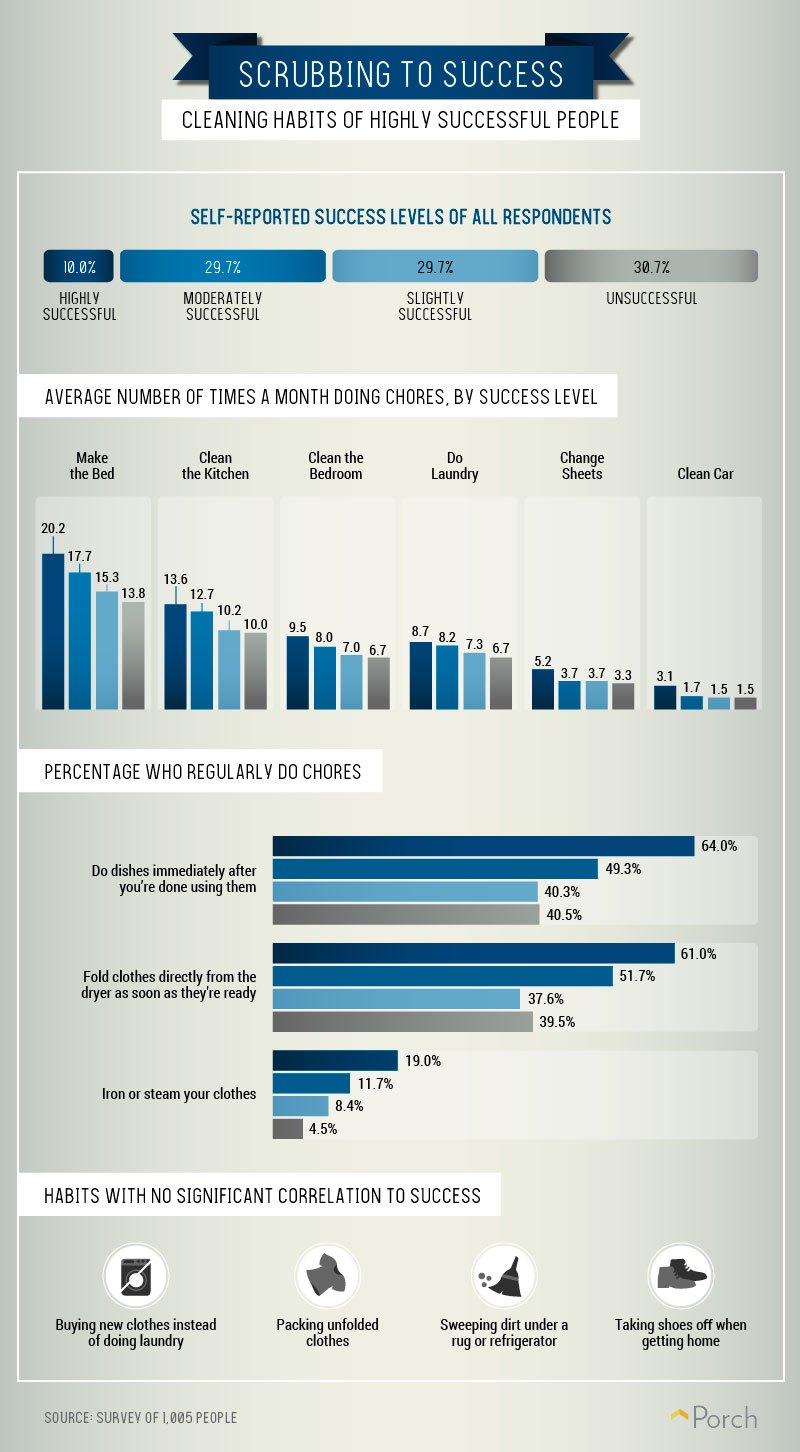
    Sanitize for success?Let’s take a closer look at how cleanliness might correlate with success, comparing the frequency with which different groups tackle household chores. In every specific cleaning activity studied, those who felt the highest degree of success tidied up most often. This positive correlation continued at every level of self-professed success: Those who felt moderately successful cleaned up more often than those who felt only slightly successful, who did so more frequently than unsuccessful respondents. Sometimes, the immediacy of cleaning seemed relevant as well. Nearly two-thirds of highly successful people did the dishes right after they were done using them. Similarly, 61 percent of highly successful people folded clean laundry as soon as the dryer was finished. Then again, some orderly habits did not correlate with success according to our data. Packing unfolded clothes in one’s suitcase or sweeping dirt out of sight rather than into the trash didn’t seem to hurt anyone in the long run, nor did buying new clothes instead of doing laundry.
    Maintaining the body and mind

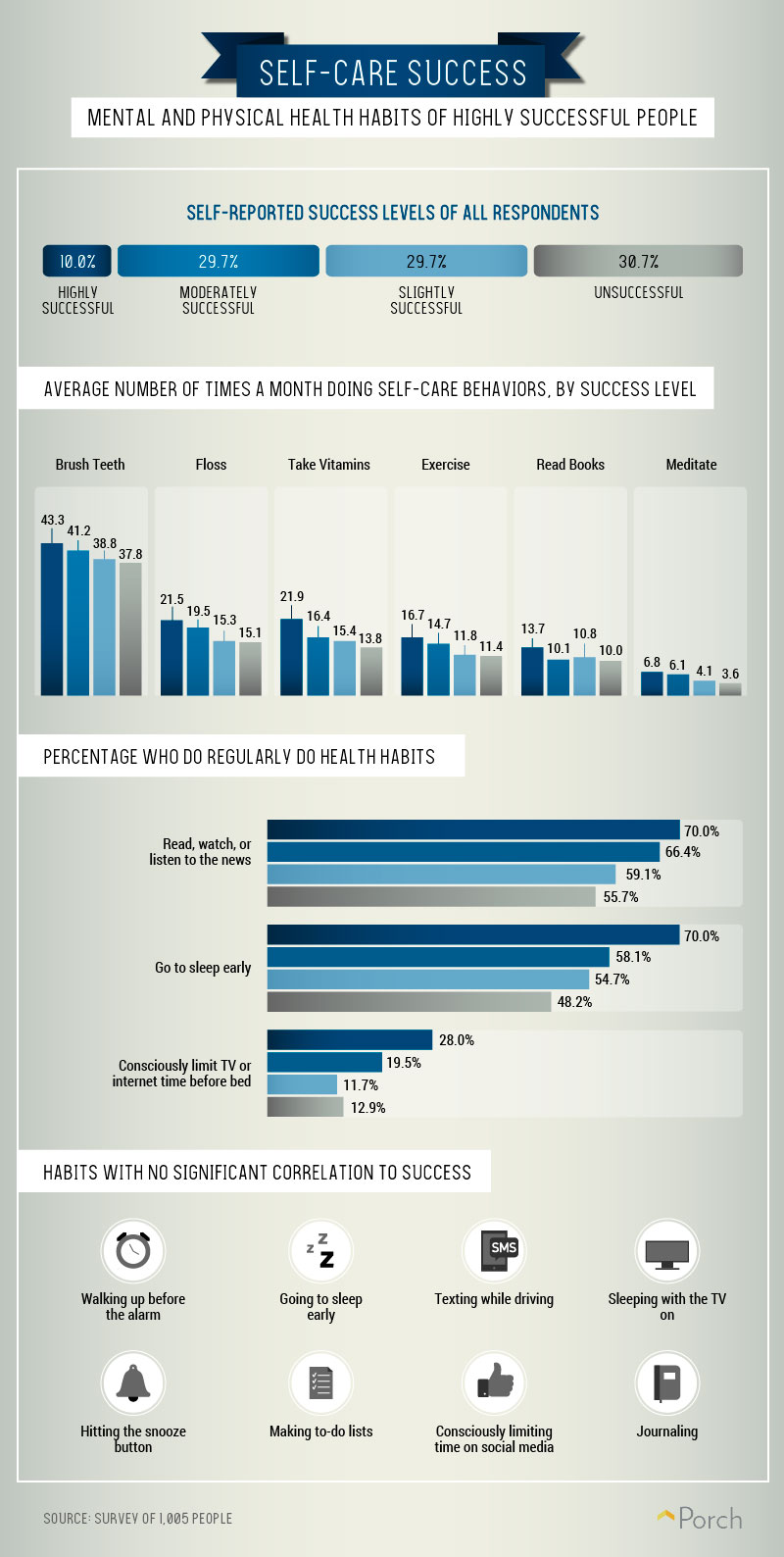
    Maintaining the body and mindSelf-care should pay off in obvious ways: You don’t need to be a dentist to understand the benefits of flossing. But our findings indicate highly successful people were quite disciplined in this regard and feelings of success were correlated with the frequency of these self-care efforts. This connection extended to measures aimed at maintaining physical health, such as exercise and dental care regimens, but highly successful people also read and practiced meditation more often, suggesting intellectual well-being is also paramount. Successful respondents were also more likely to consume news regularly, a finding that contradicts recent research suggesting staying constantly informed can actually prove harmful. Additionally, successful people were less likely to stay up late, perhaps because so many of them are early risers with busy days ahead. On the other hand, our data demonstrate no correlation between success and going to sleep early or waking up before one’s alarm. Perhaps when it comes to beauty rest, success demands a reasonable middle ground.
    Ingest for success?

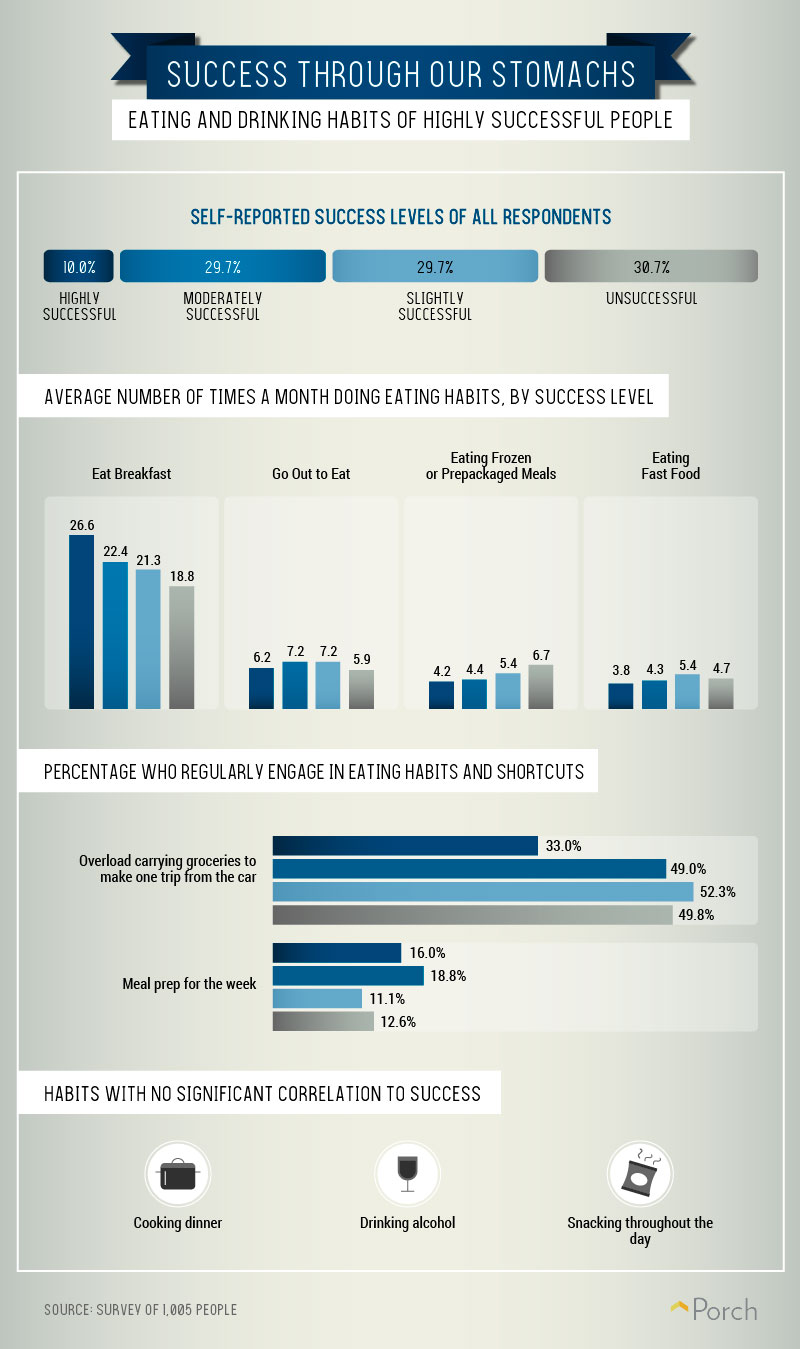
    Ingest for success?In a victory for parents everywhere, breakfast really does seem to be the most important meal of the day––or at least essential to those who feel highly successful. Conversely, frozen or prepackaged meals negatively correlated with success. On other questions of consumption, however, our results were more varied. Interestingly, highly successful participants ate out less often than moderately and slightly successful peers, although unsuccessful folks dined out least of all. Similarly, highly successful people were actually less likely to conduct meal prep than moderately successful respondents, suggesting a complex relationship between this habit and success. We did find a strong connection related to groceries, however. Only a third of highly successful people tried to take as many bags in at once as possible to avoid multiple trips. Among all other groups, about half attempted this “overload” method.
    Success means saving

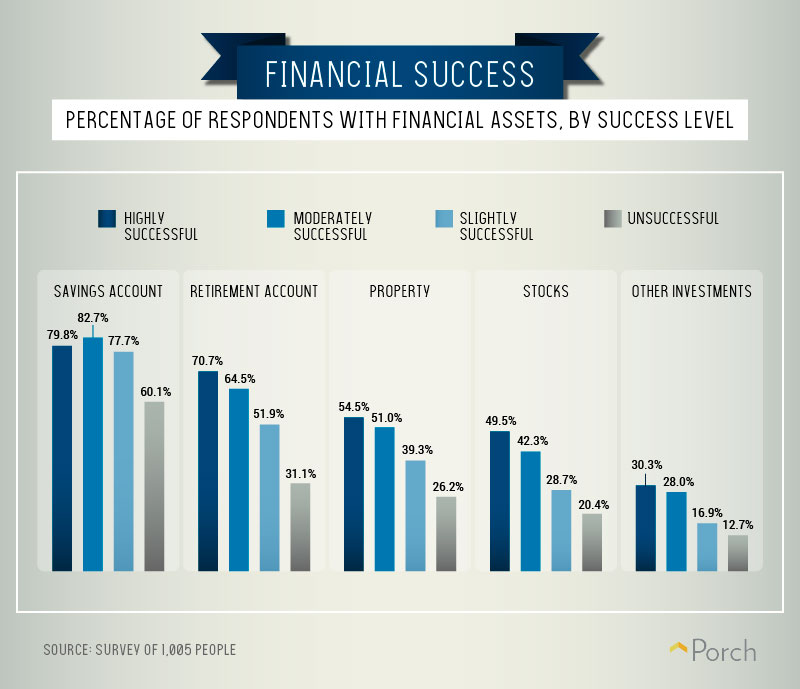
    Success means savingHowever much we resist materialism, financial concerns arise at many points in our lives and may shape our understanding of success. We found people who identified as moderately or highly successful were quite likely to have a range of investments, especially savings and retirement accounts. Conversely, less than a third of people who felt unsuccessful had a retirement account, and only a fifth were invested in stocks. These data resonate with broader concerns about Americans’ lack of retirement savings and other assets that might support them later in life. Although some have said homeownership is no longer part and parcel of the American dream, property ownership was substantially higher among people who felt highly or moderately successful. Additionally, less than a fifth of slightly successful or unsuccessful respondents had other investments, such as an ownership stake in a business.

    Healthy habits, healthy home

    Perhaps we’ll never incorporate all potentially healthy habits into our lifestyles simultaneously––incremental improvement is more attainable. If our findings have revealed habits you find admirable, establish some priorities and pursue them passionately. If our data suggest anything, it’s that small actions can have sweeping implications. So set a few manageable goals for yourself and discover achievement is possible. After all, hopeful thinking may be the most important habit successful people have in common. If you’re looking to transform your home into an orderly space conducive to good habits, you don’t have to go it alone. Whether in need of painting or pest control, Porch helps homeowners connect with trusted professionals. Letting the pros handle your home-improvement hassles––now that’s a habit we can all get used to.

    Methodology

    To compile the data above, we surveyed 1,005 people through Amazon’s Mechanical Turk. The surveys all took place in March 2018. Each person was first asked to answer how often they performed certain behaviors and later asked to evaluate their success levels on a scale of 1 to 7 in various areas of their lives. Scores across all categories were averaged to identify a respondent’s overall success level. All correlations presented relating to behavior frequency, unless otherwise stated, were found to have statistical significance through ANOVA and Chi-squared analyses. Because the information we collected relies on self-reported data, it may have issues relating to selective memory, telescoping, attribution, and exaggeration. Because “success” is a subjective term, we did not have an objective measurement for it and relied solely on a respondent’s appraisal of their success across several types of success.

    Content Originally Created by Porch.com