Join us and experience the transformative effects of a ‘Virtual Triathlon’
In this 75-minute workshop, Barbara Mintzer McMahon ‘Executive Coach and Mindfulness Expert’ will guide you through an experience to enhance engagement at all levels mind, body, and spirit. You will learn how to enhance your own well-being and the well-being and capacity of your team. Learn how these practices can maximize and sustain performance. This simple and most powerful experience can be used to:
Reduce stress
Enhance capacity for being fully present
Enable quality thinking and creativity
Build resilience
Enable quality connections to others
In this time, Barbara will engage you in exercises to enhance quality thinking and will invite you to take time (30 minutes) to energize yourself by engaging in a physical activity of your choice. You will unplug and be able to engage your body – take a walk, run, dance, do yoga, whatever you choose. Then, we will come back together to learn how to channel this energy and advance our best thinking. The topics covered will focus on “What Now” and “What Next” as we step into the field of possibilities waiting for us in 2021.
Challenges of the C-Suite Special Guest – Susan Curtin, MCEC Tuesday, Oct 27th @ 12pm MDT
Susan Curtin, MCEC, is President & Owner at Insights4Results, LLC., Executive Coach & Consultant who partners with clients in igniting new insights, innovations & increased results.
Susan started a coaching/consulting firm after 20 years of experience training & coaching internal/external personnel in San Diego County & City organizations. Soon after, she noticed gaps in coaching provided to individuals and teams that were not being addressed by existing coaching models & programs.
The first gap was that there was no coaching to hire the right individual for the job in the first place.
Approaches of existing coaching programs tended to coach everyone the same & didn’t account for each individual having a unique set of skills, challenges or their current performance State.
Then there was no support to coach leaders when they were in the Slipping State.
After coaching leaders to become better managers, there was no plan to coach these developed leaders to succession.
The gaps led to the creation of Managing4Results™ a successful, comprehensive management program that incorporates development of a department managers’ role as a coach for ongoing employee engagement and increased retention. This program helps managers learn: “How to be, What to do and When to do” in order to build stronger relationships with their direct reports through giving constructive feedback, coaching, and communicating in ways that truly motivate and enable teams to achieve greater results. Managing4Results™ provides a certification program for coaches, consultants and trainers interested in utilizing this proven training program for their current and future client organizations.
Susan’s coaching includes leadership development, transition to the next stage of leadership, succession management & work on key competencies including interpersonal savvy/EQ & political acumen. She specialize in utilizing Managing4Results™ program to facilitate managers & leaders in developing personnel while building their own capacity to coach their teams ensuring greater employee engagement. “Behind Every Good Result Is a Great Insight.”
Susan is a member of the Association of Corporate Executive Coaches https://www.acec-association and is a certified Master Corporate Executive Coach with the MEECO Leadership Institute.
Ask the #1 Leadership Thinker in the world your questions.
Do you have leadership challenges right now? Is coaching changing? What new skills do I need to lead post COVID? How do I find balance and calm in such uncertain times?
Marshall Goldsmith joins #MG100 coaches CB Bowman, Rhett Power, Andrew Nowak, and Mitali Chopra and shares his insights on leadership, life, and finding balance.
This is your chance to ask Marshall your burning questions.
Date: July 9th Time: 6 am PT, 9 am ET, 2 pm London, 9 pm Hong Kong
Five years ago on a summer day, we set
out to learn more about this thing called blogging. We made a little
survey, did a lot of outreach and eventually got 1000 bloggers to
respond.
You are now reading the 2019 Annual Blogging Survey. In it, you’ll
find a goldmine of blogging statistics, data and trends. Together, the
numbers tell the story of huge changes in blogging and content
marketing.
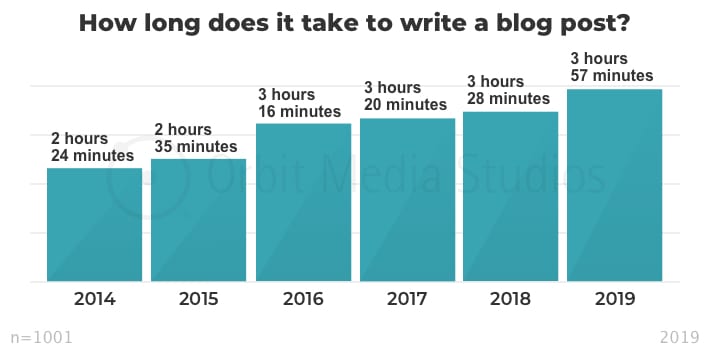
The average blog post takes 3 hours and 57 minutes to write …up 65% from 2014
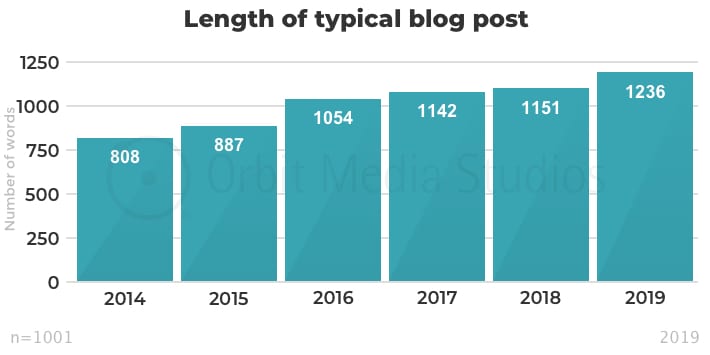
The average blog post is 1236 words long …56% longer than in 2014
52% of bloggers report that it’s getting harder to get readers to engage with their content
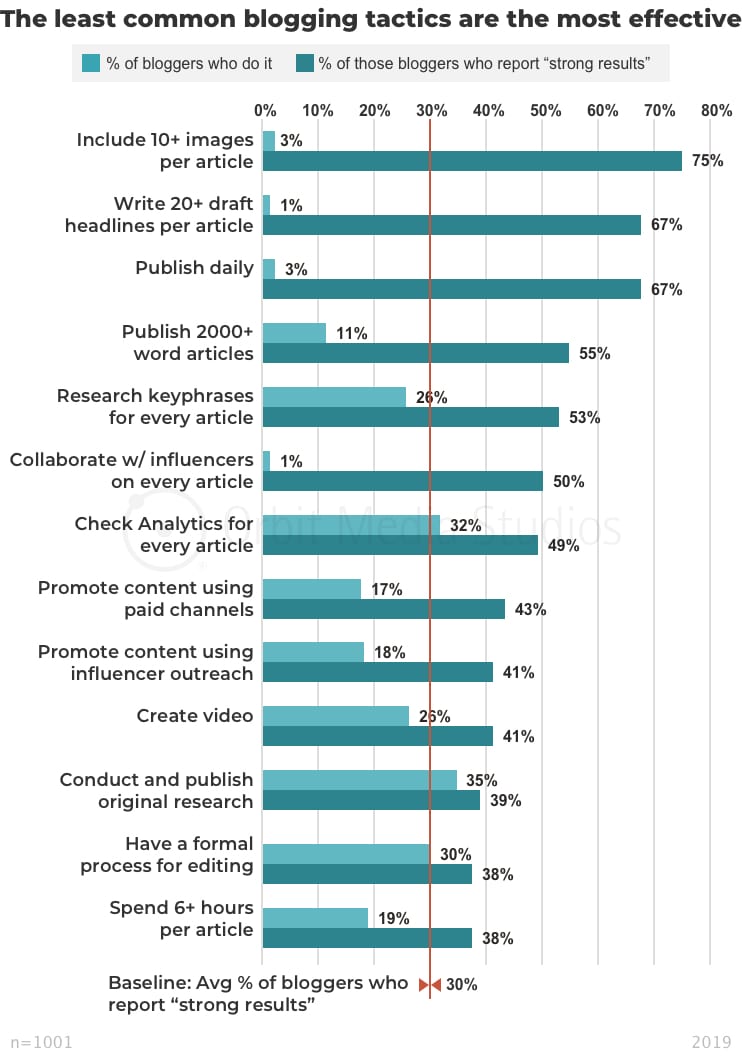
One of the final questions is about success, and we correlate that
answer with the other answers, we can see what’s working today. Here is
the summary, ordered by effectiveness. It shows not only shows which
tactics are the most effective, but how few bloggers use them.
Note: “Strong results” data is self-reported and naturally
depends on the goals of each blogger. Because results such as traffic,
engagement and revenue vary widely across content programs, we did not
ask bloggers to provide Analytics or revenue data. You’ll find more info
about the methodology and data at the end of this report.
Here are the final statistics, analysis and input from blogging and content marketing experts.
1. How long does it take to write a blog post?
The average blog post takes 3 hours and 57 minutes to write.
The time invested in each article rises every year. This year the
average time spent per post jumped 30 minutes and is up 65% since 2014.
The data from 2014 to 2016 showed big drops in bloggers who spent two
hours or less per article. This year we see big jumps in the percentage
of bloggers who spend four hours or more.
Note: 30% of bloggers reported “strong results.” That’s the benchmark. We’ll discuss this in the final section.
2. How long is the typical blog post?
The average blog post is 1236 words long.
That’s 53% longer than six years ago. Articles keep getting longer,
as bloggers invest more time and effort in long-form, detailed articles.
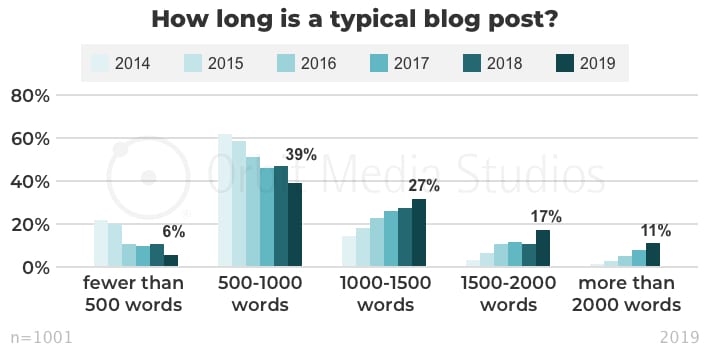
Look closer and we see the big jump is in the 1500-2000 word range.
It’s as if editors everywhere updated their guidelines for length from
1000 to 1500 words.
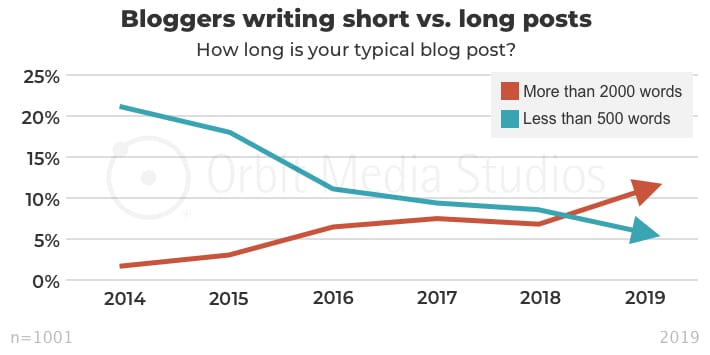
Compare the percentage of bloggers at the far ends of the spectrum. An approach that was once rare is now quite common.
Perhaps we’ve seen a tipping point in the awareness of the benefits
of big content. Lots of studies have found a correlation between
long-form content with higher rankings, greater social engagement and
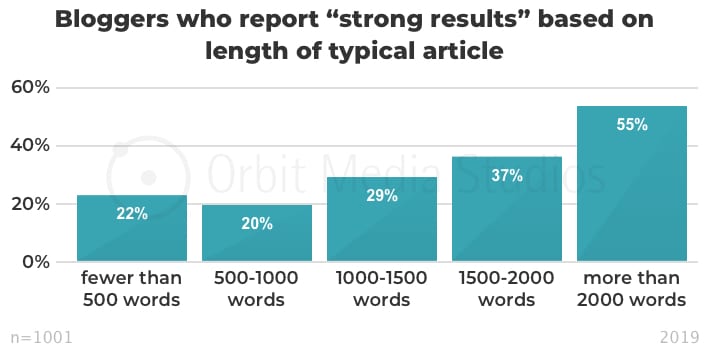
better results in general. Here’s one more: bloggers who write longer content are far more likely to report success. More than half of the bloggers who go big report “strong results” from blogging.
Joe Pulizzi, Founder, CONTENT MARKETING INSTITUTE“In looking through the data, it’s almost like going into the
past where longer, meatier articles were king, and each article took
hours of time. This gives me hope for the future of content consumption.
At least for blogging, snackable content is clearly dead. Audiences
expect more, and bloggers are giving them better researched more
advanced and well-thought-out content.”
Gill Andrews, COPYWRITER AND WEB CONSULTANT“I am surprised by how much the average blog post length has increased over time. It either means that more bloggers have finally realized that they need to try harder to get results or that the reader’s expectations increased drastically. If it’s the latter, I wonder if that means that at some point in the future, small businesses won’t be able to blog at all, because they won’t have the resources to produce the content an average online reader expects.”
Gini Dietrich, founder and author, SPINSUCKS“There are many days I complain about how I have six hours of meetings without time to pee or eat, let alone write or record a podcast. And then I read this survey that shows a significant number of bloggers now spend six hours writing one blog post. Six hours! ONE blog post. This means that kind of time, research, and collaboration results in cold, hard cash. So pack your desk drawer with protein-packed snacks and get to work!”
3. How frequently do bloggers publish?
About half of bloggers publish weekly or several times per month.
Has the increase in time and length affected how often bloggers hit
the publish button? Yes. There has been a steady decline in the “several
per week” category since 2014.
Around half of all bloggers publish 2-4 posts per month. That’s holding steady, but notice the jump in daily blogging.
Is there a relationship between publishing frequency and results? Yes. Bloggers who write more (either in length or in frequency) are more likely to report strong results.
But there seems to be a point of diminishing returns with frequency.
Bloggers who publish daily are more likely to report strong results than
bloggers who publish several times per day.
4. What content formats are bloggers using?
We’ve seen the size. Now let’s look at the shape of the content.
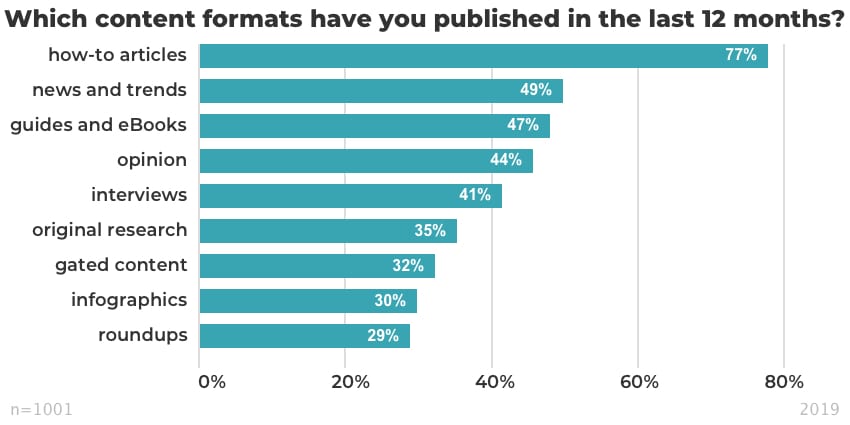
Practical, how-to content is dominant in content strategies.
About half of bloggers publish news. About half publish opinion.
Just one-third of bloggers use collaborative formats: round ups and interviews.
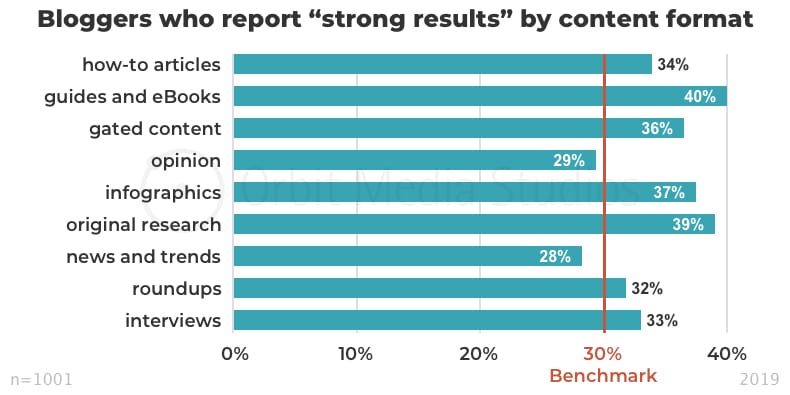
Here is the correlation between content formats and blogging
performance. This reinforces the previous findings about the value of
in-depth, visual and collaborative content.
Most likely to succeed: Bloggers who create long-form guides, ebooks and original research
Least likely to succeed: Bloggers who publish news and opinion
Mega-Trend: Research on the rise
Last year, 25% of bloggers added original research to their mix. Now
we see a big jump up in that number. More bloggers are conducting and
publishing original research as the word gets out about its
effectiveness.
35% of bloggers conduct and publish original research
85% of bloggers who publish original research report some/strong results from blogging (39% of them report strong results)
To gate or not to gate
This year we asked if bloggers are putting content behind lead gen
forms, requiring readers to give their email address prior to getting
access. About one-third of bloggers do this, even though almost half of
bloggers publish guides and ebooks.
32% of bloggers gate content
88% of bloggers who gate content report some/strong results from blogging (35% of them report strong results)
5. What does the typical blog post include?
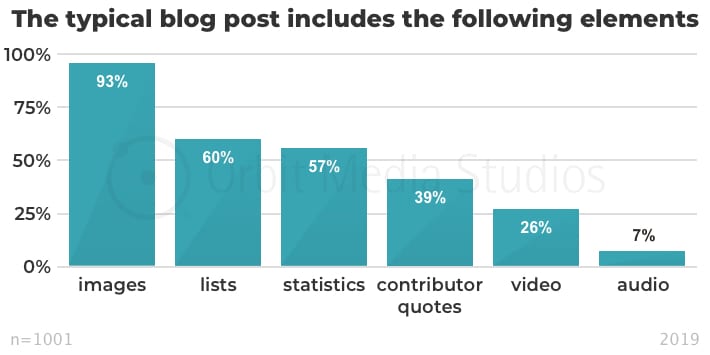
Now let’s look at the features of specific articles, including
images, video, statistics and contributor quotes. These statistics show
how visual, scannable and collaborative blog posts are in general.
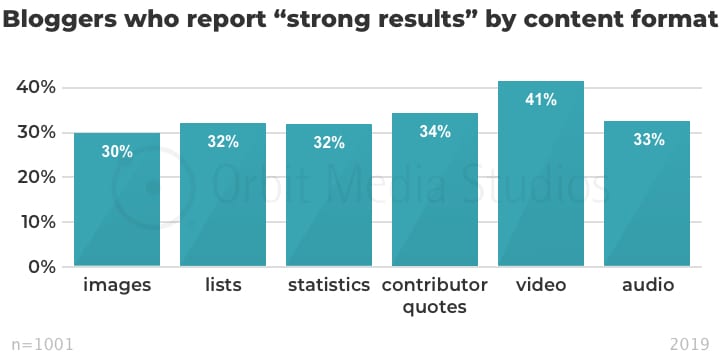
When we check the correlation data, you can see which specific elements correlate with success when included in blog content.
You can see that video makes the biggest difference. We’ve seen the correlation between video and success grow year after year.
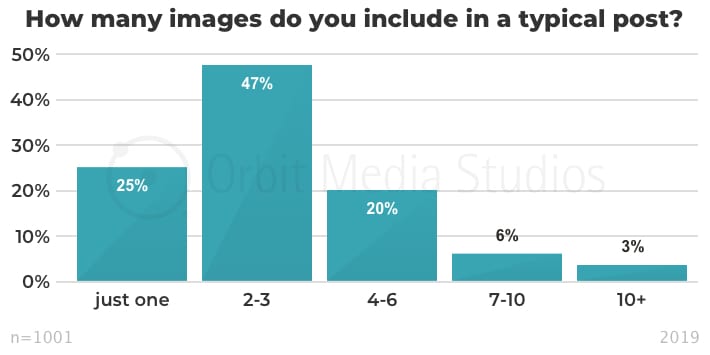
Just how visual is blog content?
Most bloggers add a few images to their content. But fewer than 10%
of bloggers are producing very visual content with 7+ images per
article. Does that sound high? The average article here on the Orbit
Media blog includes 14 images, not including the author’s picture.
There is a clear correlation between highly visual content and
success. The more images a blogger adds to a typical article, the more
likely they are to win at the content game.
Just 3% of bloggers add 10+ images per article, but they are 2.5x
more likely to report “strong results” than the average blogger.
This along with the trends in video shows the importance of visuals.
It shows just how visual blogging has become. Is blogging more about
images or words? Are blogs post written or designed? It seems the more
visual the content strategy, the more likely it is to succeed.
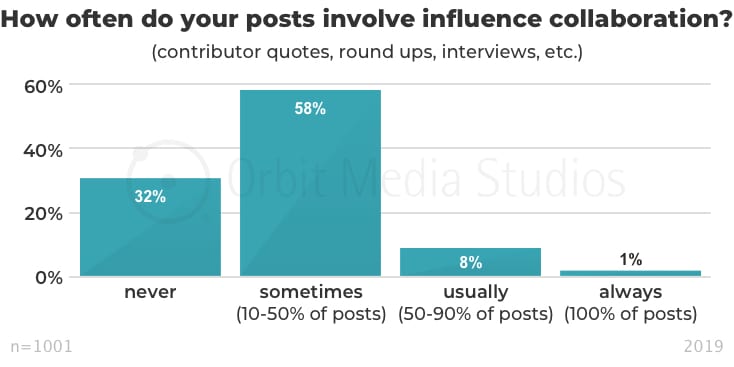
Just how collaborative is blog content?
Seeing the big trends of influencer marketing inspired us to ask
about the popularity of collaborative content, which we define as
content that includes contributor quotes, roundups or interviews. The
response indeed shows that most bloggers do collaborate.
32% of bloggers never collaborate
1% of bloggers always collaborate
Is there a correlation between collaboration and success? Yes. The
more often bloggers collaborate with influencers, the more likely they
are to report “strong results.”
Here at Orbit, as a rule, each article we write includes a
contributor quote from at least one expert. Just as a journalist
wouldn’t publish an article without a source, we would never publish an
article without an expert POV.
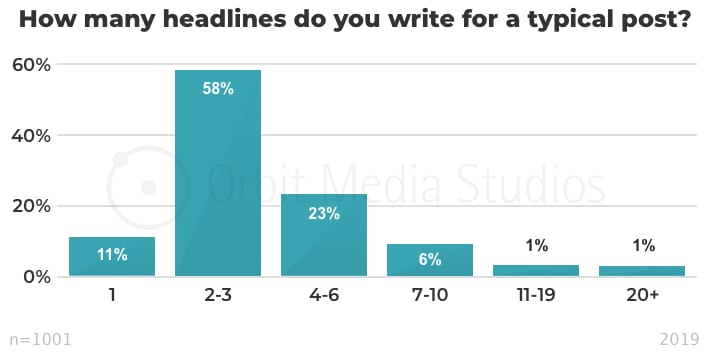
6. How many draft headlines are bloggers writing?
The average blogger writes four headlines before selecting one.
Everyone sweats over headlines, or so we assume. As an all-important
element for blog posts, it’s worth the extra attention. After hearing
that some content teams consider 20+ headlines before selecting one, we
decided to pose the question.
We see that most bloggers write a couple of headlines before choosing
one and a tiny percentage are writing more than ten. Fewer than 1% of
bloggers write 20+ draft headlines per article.
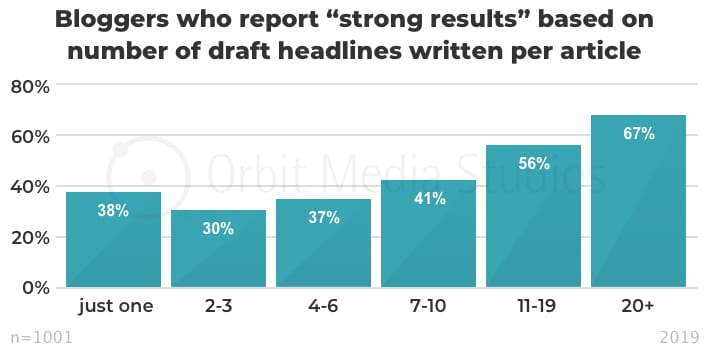
Yet bloggers who consider more headlines are far more likely to
report success. Very few bloggers are doing the thing that correlates
with results.
Ann Handley, Cheif content officer, MARKETING PROFS“We all recognize the value of a great headline. Well done, us! Now let’s spend as much time thinking about the first line of a piece. PRO TIP: Write as many first lines as you do headlines. Why? Because the headline makes a reader click. And the first line makes them actually read the piece.”
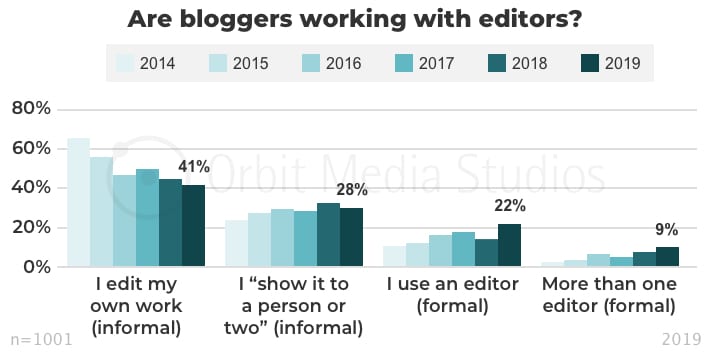
7. Are bloggers working with editors?
30% of bloggers have a formal process for editing.
For our final question about process, we ask about working with
editors. Most bloggers edit their own work or get “a second set of eyes”
on their content before publishing. Only 30% have a formal process for
editing. That’s way up from five years ago when just 1 in 10 bloggers
had a formal process.
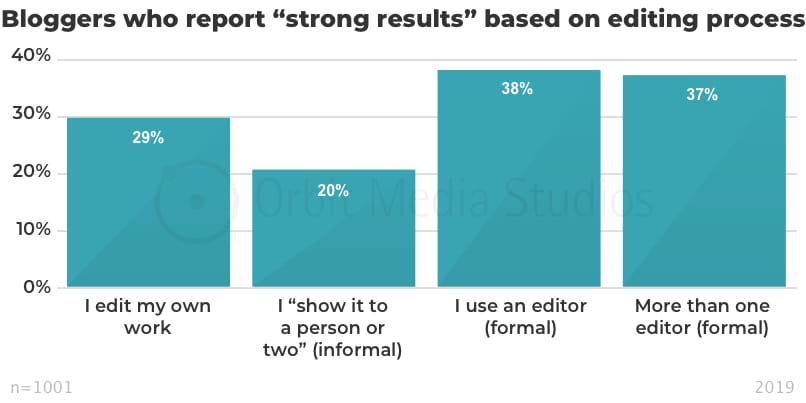
Bloggers with a formal editing process were about 50% more likely to
report strong results. Working with multiple editors doesn’t seem to
make strong outcomes more likely. And bloggers who edit their own seem
to be doing pretty well.
Another tip from Ann: “Behind every decent writer is a fantastic
editor! If you want to be a better writer… get yourself a great editor
to work with you.”
8. How is your content typically promoted?
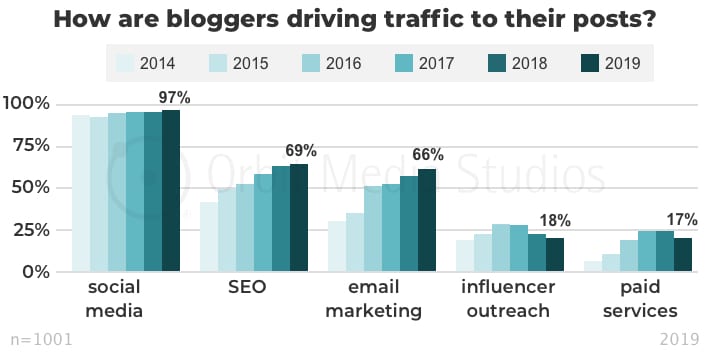
Social media, of course. But just one in five bloggers uses influencer outreach and paid promotion.
Obviously, the fast, easy and cheap promotion channel is the most
popular. Virtually all bloggers share their content on social media.
Two-thirds use search and email, both of which have become much more
popular over the last five years.
The percentage of bloggers using email marketing has increased 2x since 2014
The percentage of bloggers using paid promotion has increased 3x since 2014
1 in 5 bloggers leverages influencers to help drive traffic (that’s down from two years ago)
1 in 5 bloggers buys traffic (that’s leveled off after a dramatic rise)
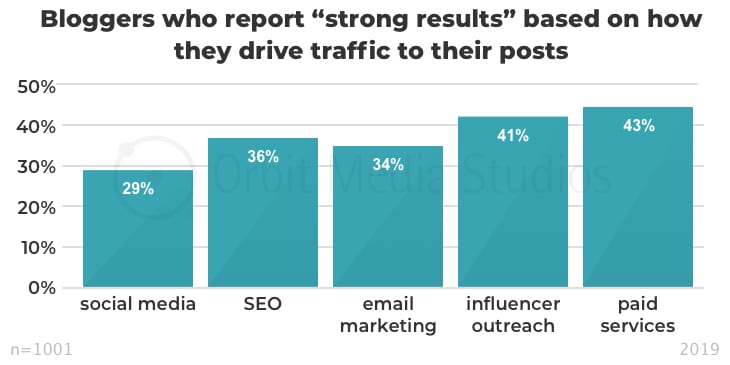
Let’s see what’s working. The less popular promotion channels are
more strongly correlated with success. This may be because they are more
difficult (or expensive) and this is another example of hard work
paying off.
9. How often do bloggers research keywords?
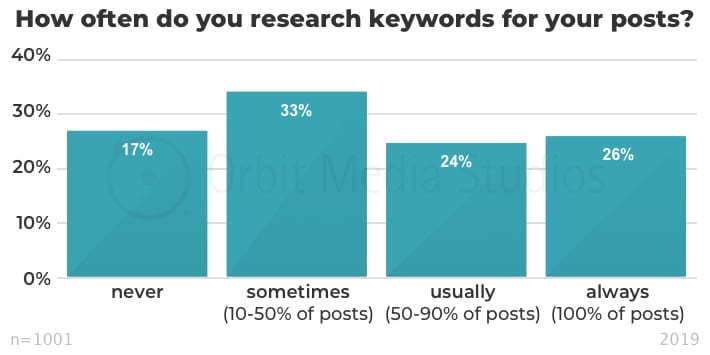
Half of bloggers research keywords for the majority of their content.
As SEO has grown in popularity and importance, keyword research as a skill and practice has become more common. Most bloggers do it sometimes. Half of all bloggers do it most of the time.
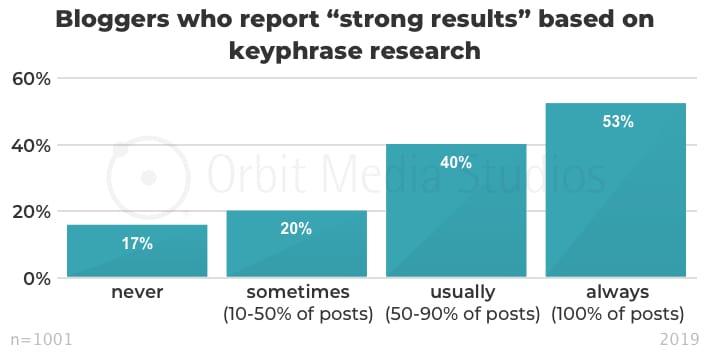
It’s work that pays off. The more the blogger researches keywords,
the more likely they are to report success. Bloggers who are also SEOs
report “strong results” at much higher than average rates.
10. Are bloggers using analytics?
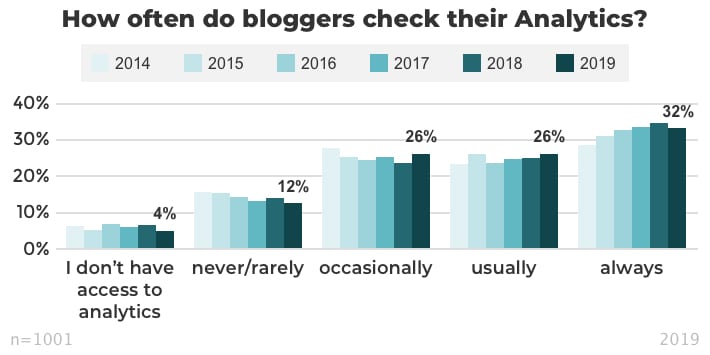
Half of bloggers usually check the analytics for a post. The other half check occasionally, rarely or never.
The trend here is mostly flat. Use of Analytics has remained steady
for years. But it remains one of the big indicators of blogging
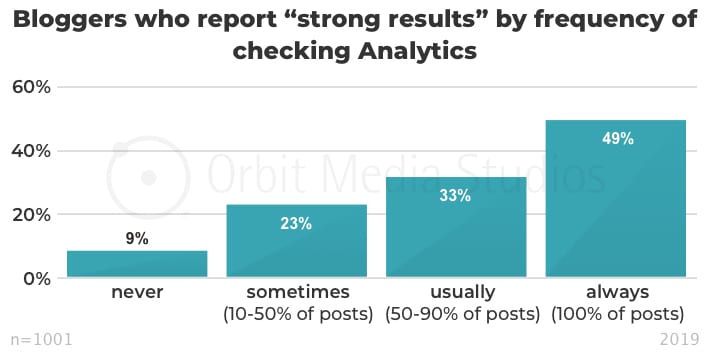
performance. Bloggers who measure the performance of every post are far
more likely to report “strong results” than the average blogger.
If they aren’t using analytics, you have to wonder how they even know if they’re getting results.
Jay Baer, luminary, CONVINCE AND CONVERT“What’s most interesting to me is the combination of expanded blog post length and corresponding time spent per post with the decline in attention paid to Analytics and keyword research. It’s remarkable to me that bloggers would spend nearly 4 hours to craft an 1800 word post, yet only 57% of them check their analytics with any degree of frequency and only about 50% of the time are they actually thinking about keywords when writing that post. If I was going to spend four hours on something, I would want to make sure that I had a measurement and success schema identified before I wrote the first of those 1800 words.”
11. Is it part of your strategy to update older blog posts?
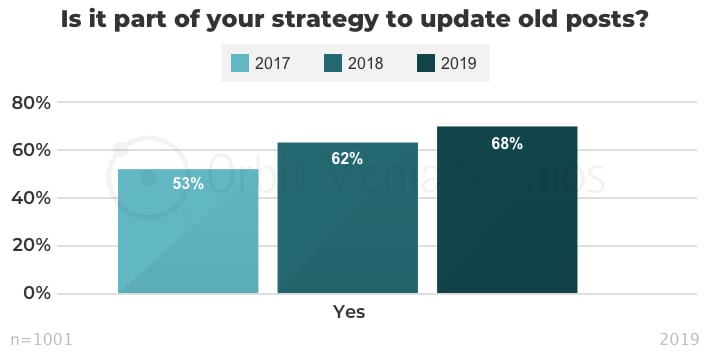
Two-thirds of bloggers update previously published blog posts.
An obvious trend has emerged since we started asking this question a
few years ago. Nearly 70% of bloggers now report going back to older
content and making updates.
ian cleary, founder, RAZOR SOCIAL“Updating old content is an essential part of any online strategy
so it’s good to see that this year the percentage of people updating
old content. It’s great for SEO, especially when combined with keyword
research, adding more media and careful internal linking.”
Ian’s right. Updating old content appears to be an SEO tactic.
Bloggers who research keywords are 3x more likely to update old posts.
It’s a powerful way
to improve rankings and search traffic quickly. Also, bloggers who
publish news and original research are more likely to update old posts.
Makes sense.
This is another of those tactics that have a very strong correlation
with success. Bloggers who update old posts are 2x more likely to report
success.
35% of bloggers who update old content report “strong results”
16% of bloggers who do not update old content report “strong results”
12. Are bloggers getting results from their content?
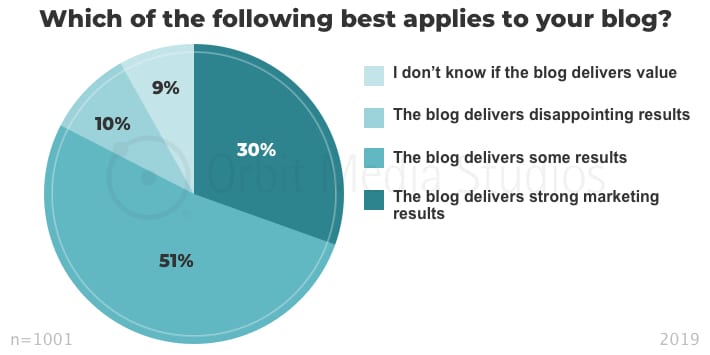
Most bloggers are getting results, but just 30% are getting strong results.
We’ve seen this correlated with other statistics throughout the
survey. Now here’s the raw data on success. Naturally, the definition of
success varies as bloggers have a wide range of goals, from rankings to
revenue, likes to leads.
If you put 10 bloggers in a room…
5 would report getting some results
3 would report strong results
1 would report disappointing results
1 wouldn’t even know if they’re getting results
Is there a trend here? No. These numbers have changed very little over the last four years.
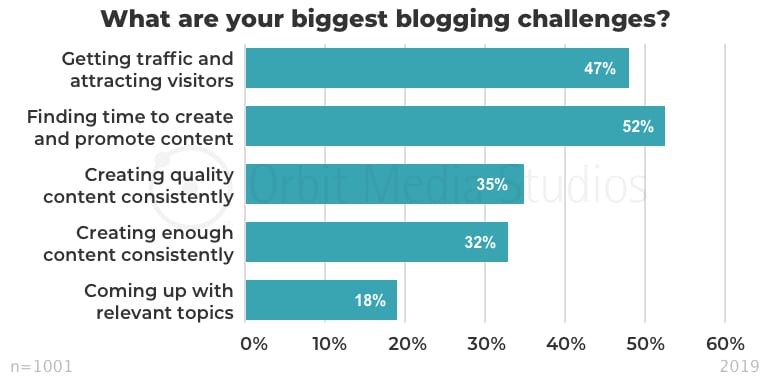
Bonus: What are the biggest blogging challenges?
This year we added a few questions about the challenges. What is the
hardest thing about blogging. The most common answer is personal: finding time.
We included an “other” category and gave respondents the opportunity
to add their own answers. The most common responses were related
specifically to business blogging: getting internal buy-in and
measurement/attribution.
The challenges are timeless, but when we ask bloggers what’s getting harder now, we see where the headwinds are coming from.
Henneke Duistermaat, ENCHANTING MARKETING“If reader engagement feels like your biggest challenge, it’s worth asking yourself whether your content strategy needs fine-tuning. Do you have a clear idea who your ideal reader is and how you can help them solve their problems, answer their questions and achieve their aims? Is the traffic to your site relevant? Are you writing to engage your reader or to impress Google? How human is your writing?”
Robert Rose, founder, THE CONTENT ADVISORY“It’s no surprise, but it’s very refreshing to see the quantity and quality challenge expressed in such contrast. Time spent on each post is up. Length and exploration of depth is up. And the biggest mentioned challenge to not only attract attention but hold it. A loud noise gets your attention – but it’s what kind of noise you’re making that determines whether people stay and listen.”
Bloggers are struggling with search and social more than email
marketing. This is probably because search and social are dominated by
digital monopolies, which control user experience. Google and Facebook
have reduced clickthrough rates to websites in order to keep visitors on
their platforms. But email isn’t owned by anyone. There’s no
intermediary between the blogger and their audience. Bloggers are
reporting an easier time.
Most bloggers (54%) are finding it harder to keep visitors engaged
with content. It’s a constant struggle. The signals that indicate that a
reader is connecting with the post aren’t looking good.
Two key takeaways
There are a few big themes here. There seem to be two main factors
that are the strongest indicators of success: depth and consistency.
Deep Content
Bloggers who do more are getting better results. These are the bloggers most likely to report success:
Bloggers who write 2000+ words
Bloggers who include 10+ images per post
Bloggers who consider 20+ headlines
Consistent Performance
Bloggers who are more consistent are getting better results. These are the bloggers most likely to report success:
Bloggers who always research keywords report strong results
Bloggers who always collaborate on content report strong results
Bloggers who always check Analytics report strong results
These tactics are so effective because bloggers are using them every time.
Methodology and Data
The respondents to this survey are self-described bloggers that we
connected with over many years on social media and at live events. The
data set is heavily populated with my network, which skews toward
LinkedIn users, B2B marketers and people in the US. Responses were
gathered from July through September 2019.
No one was incentivized to take the survey. This is a survey of
bloggers (individuals), not companies or brands (groups). Here are the
three ways we gathered responses along with our estimates for their
contribution:
Email to past respondents (30% of responses)
Social media and shares by influencers (30% of responses)
Individual outreach through messages and email (40% of responses)


 Susan Curtin, MCEC, is President & Owner at Insights4Results, LLC., Executive Coach & Consultant who partners with clients in igniting new insights, innovations & increased results.