In uncertain times, the leader is the message, says Korn Ferry CEO Gary Burnison.
Published: Mar 12, 2020
When we face fear—whether personally or of the more existential
variety— the natural inclination for any of us is to be paralyzed. But
taking no action is an action – often, an ill-advised action.
If knowledge is power, then people need to be empowered by information.
As a CEO, I’ve always compared the leader’s role to that of a
shepherd: occasionally in front, sometimes beside, and often behind.
These days, however, the leader must be in front.
Sharing information is critical, but far less than half the battle.
Of course, people need to know about strategy, speed, direction, and
results. But it can’t stop there.
Language is an art to express ideas—but the messenger is the message. “Actions speak louder than words” is true for everyone—and twice as true for leaders. It’s not just what you say, but how you say it. It’s not just what you say, but how you say it.
Verbally and non-verbally, the way in which communication occurs—humbly, passionately, confidently—has more impact than merely the words chosen.
Communication is where leadership lives and breathes. It informs, persuades, guides, assures, and inspires. Here’s how:
Listen for the truth. If leaders want to hear the truth, they must
welcome it. That won’t happen, though, unless people feel it’s safe to
say what they really think without fear of retribution and not just what
they think leadership wants to hear. Leaders need to ensure a culture of world-class observers,
where information doesn’t just cascade down—it bubbles up. Observation
needs to be a “team sport” as people throughout the organization are
empowered to speak up and share their views about what they see.
Perspectives will differ, but that only enriches the discussion. And,
when perspectives are shared, people learn.
The information highway. Communication
is far more than a transmission of information. Communication needs to
be the “information highway,” flowing freely in both directions and in
every circumstance. Important in good times—crucial in challenging ones.
More assurance, less authority. Communication is connecting and engaging with others. Messages must be delivered frequently and consistently,
with candor and honesty. That means speaking with more assurance than
authority—and being concerned with tone as well as content. Passionate,
confident words motivate. Although information is crucial, if the
message lacks authenticity, the team’s follow-through may be
lackluster—or even lacking.
People would rather know the truth. In bull markets, people look to the leader for validation. In
bear markets, they look to the leader for assurance. When faced with a
challenge, people would rather know the truth than dwell in the
worst-case scenarios residing in their imaginations. Leaders who don’t
communicate will become the subject of others’ communication—and not in a
flattering way.
Beware the vacuum. If not addressed, a lack of information can lead to hazardous
uncertainty. People will spend their time speculating, because there’s
an information vacuum that needs to be filled. Uncertainty breeds
conjecture, escalating fear and causing chaos. No matter how serious the
news, people prefer certainty. To predict tomorrow, people have to
accurately perceive the reality of today. Then you can plot a course for
tomorrow.
No shortcuts allowed. Communication takes time—and lots of it. The temptation,
therefore, is to take shortcuts such as assuming that people already
know certain information or else glossing over a message from an
employee or passing it along to someone else. Take time to acknowledge
messages—and the messengers. Show others that they matter.
Remember, for a leader in uncertain times—and, in particular, these times—it’s not simply about staying on message. The leader is the message.
In our era of globalization, your job performance may depend on your “CQ”. So what is it?
David Robson
Imagine meeting someone for the first time who
comes from a distant country but is fluent in your language. There may
appear to be no immediate communication barrier, so would you adapt the
tone and cadence of your voice, or the spacing of pauses in your speech?
How about altering your body language,
mannerisms and facial expressions, depending on the background of the
person in front of you? Would you sit or stand differently and pay
attention to your hand gestures?
“The number one predictor of your success in
today’s borderless world is not your IQ, not your resume (CV), and not
even your expertise,” writes social scientist David Livermore in his
book The Cultural Intelligence Difference. “It’s your CQ.”
According to the latest findings, a high CQ
could be crucial in a wide range of careers, from bankers to soldiers and scientists and teachers – anyone, in fact, who regularly interacts with people from different backgrounds.
So what is CQ? Why do some people have a higher CQ than others? And how can we nurture these abilities?
Cultural Differences
Much of the research on CQ has been done by Soon Ang,
a professor of management at the Nanyang Technological University in
Singapore. In the late 1990s, her job was updating computer systems in
Singapore to tackle the “Y2K bug” – a software glitch that was feared
would bring down the world’s computer networks at the turn of the
millennium. Ang put together an international team of programmers to solve the problem.
They were some of the brightest minds in the
business, yet she soon found that they just couldn’t work together. The
groups were ineffectual and failed to gel. Often, individual members
would appear to agree on a solution, but then implement it in completely
different ways.
Clearly, it wasn’t a question of expertise or
motivation. Instead, she saw that these highly capable employees were
stumbling over each other’s cultural differences, leading to a breakdown
in communication and understanding.
These insights would lead Ang to collaborate
with the organisational psychologist P. Christopher Earley, then at the
London Business School but now dean of the school of business and
economics at the University of Tasmania, Australia. Together they built a
comprehensive theory of CQ, which they defined as “the capability to
function effectively in a variety of cultural contexts”.
Typically CQ is measured through a series of questions that assess four distinct components.
The first is “CQ Drive” – the motivation to learn about other cultures.
Then there is “CQ Knowledge”, which is an understanding of some of the
general cultural differences you may face. “CQ Strategy”, examines how
you make sense of those difficult confrontations and learn from them
while “CQ Action”, involves your behavioural flexibility – whether you
are able to adapt your conduct like a cultural chameleon.
Someone with low CQ might have a tendency to
view everyone else’s behaviour through his own cultural lens. If he
comes from a more gregarious environment, for instance, and notices that
his Japanese or Korean colleagues are very quiet in a meeting, he may
assume that they are being hostile or bored. In aviation, such cultural
differences have sometimes caused a breakdown in communication between pilots and air traffic controllers, leading to fatal crashes.
A person at the top of the scale, meanwhile,
might realise that silence is a sign of respect and that feedback won’t
be given unless it is explicitly invited. As a result, she’ll make sure
to offer suitable opportunities within the meeting for others to provide
their opinions.
One study from 2011 measured the IQ, emotional
intelligence, or EQ, and CQ of 126 officers studying at the Swiss
Military Academy as they engaged in various assignments supporting the
United Nations in foreign territories and on international training
exercises. Although all three forms of intelligence appeared to
contribute to their overall performance, CQ turned out to be the best
predictor – accounting for around 25 percent of the variation in the officers’ success on the international missions. IQ, by contrast, only predicted around 9.5 percent of the differences, while EQ predicted 3.5 percent.
While people with a high CQ might naturally
gravitate to international jobs, these studies suggest differences in CQ
can also predict their performance once they’re hired.
This evaluation is leading many companies to
consider testing CQ and find out how they can boost their employees’
scores. Organisations such as Starbucks, Bloomberg and the University of
Michigan have used the services of the Cultural Intelligence Center in Michigan, which offers intercultural assessments and a range of courses.
Crucially, Livermore, who is president of the Centre, says that CQ can be learned. There’s no replacement for direct, personal experience in another country, though it seems that people mostly benefit from having tasted a variety of different cultures if they want to learn those generalization skills. “While understanding a specific culture can be useful, it may not predict at all your ability to engage effectively in a new place,” he says. “In fact, our research finds that individuals who have spent extended time in multiple locations are more likely to have higher CQ Knowledge than those who have lived multiple decades in one overseas setting.”
But explicitly teaching some of the key concepts
seems to ease that process. Employees may take a CQ test and then work
with a coach to identify potential challenges. Afterwards, they discuss
those experiences and the ways they could adapt their behaviour in the
future. Using this strategy, expat bankers moving to the Middle East and
Asia appeared to have fully adjusted to their new life in just three
months, while without the training, it normally took expat employees
nine months to become fully functional.
Mindset
But not everyone’s CQ grows with experience.
Even after years of living abroad, some people’s understanding of other
cultures appear to plateau, and they may also be resistant to training.
Now researchers are trying to discover the
reasons for these differences. Melody Chao, a social psychologist at the
Hong Kong University of Science and Technology believes one answer lies
in an individual’s mindset.
She has been inspired by the work of the educational psychologist Carol Dweck,
who has shown that people’s beliefs of their own capabilities often
become self-fulfilling prophecies. On one hand, some people view their
abilities as “fixed” and unchangeable. Others may have a “growth
mindset”, meaning that they see their abilities as being more fluid, and
so they are likely to persevere through hardship and embrace new
challenges.
These differences soon add up, meaning someone
with the fixed mindset may start out with greater natural talent, only
to quickly fall behind someone with a growth mindset.
Dweck’s work considered traditional concepts of intelligence, but Chao has shown that a similar process underlies changes in CQ too.
If someone believes that cultural attributes are fixed, for instance,
they may face greater anxiety during their interactions with local
people, and may crumble after a confusing or difficult encounter without
thinking of ways to adapt in the future. As a result, those cultural
differences may come to feel like insurmountable boundaries.
Savvy business leaders adapt their body language as a mark of respect.
“Individuals’ beliefs create a reality for
themselves,” says Chao. She argues that businesses could measure these
underlying beliefs in addition to their employees’ raw CQ scores, and
adjust their training to address those anxious, fixed beliefs.
Despite these new ways of thinking about CQ, research in this area is still in its infancy, warns Chao.
“As international and intercultural dynamics
have been changing very rapidly, there is still much for us to learn
about how to enhance cultural competence of individuals,” she says. In a
world where our global connections grow ever tighter, that new
understanding can’t come quickly enough.
David Robson is a freelance writer. He is @d_a_robson on Twitter.
This article was originally published on October
13, 2017, by BBC Worklife, and is republished here with permission.
Five years ago on a summer day, we set
out to learn more about this thing called blogging. We made a little
survey, did a lot of outreach and eventually got 1000 bloggers to
respond.
You are now reading the 2019 Annual Blogging Survey. In it, you’ll
find a goldmine of blogging statistics, data and trends. Together, the
numbers tell the story of huge changes in blogging and content
marketing.
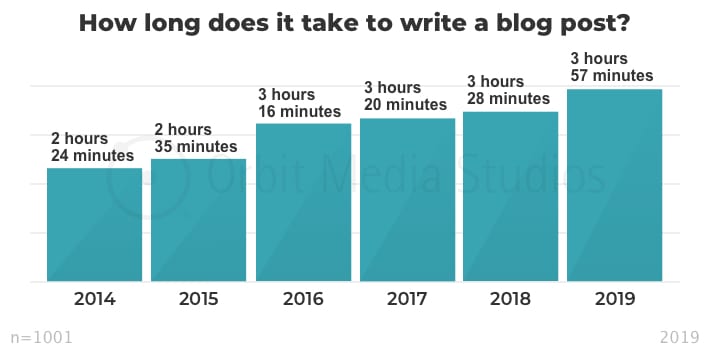
The average blog post takes 3 hours and 57 minutes to write …up 65% from 2014
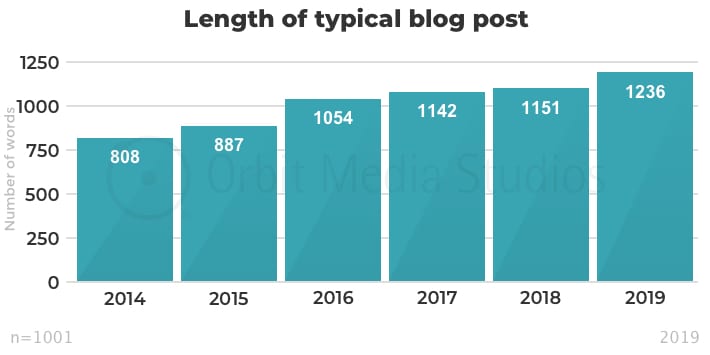
The average blog post is 1236 words long …56% longer than in 2014
52% of bloggers report that it’s getting harder to get readers to engage with their content
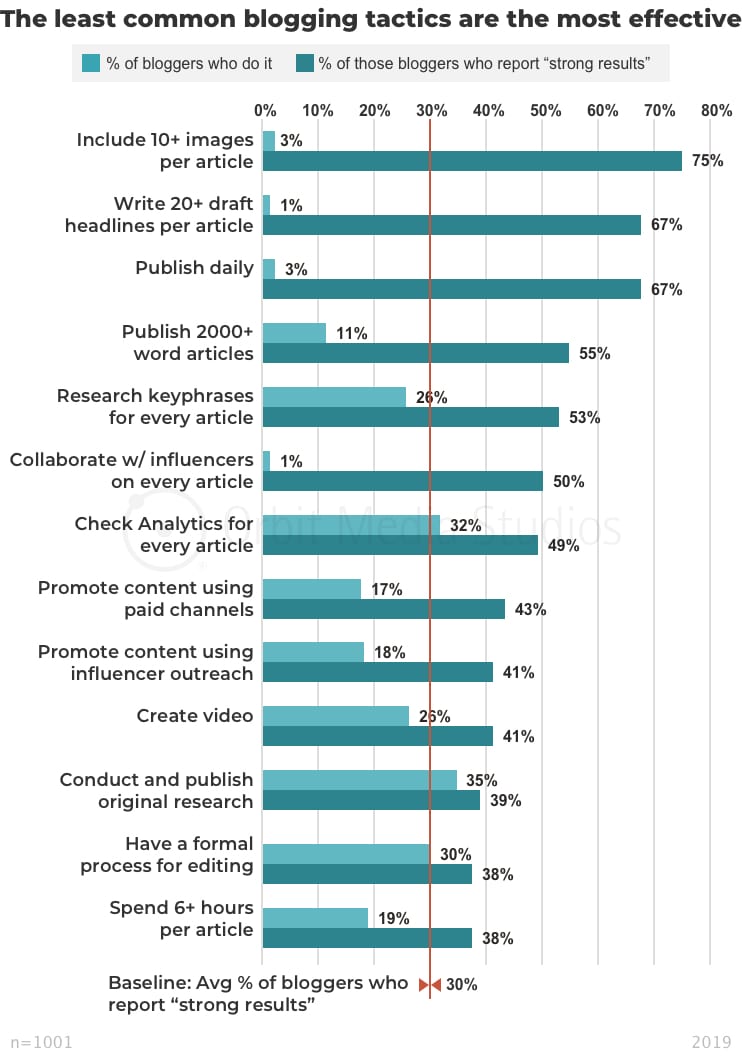
One of the final questions is about success, and we correlate that
answer with the other answers, we can see what’s working today. Here is
the summary, ordered by effectiveness. It shows not only shows which
tactics are the most effective, but how few bloggers use them.
Note: “Strong results” data is self-reported and naturally
depends on the goals of each blogger. Because results such as traffic,
engagement and revenue vary widely across content programs, we did not
ask bloggers to provide Analytics or revenue data. You’ll find more info
about the methodology and data at the end of this report.
Here are the final statistics, analysis and input from blogging and content marketing experts.
1. How long does it take to write a blog post?
The average blog post takes 3 hours and 57 minutes to write.
The time invested in each article rises every year. This year the
average time spent per post jumped 30 minutes and is up 65% since 2014.
The data from 2014 to 2016 showed big drops in bloggers who spent two
hours or less per article. This year we see big jumps in the percentage
of bloggers who spend four hours or more.
Note: 30% of bloggers reported “strong results.” That’s the benchmark. We’ll discuss this in the final section.
2. How long is the typical blog post?
The average blog post is 1236 words long.
That’s 53% longer than six years ago. Articles keep getting longer,
as bloggers invest more time and effort in long-form, detailed articles.
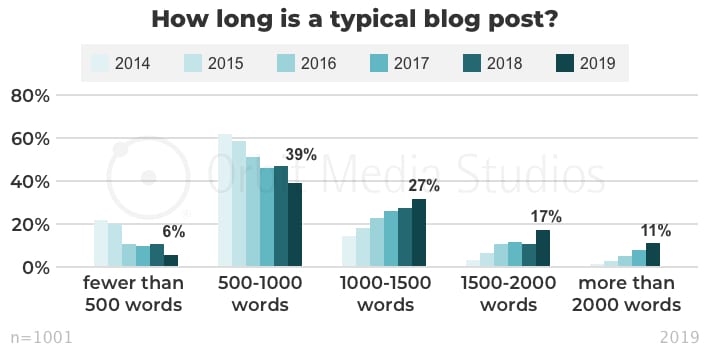
Look closer and we see the big jump is in the 1500-2000 word range.
It’s as if editors everywhere updated their guidelines for length from
1000 to 1500 words.
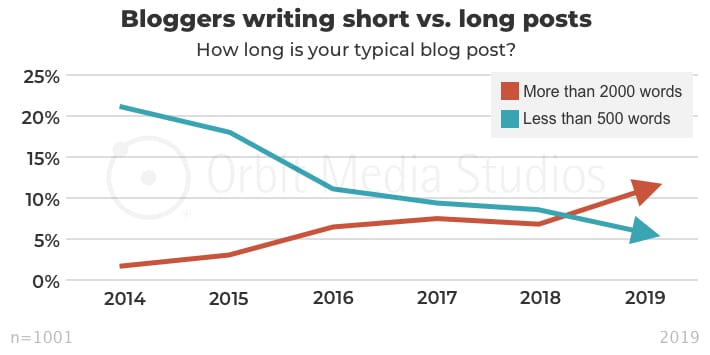
Compare the percentage of bloggers at the far ends of the spectrum. An approach that was once rare is now quite common.
Perhaps we’ve seen a tipping point in the awareness of the benefits
of big content. Lots of studies have found a correlation between
long-form content with higher rankings, greater social engagement and
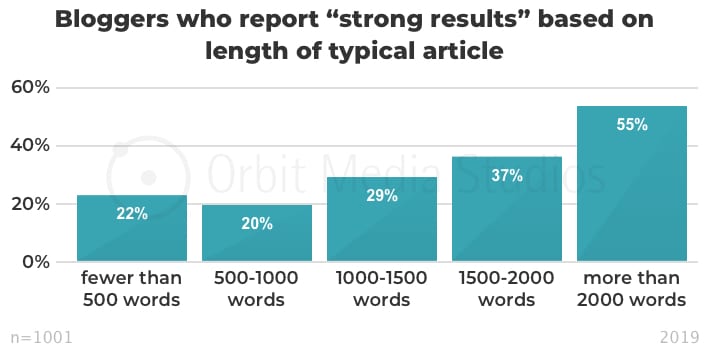
better results in general. Here’s one more: bloggers who write longer content are far more likely to report success. More than half of the bloggers who go big report “strong results” from blogging.
Joe Pulizzi, Founder, CONTENT MARKETING INSTITUTE“In looking through the data, it’s almost like going into the
past where longer, meatier articles were king, and each article took
hours of time. This gives me hope for the future of content consumption.
At least for blogging, snackable content is clearly dead. Audiences
expect more, and bloggers are giving them better researched more
advanced and well-thought-out content.”
Gill Andrews, COPYWRITER AND WEB CONSULTANT“I am surprised by how much the average blog post length has increased over time. It either means that more bloggers have finally realized that they need to try harder to get results or that the reader’s expectations increased drastically. If it’s the latter, I wonder if that means that at some point in the future, small businesses won’t be able to blog at all, because they won’t have the resources to produce the content an average online reader expects.”
Gini Dietrich, founder and author, SPINSUCKS“There are many days I complain about how I have six hours of meetings without time to pee or eat, let alone write or record a podcast. And then I read this survey that shows a significant number of bloggers now spend six hours writing one blog post. Six hours! ONE blog post. This means that kind of time, research, and collaboration results in cold, hard cash. So pack your desk drawer with protein-packed snacks and get to work!”
3. How frequently do bloggers publish?
About half of bloggers publish weekly or several times per month.
Has the increase in time and length affected how often bloggers hit
the publish button? Yes. There has been a steady decline in the “several
per week” category since 2014.
Around half of all bloggers publish 2-4 posts per month. That’s holding steady, but notice the jump in daily blogging.
Is there a relationship between publishing frequency and results? Yes. Bloggers who write more (either in length or in frequency) are more likely to report strong results.
But there seems to be a point of diminishing returns with frequency.
Bloggers who publish daily are more likely to report strong results than
bloggers who publish several times per day.
4. What content formats are bloggers using?
We’ve seen the size. Now let’s look at the shape of the content.
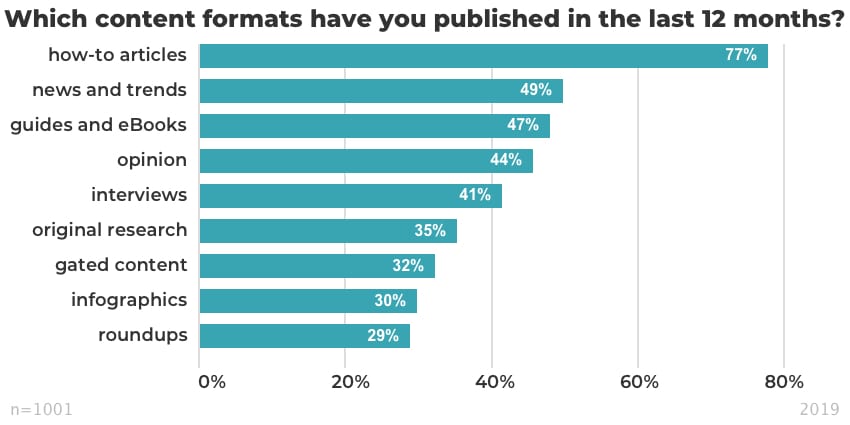
Practical, how-to content is dominant in content strategies.
About half of bloggers publish news. About half publish opinion.
Just one-third of bloggers use collaborative formats: round ups and interviews.
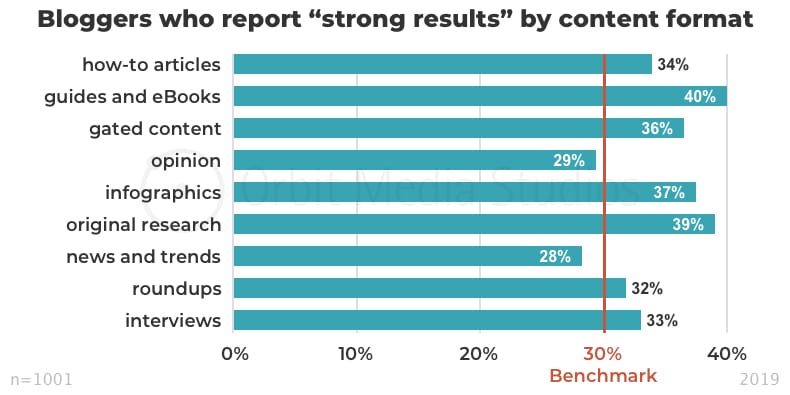
Here is the correlation between content formats and blogging
performance. This reinforces the previous findings about the value of
in-depth, visual and collaborative content.
Most likely to succeed: Bloggers who create long-form guides, ebooks and original research
Least likely to succeed: Bloggers who publish news and opinion
Mega-Trend: Research on the rise
Last year, 25% of bloggers added original research to their mix. Now
we see a big jump up in that number. More bloggers are conducting and
publishing original research as the word gets out about its
effectiveness.
35% of bloggers conduct and publish original research
85% of bloggers who publish original research report some/strong results from blogging (39% of them report strong results)
To gate or not to gate
This year we asked if bloggers are putting content behind lead gen
forms, requiring readers to give their email address prior to getting
access. About one-third of bloggers do this, even though almost half of
bloggers publish guides and ebooks.
32% of bloggers gate content
88% of bloggers who gate content report some/strong results from blogging (35% of them report strong results)
5. What does the typical blog post include?
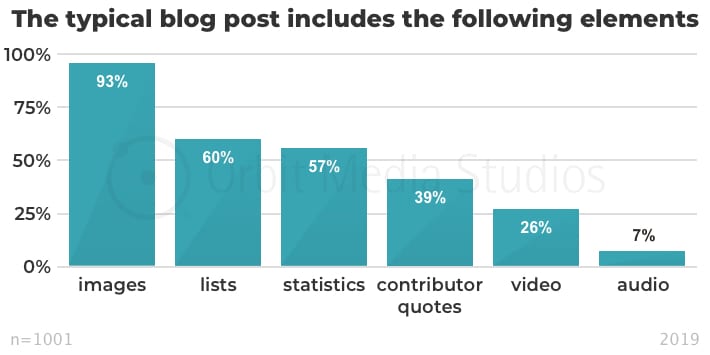
Now let’s look at the features of specific articles, including
images, video, statistics and contributor quotes. These statistics show
how visual, scannable and collaborative blog posts are in general.
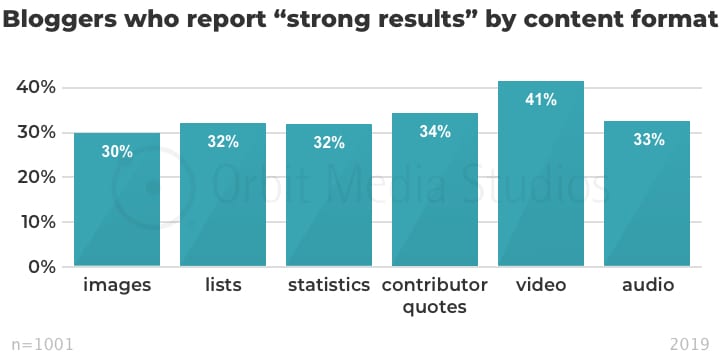
When we check the correlation data, you can see which specific elements correlate with success when included in blog content.
You can see that video makes the biggest difference. We’ve seen the correlation between video and success grow year after year.
Just how visual is blog content?
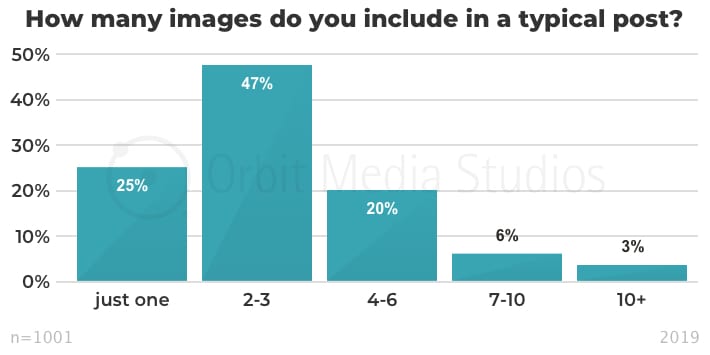
Most bloggers add a few images to their content. But fewer than 10%
of bloggers are producing very visual content with 7+ images per
article. Does that sound high? The average article here on the Orbit
Media blog includes 14 images, not including the author’s picture.
There is a clear correlation between highly visual content and
success. The more images a blogger adds to a typical article, the more
likely they are to win at the content game.
Just 3% of bloggers add 10+ images per article, but they are 2.5x
more likely to report “strong results” than the average blogger.
This along with the trends in video shows the importance of visuals.
It shows just how visual blogging has become. Is blogging more about
images or words? Are blogs post written or designed? It seems the more
visual the content strategy, the more likely it is to succeed.
Just how collaborative is blog content?
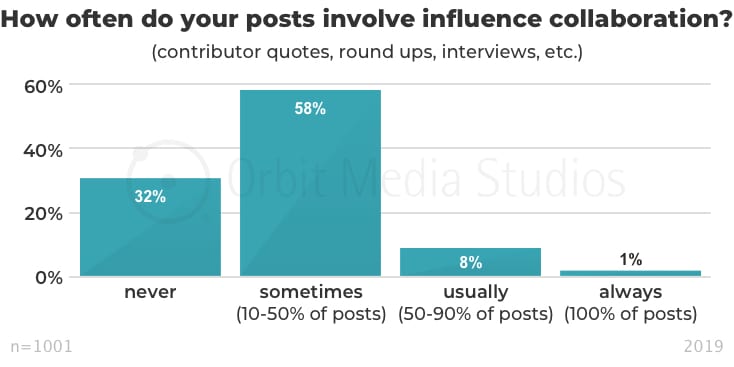
Seeing the big trends of influencer marketing inspired us to ask
about the popularity of collaborative content, which we define as
content that includes contributor quotes, roundups or interviews. The
response indeed shows that most bloggers do collaborate.
32% of bloggers never collaborate
1% of bloggers always collaborate
Is there a correlation between collaboration and success? Yes. The
more often bloggers collaborate with influencers, the more likely they
are to report “strong results.”
Here at Orbit, as a rule, each article we write includes a
contributor quote from at least one expert. Just as a journalist
wouldn’t publish an article without a source, we would never publish an
article without an expert POV.
6. How many draft headlines are bloggers writing?
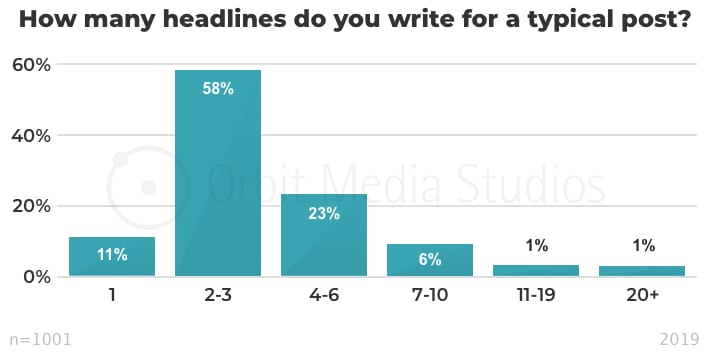
The average blogger writes four headlines before selecting one.
Everyone sweats over headlines, or so we assume. As an all-important
element for blog posts, it’s worth the extra attention. After hearing
that some content teams consider 20+ headlines before selecting one, we
decided to pose the question.
We see that most bloggers write a couple of headlines before choosing
one and a tiny percentage are writing more than ten. Fewer than 1% of
bloggers write 20+ draft headlines per article.
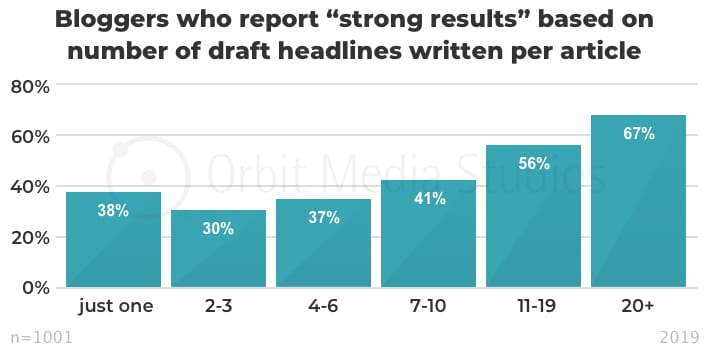
Yet bloggers who consider more headlines are far more likely to
report success. Very few bloggers are doing the thing that correlates
with results.
Ann Handley, Cheif content officer, MARKETING PROFS“We all recognize the value of a great headline. Well done, us! Now let’s spend as much time thinking about the first line of a piece. PRO TIP: Write as many first lines as you do headlines. Why? Because the headline makes a reader click. And the first line makes them actually read the piece.”
7. Are bloggers working with editors?
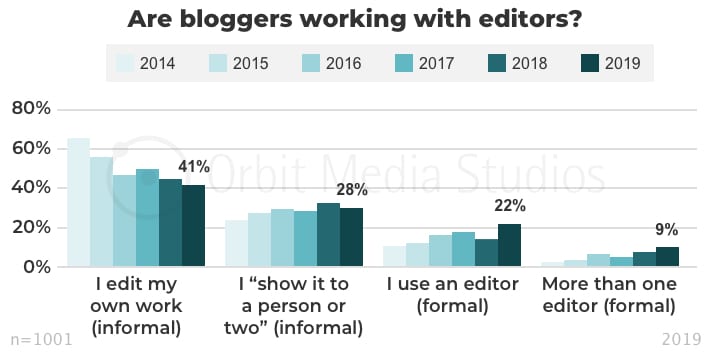
30% of bloggers have a formal process for editing.
For our final question about process, we ask about working with
editors. Most bloggers edit their own work or get “a second set of eyes”
on their content before publishing. Only 30% have a formal process for
editing. That’s way up from five years ago when just 1 in 10 bloggers
had a formal process.
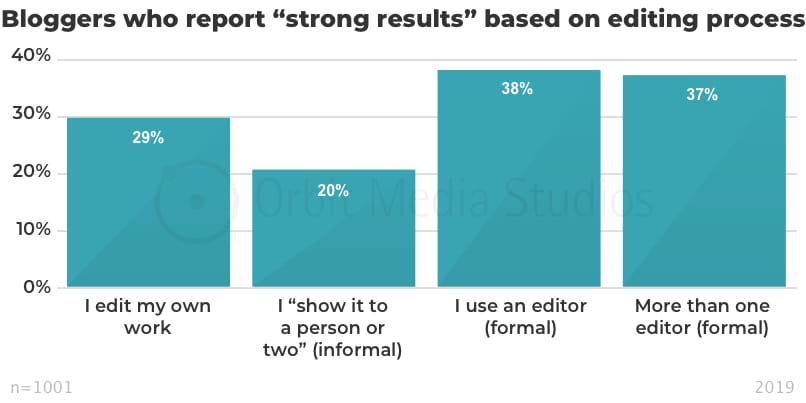
Bloggers with a formal editing process were about 50% more likely to
report strong results. Working with multiple editors doesn’t seem to
make strong outcomes more likely. And bloggers who edit their own seem
to be doing pretty well.
Another tip from Ann: “Behind every decent writer is a fantastic
editor! If you want to be a better writer… get yourself a great editor
to work with you.”
8. How is your content typically promoted?
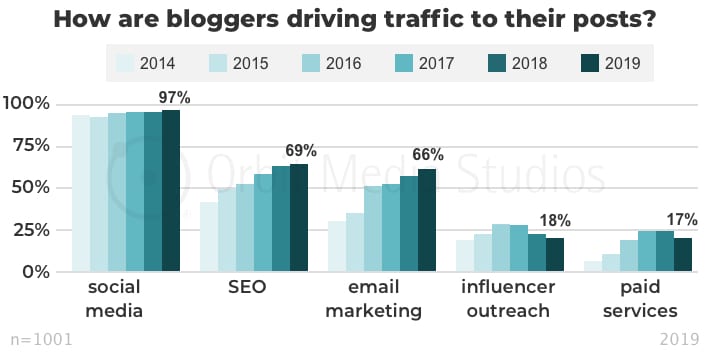
Social media, of course. But just one in five bloggers uses influencer outreach and paid promotion.
Obviously, the fast, easy and cheap promotion channel is the most
popular. Virtually all bloggers share their content on social media.
Two-thirds use search and email, both of which have become much more
popular over the last five years.
The percentage of bloggers using email marketing has increased 2x since 2014
The percentage of bloggers using paid promotion has increased 3x since 2014
1 in 5 bloggers leverages influencers to help drive traffic (that’s down from two years ago)
1 in 5 bloggers buys traffic (that’s leveled off after a dramatic rise)
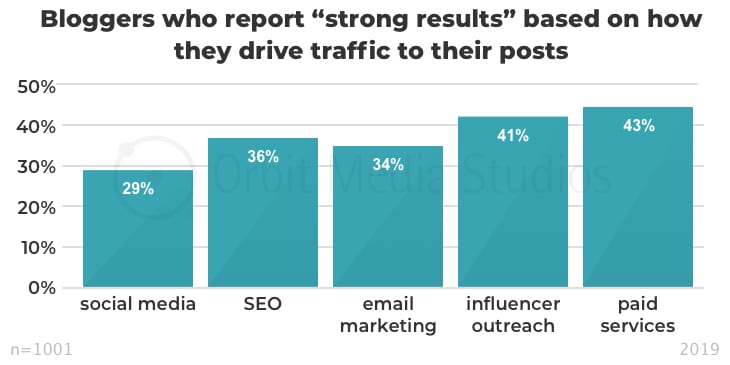
Let’s see what’s working. The less popular promotion channels are
more strongly correlated with success. This may be because they are more
difficult (or expensive) and this is another example of hard work
paying off.
9. How often do bloggers research keywords?
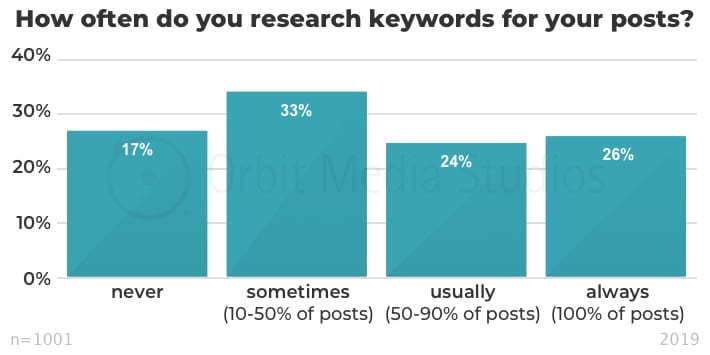
Half of bloggers research keywords for the majority of their content.
As SEO has grown in popularity and importance, keyword research as a skill and practice has become more common. Most bloggers do it sometimes. Half of all bloggers do it most of the time.
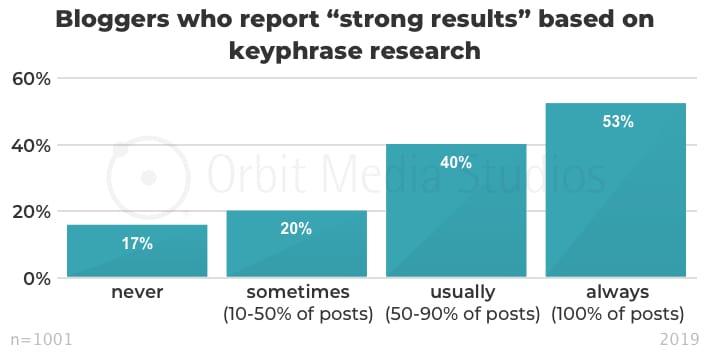
It’s work that pays off. The more the blogger researches keywords,
the more likely they are to report success. Bloggers who are also SEOs
report “strong results” at much higher than average rates.
10. Are bloggers using analytics?
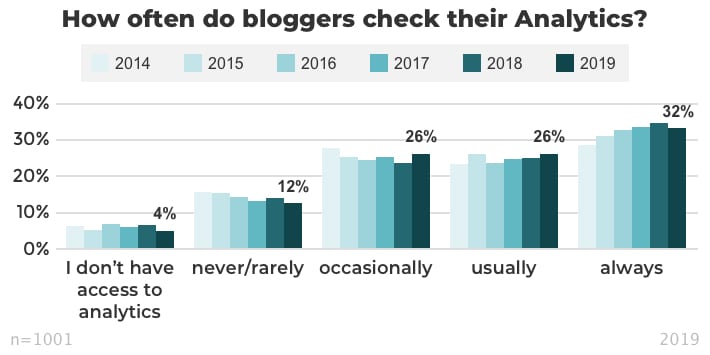
Half of bloggers usually check the analytics for a post. The other half check occasionally, rarely or never.
The trend here is mostly flat. Use of Analytics has remained steady
for years. But it remains one of the big indicators of blogging
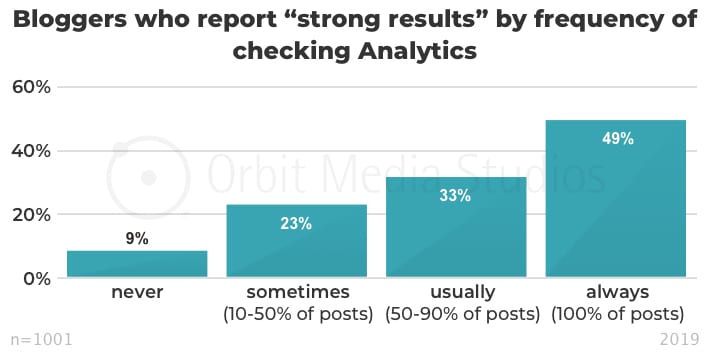
performance. Bloggers who measure the performance of every post are far
more likely to report “strong results” than the average blogger.
If they aren’t using analytics, you have to wonder how they even know if they’re getting results.
Jay Baer, luminary, CONVINCE AND CONVERT“What’s most interesting to me is the combination of expanded blog post length and corresponding time spent per post with the decline in attention paid to Analytics and keyword research. It’s remarkable to me that bloggers would spend nearly 4 hours to craft an 1800 word post, yet only 57% of them check their analytics with any degree of frequency and only about 50% of the time are they actually thinking about keywords when writing that post. If I was going to spend four hours on something, I would want to make sure that I had a measurement and success schema identified before I wrote the first of those 1800 words.”
11. Is it part of your strategy to update older blog posts?
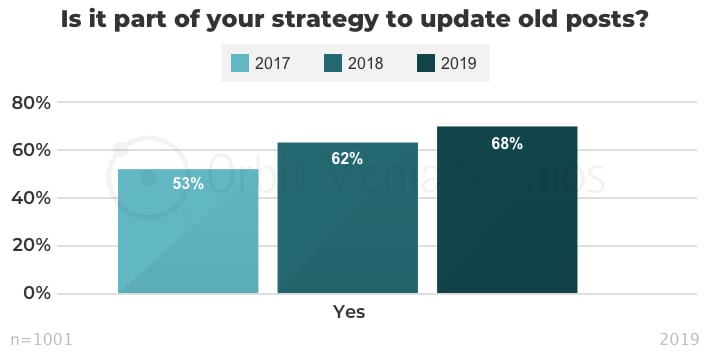
Two-thirds of bloggers update previously published blog posts.
An obvious trend has emerged since we started asking this question a
few years ago. Nearly 70% of bloggers now report going back to older
content and making updates.
ian cleary, founder, RAZOR SOCIAL“Updating old content is an essential part of any online strategy
so it’s good to see that this year the percentage of people updating
old content. It’s great for SEO, especially when combined with keyword
research, adding more media and careful internal linking.”
Ian’s right. Updating old content appears to be an SEO tactic.
Bloggers who research keywords are 3x more likely to update old posts.
It’s a powerful way
to improve rankings and search traffic quickly. Also, bloggers who
publish news and original research are more likely to update old posts.
Makes sense.
This is another of those tactics that have a very strong correlation
with success. Bloggers who update old posts are 2x more likely to report
success.
35% of bloggers who update old content report “strong results”
16% of bloggers who do not update old content report “strong results”
12. Are bloggers getting results from their content?
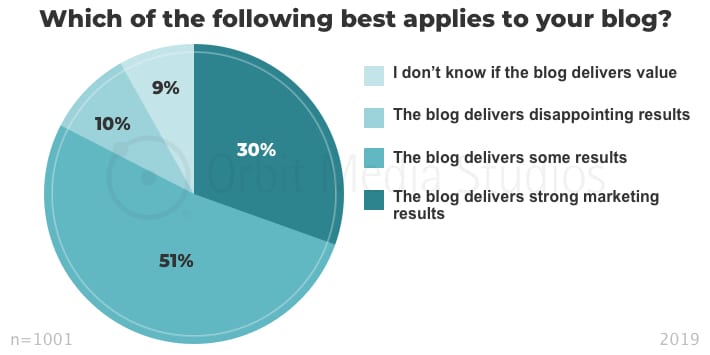
Most bloggers are getting results, but just 30% are getting strong results.
We’ve seen this correlated with other statistics throughout the
survey. Now here’s the raw data on success. Naturally, the definition of
success varies as bloggers have a wide range of goals, from rankings to
revenue, likes to leads.
If you put 10 bloggers in a room…
5 would report getting some results
3 would report strong results
1 would report disappointing results
1 wouldn’t even know if they’re getting results
Is there a trend here? No. These numbers have changed very little over the last four years.
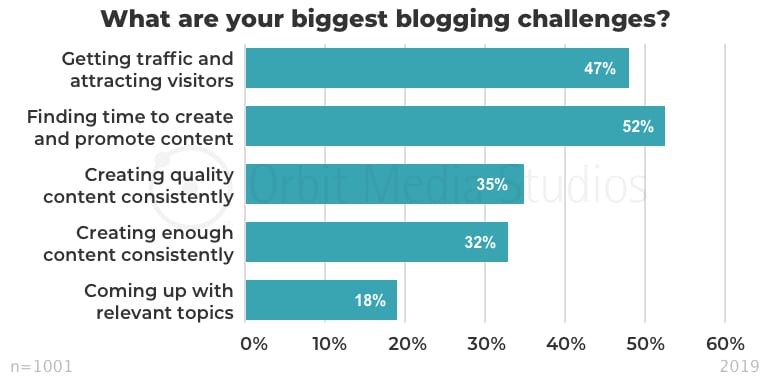
Bonus: What are the biggest blogging challenges?
This year we added a few questions about the challenges. What is the
hardest thing about blogging. The most common answer is personal: finding time.
We included an “other” category and gave respondents the opportunity
to add their own answers. The most common responses were related
specifically to business blogging: getting internal buy-in and
measurement/attribution.
The challenges are timeless, but when we ask bloggers what’s getting harder now, we see where the headwinds are coming from.
Henneke Duistermaat, ENCHANTING MARKETING“If reader engagement feels like your biggest challenge, it’s worth asking yourself whether your content strategy needs fine-tuning. Do you have a clear idea who your ideal reader is and how you can help them solve their problems, answer their questions and achieve their aims? Is the traffic to your site relevant? Are you writing to engage your reader or to impress Google? How human is your writing?”
Robert Rose, founder, THE CONTENT ADVISORY“It’s no surprise, but it’s very refreshing to see the quantity and quality challenge expressed in such contrast. Time spent on each post is up. Length and exploration of depth is up. And the biggest mentioned challenge to not only attract attention but hold it. A loud noise gets your attention – but it’s what kind of noise you’re making that determines whether people stay and listen.”
Bloggers are struggling with search and social more than email
marketing. This is probably because search and social are dominated by
digital monopolies, which control user experience. Google and Facebook
have reduced clickthrough rates to websites in order to keep visitors on
their platforms. But email isn’t owned by anyone. There’s no
intermediary between the blogger and their audience. Bloggers are
reporting an easier time.
Most bloggers (54%) are finding it harder to keep visitors engaged
with content. It’s a constant struggle. The signals that indicate that a
reader is connecting with the post aren’t looking good.
Two key takeaways
There are a few big themes here. There seem to be two main factors
that are the strongest indicators of success: depth and consistency.
Deep Content
Bloggers who do more are getting better results. These are the bloggers most likely to report success:
Bloggers who write 2000+ words
Bloggers who include 10+ images per post
Bloggers who consider 20+ headlines
Consistent Performance
Bloggers who are more consistent are getting better results. These are the bloggers most likely to report success:
Bloggers who always research keywords report strong results
Bloggers who always collaborate on content report strong results
Bloggers who always check Analytics report strong results
These tactics are so effective because bloggers are using them every time.
Methodology and Data
The respondents to this survey are self-described bloggers that we
connected with over many years on social media and at live events. The
data set is heavily populated with my network, which skews toward
LinkedIn users, B2B marketers and people in the US. Responses were
gathered from July through September 2019.
No one was incentivized to take the survey. This is a survey of
bloggers (individuals), not companies or brands (groups). Here are the
three ways we gathered responses along with our estimates for their
contribution:
Email to past respondents (30% of responses)
Social media and shares by influencers (30% of responses)
Individual outreach through messages and email (40% of responses)
New research suggests personality has a larger effect on success than IQ.
How much is a child’s future success determined by innate intelligence? Economist James Heckman says it’s not what people think. He likes to ask educated non-scientists—especially politicians and policy makers—how much of the difference between people’s incomes can be tied to IQ. Most guess around 25 percent, even 50 percent, he says. But the data suggest a much smaller influence: about 1 or 2 percent.
So if IQ is only a minor factor in success, what is it that separates the low earners from the high ones? Or, as the saying goes: If you’re so smart, why aren’t you rich?
Science doesn’t have a definitive answer, although luck certainly plays a role. But another key factor is personality, according to a paper Heckman co-authored in the Proceedings of the National Academy of Sciences. He found financial success was correlated with conscientiousness, a personality trait marked by diligence, perseverance and self-discipline.
To reach that conclusion, he and colleagues examined four different data sets, which, between them, included IQ scores, standardized test results, grades and personality assessments for thousands of people in the U.K., the U.S. and the Netherlands. Some of the data sets followed people over decades, tracking not just income but criminal records, body mass index and self-reported life satisfaction.
The study found that grades and achievement-test results were markedly better predictors of adult success than raw IQ scores. That might seem surprising—after all, don’t they all measure the same thing? Not quite. Grades reflect not just intelligence but also what Heckman calls “non-cognitive skills,” such as perseverance, good study habits and the ability to collaborate—in other words, conscientiousness. To a lesser extent, the same is true of test scores. Personality counts.
Heckman, who shared a Nobel Prize in 2000 and is founder of the University of Chicago’s Center for the Economics of Human Development, believes success hinges not just on innate ability but on skills that can be taught. His own research suggests childhood interventions can be helpful, and that conscientiousness is more malleable than IQ. Openness—a broad trait that includes curiosity—is also connected to test scores and grades.
IQ still matters, of course. Someone with an IQ of 70 isn’t going to be able to do things that are easy for a person with an IQ of 190. But Heckman says many people fail to break into the job market because they lack skills that aren’t measured on intelligence tests. They don’t understand how to behave with courtesy in job interviews. They may show up late or fail to dress properly. Or on the job, they make it obvious they’ll do no more than the minimum, if that.
John Eric Humphries, a co-author of the paper, says he hoped their work could help clarify the complicated, often misunderstood notion of ability. Even IQ tests, which were designed to assess innate problem-solving capabilities, appear to measure more than just smarts. In a 2011 study, University of Pennsylvania psychologist Angela Duckworth found that IQ scores also reflected test-takers’ motivation and effort. Diligent, motivated kids will work harder to answer tough questions than equally intelligent but lazier ones.
Teaching personality or character traits in school wouldn’t be easy. For one thing it’s not always clear whether more of a trait is always better. The higher the better for IQ, and perhaps for conscientiousness as well. But personality researchers have suggested the middle ground is best for other traits — you don’t want to be so introverted that you can’t speak up, or so extroverted that you can’t shut up and listen.
What does any of this have to do with economics? “Our ultimate goal is to improve human well-being,” Heckman says, and a major determinant of well-being comes down to skills.
A newer study published in the journal Nature Human Behaviour focused on the flip side of success: hardship. After following some 1,000 New Zealanders for more than 30 years, researchers concluded that tests of language, behavioral skills and cognitive abilities taken when children were just three years old could predict who was most likely to need welfare, commit crimes, or become chronically ill.
The lead author of that paper, Duke University psychologist Terrie Moffitt, says she hopes the results would foster compassion and help, not stigma. Her results also suggested that helping people improve certain kinds of skills before they’re out of diapers would benefit everyone.
Faye Flam is a Bloomberg Opinion columnist. She has written for the Economist, the New York Times, the Washington Post, Psychology Today, Science and other publications. She has a degree in geophysics from the California Institute of Technology. This column does not necessarily reflect the opinion of the editorial board or Bloomberg LP and its owners. For more columns from Bloomberg Opinion, visit http://www.bloomberg.com/opinion.
Employees now look to their workplace for purpose and development Companies that create a high-development culture achieve high performance Learn four development strategies to retain your best employees You’ve heard of high-performance workplaces, but how do they become “high-performance”? Gallup has discovered that one of the most important factors in creating a high-performance workplace is instilling a high-development culture: one that values the growth of individuals. Organizations that have made a strategic investment in employee development, Gallup finds, report 11% greater profitability and are twice as likely to retain their employees. It makes sense. High-achieving people (the ones who can grow your company) seek development. And all employees have a psychological need to learn and grow as human beings. Development at work satisfies two of the five essential elements of well being by fulfilling a person’s drive for career and social well being. Having a sense of purpose makes people feel great about what they do at work and helps them enrich and deepen their relationships outside of it.
Nearly nine in 10 millennials say professional development or career growth opportunities are very important to them in a job. “Career growth opportunities” is the No. 1 reason people give for changing jobs. People need to be connected and involved in their workplace, and they want to be when that workplace offers them not only purpose, but also employee training and development. How to Create a High-Development Culture Perspective Paper Employee Engagement: Maximizing Employee Potential Learn how to build a high-development workplace culture driven by engagement that improves productivity, performance and profitability. Creating a high-development culture means more than adding a few learning programs and development plans to the roster. Here are four strategies that set the highest-performing workplaces apart:
1. They protect their investment in employee development with a focus on increasing employee engagement. Many leaders fear that they will invest in their employees’ development only to see them walk out the door anyway. This does happen — but the best way to keep it from happening is to secure people’s psychological commitment through an employee engagement strategy. Organizations can foster commitment and improve engagement by meeting employees’ basic needs with clear expectations, sincere recognition, the right materials and equipment — and the rest of the 12 elements we outline in our employee engagement practices. People won’t stay with an organization or perform at their best — even if they’re given lots of development and learning opportunities — if they’re not engaged in their work and committed to the company. Read more about building a high-development culture through employee engagement.
2. They avoid the most common misunderstanding about development. Companies have typically defined growth and development as a promotion. While effective development may involve a promotion, it doesn’t have to. Often, the employees who are really good at what they’re currently doing don’t necessarily want to be promoted — but they still want growth. From Gallup’s extensive workplace research, development should primarily be: A process of understanding each person’s unique talents (naturally recurring patterns of thought, feeling or behavior that can be productively applied) and finding roles, positions and projects that allow them to combine their talents and abilities with experiences to build strengths (the ability to consistently provide near-perfect performance in a specific activity). Giving people the opportunity to understand themselves, develop what they’re good at and use their strengths every day at work can be more fulfilling than a new title for most of your employees. Gallup research shows that when employees know and use their strengths, they are more engaged (nearly six times more), have higher performance and are much less likely to leave their company. NEW BOOK It’s the Manager Learn why the manager is key to every aspect of your workplace.
3. Their managers are highly involved in the development of individuals — they act as coaches, not bosses. The manager is the vessel that makes culture change and engagement a reality. Managers are closer than HR or leadership to employees’ daily realities, so they’re more likely to understand how to develop employees and engage them. And since people are more likely to learn and grow when they receive immediate feedback that is specific and targeted to their development, managers become the perfect people to coach employees and link them to practical learning and action. Learn more about the importance of the manager in employee development.
4. Their leadership owns the culture change (not HR alone). Culture change does not happen through all-hands meetings, emails, newsletters and strategy retreats. Consistent communication does help. But the fundamental driver of culture change is commitment from leadership to high-performance workplace practices that is backed by their actions. When C-level officers model a focus on development and put resources toward it, managers and employees will begin to mimic that focus on their own. This behavior change is foundational to making culture change stick. The Best Employees Will Always Seek Development A focus on developing people has the potential to outperform practices like Six Sigma in creating organic growth for companies. High-achieving employees continuously seek purpose and development — so if they’re engaged at your company and you provide those growth and development opportunities, they won’t have a reason to leave, and you’ll attract even more top talent. It’s a powerful opportunity for companies to capture the loyalty of hardworking employees who want to invest in their future and the future of your business. Start creating a high-development culture today: Download our latest perspective paper, Building a High-Development Culture Through Your Employee Engagement Strategy. Learn what Gallup recommends for a transformative learning and development strategy for your company. Get our bestselling book, It’s the Manager, to learn more about how managers play a key role in creating your ideal culture. Rob DeSimone is a Gallup Consultant based in Washington, D.C. Jessica Buono contributed to this article. Related Topics Include: Article CliftonStrengths Culture Development Employee Engagement Leadership Learning & Development Millennials Performance Management Profitability Retention Workplace Gallup at Work Newsletter Get the insights you need to create an exceptional workplace. Subscribe to the Gallup at Work newsletter to get our latest articles, analytics and advice. * Email Address * Country or Region I’d also like to be among the first to know about new Gallup offerings and services. I understand that I may unsubscribe from these offerings at any time. Recommended
The more we rely on technology to make us efficient, the fewer skills we have to confront the unexpected, says writer and entrepreneur Margaret Heffernan. She shares why we need less tech and more messy human skills — imagination, humility, bravery — to solve problems in an unpredictable age. “We are brave enough to invent things we’ve never seen before,” she says. “We can make any future we choose.”
When it comes to small business marketing, trust is by far the most valuable currency. Driving web traffic and increasing brand awareness are great goals, but there’s nothing more impactful than engendering trust in your business. This can be achieved in a number of ways, but word-of-mouth consistently produces the best results. Indeed, 92 percent of customers say they are inclined to trust “earned” media like word-of-mouth and personal recommendations. Referral marketing is the simplest and most effective way to generate this invaluable buzz, so take a look at what you need to know to get started.
What Is Referral Marketing?
There’s no question that word-of-mouth is a powerful force. Plenty of businesses have succeeded largely on the strength of word-of-mouth marketing. In-person recommendations generate over five times more sales than paid marketing efforts, making them a holy grail of advertising. Unfortunately, most businesses can’t afford to simply sit back and wait for these recommendations to happen organically. The solution, then, is referral marketing.
In its most basic form, referral marketing simply means offering some kind of incentive to encourage satisfied customers to spread the word about your business. Why is this necessary? While 83 percent of customers are willing to spread the word about great products or services, just 29 percent actually do so on their own. Offering a referral program can tap into that remaining 54 percent and lead to a huge increase in your word-of-mouth recommendations. It’s a simple strategy that can produce serious growth, but it’s not right for every situation.
Is Referral Marketing Right for Your Business?
An effective referral marketing campaign requires that a business has a few things in place. The first requirement is a truly excellent product or service. After all, few customers are going to suggest a subpar product to their family and friends. Even worse, offering a referral program for something that doesn’t meet expectations can backfire in a serious way. Good reviews for your offerings, positive feedback from customers and unsolicited referrals are all good signs that referral marketing is a fit for your business.
Another prerequisite is excellent customer support. This serves a few important purposes. The first is to ensure that your business can adequately handle an influx of new customers. It’s no guarantee, but a referral program can sometimes bring in a major increase in traffic. Can your company handle this increase appropriately? The second factor is to make sure that each new customer has as good an experience as the person who made the recommendation. A single referral doesn’t do much good, but a negative experience can stop the chain before it even begins. The best campaigns rely on each referred customer subsequently bringing even more referrals on board.
The Basics of Creating a Referral Program
The first step in building a referral program is defining the goals you’d like to achieve. What would constitute a success for your campaign? For some businesses, it may involve hitting a specific sales figure in a certain time frame. For others, it may be more important to bring on a particular number of new customers. Perhaps the most important factor for your industry is building greater trust and recognition. No matter what success looks like to you, it’s important to be specific and set tangible targets that can be used to track your progress later on.
The next task is to choose the right incentives. In some cases, simply thanking your customers and asking them to spread the word if they’re satisfied is enough to jump-start the process. In other cases, it’s best to offer a reward to help spur your customers into action. Take a look at what your competitors are doing and consider which incentives are appropriate for your industry. Popular options include the following:
• Priority service
• Credits or cash back on purchases
• Access to exclusive deals and discounts
• Free or upgraded shipping
Promote, Refine and Refocus
Once you’ve determined your goals and settled on incentives, the key to success is building awareness of your program. As with incentives, the right approach to promotion may vary depending on your industry and the goods or services you offer. Reaching out to existing customers with an invitational email is almost always a great place to start. A prominent call to action on your website is usually an effective approach as well. It’s also a good idea to incorporate your referral program into your newsletter. Recent studies have shown that 90 percent of people who are prompted to subscribe to a newsletter opt to do so.
After the program has been launched, it’s important to track the results and adapt your approach as necessary. Unfortunately, it sometimes takes some trial and error to hit upon the most effective combination of incentives and promotional strategies for your industry and customer base. Regularly refining your approach and refocusing your long-term aims will help you maximize your returns. Utilize the metrics that are most important to you to track your success. Consider requesting feedback from customers to gauge their response to your program and use this information to shape any changes moving forward.
The modern hyperconnected, media-saturated world has given businesses more avenues for marketing than ever before. Nonetheless, word-of-mouth is undoubtedly still king. In fact, it’s the primary motivating factor behind a staggering 50 percent of all purchasing decisions. The most successful small businesses capitalize on this and turn satisfied customers into true allies. With small business referral programs, you can engender trust, give back to the customers who fuel your success and open up new opportunities for strong and sustainable growth.