Tag: Association of Corporate Executive Coaches

  • How To Use 360-Degree Feedback For Executive Coaching

    Executive coaching has been on the rise for decades as a strategic investment in human capital. When well-designed and delivered, coaching has been found to be one of the most effective approaches for developing senior leaders and enhancing the performance of their teams and organizations.

    One of the most important components of executive coaching is the 360-degree feedback that the coach gathers for coaching participants about their strengths and development needs, how they are perceived, and what they need to do in order to achieve a higher level of performance and positive impact. Feedback can be gathered via automated online surveys or one-on-one interviews.

    The first decision for coaching participants, their managers, and the coach is whether to collect data online or through in-person, video conference, or telephone interviews, or some combination thereof. Online 360s are more convenient and less costly, but, if correctly formulated and well-structured, interviews can help provide additional context and information. Sometimes an executive coach can use both, and follow up on a previous online 360 or performance review by interviewing designated feedback providers, in-person when possible, and via video conference or phone for those who are traveling and/or who work in different locations.

    Once the approach has been decided on, the next decision is who should participate. The list of feedback providers should generally include anyone who has enough familiarity with the coachee’s work to be able to contribute useful observations and suggestions. The list should also be inclusive rather than exclusive, and should include all of the coachee’s direct reports, peers, and managers. It’s important to take organizational politics into account when drafting the 360 list: internal or external constituencies, such as customers or counter-parties, may also have helpful feedback to provide, and inviting them to participate can send a positive message, indicating that the coachee cares about their views and feedback. In order to ensure that the feedback providers will have a balanced perspective, there should be no sample bias, wherein only those who have positive (or negative) things to say are invited to participate. As far as process is concerned, it’s generally best to have coachees draft the initial list, and then run it by their boss, and possibly even HR, for refinement and approval.

    In advance of doing the online 360 or conducting the interviews, it’s important to define who will see the feedback reports, either in full, edited, or summary form, and to clarify whether comments will be given “verbatim” in the feedback providers’ own words, or whether the coach will offer filtered/paraphrased feedback. Generally, we recommend that verbatim comments get shared in the report in order to include the most direct feedback. However, it should be clear to everyone who participates in an online or interview 360 that their verbatim comments will be shared, and in the case of an online 360, it’s useful to provide feedback providers with a sample report so they can see how their comments will be reflected in the report. We also suggest that the online or interview-based 360 should be shared in full, but only with the coaching participants themselves, as this increases the comfort that people have in being open and honest in the feedback that they provide without concern that tough feedback and/or specific criticism will somehow end up in the coachee’s “file.” However, once participants have received the full report, they should be willing to share a summary of insights gained, and/or developmental plans made, based on the feedback in order to ensure that they will be (and feel) accountable for making progress based on the report. Regardless of which option is chosen, the choice needs to be made and communicated before the interviews are conducted, so that parameters are fully clear in advance to all participants, and they know exactly how, and with whom, their feedback will, and will not, be shared.

    Once a consensus has been reached about the list of 360 providers, and who will see the report, the next step is drafting the questions that will be asked. If a standard online 360 will be used, it can be helpful, at times, to include a few additional context-specific questions, including open-ended questions, to gather more relevant information for the coachee. The boss and the coaching participant will likely be interested in each other’s preferred additional open-ended questions, as these questions will reveal their respective priorities and goals for the coaching program. If the boss wants to ask questions about executive presence or presentation skills, that is a signal to the coachee that the boss believes that those areas are relevant and improvable. If the coachee wants to ask what he or she needs to do in order to get promoted, that informs the boss that getting a promotion is a current goal or expectation for the coaching participant.

    It’s important to achieve consensus between the boss and the coachee about how broadly or narrowly to focus the questions, whether or not to include questions about the individual’s role and organizational constraints, whether to ask about potential future roles for the coachee, and whether or not to ask the same, or different questions to different people. Every question will also send a signal to participants about the coaching participant’s (and potentially the boss’s) coaching concerns and priorities, so it’s important to also consider organizational politics in drafting the questions in order to make sure that they are conveying the right messages. As with the participant list, we recommend that the coaching participants first draft the list of questions and then ask their boss (and possibly HR as well) for any edits, additions or changes.

    For interview-based 360s, here are some open-ended questions that we find helpful as a starting point:

    • How would you describe Jane’s leadership and management style?

    • How would you describe Jane’s communication and collaboration style?

    • What are Jane’s strengths?

    • What are Jane’s areas for development?

    • If you could give Jane one piece of advice, what would it be?

    • If you could make one request to Jane, what would it be?

    If the boss and organization are open to it, the coach can also ask contextual questions like:

    • What organizational factors or changes outside of Jane’s department present challenges and opportunities?

    • What organizational factors or changes inside of Jane’s department present challenges and opportunities?

    • What leadership suggestions do you have for Jane and her department to be more successful in the future?

    • What organizational suggestions do you have for Jane and her department to be more successful in the future?

    After all of the above decisions have been made, the next step is for participants to email their feedback providers about the upcoming interviews (or online 360). Sharing the questions in advance can have the dual benefit of giving people time to prepare their answers in advance, and also providing reassurance that everyone will be asked the same questions in the interviews. Furthermore, gaining alignment about the timing and logistics of the interview-based or online 360, including the list of participants, the questions that will be asked, and the confidentiality and reporting parameters can help set up the process for success. When the coach asks the most topical and timely 360 questions of the right sample of feedback providers, the answers will enable the coach to provide the most specific, relevant and useful feedback to coaching participants who can in turn utilize it to develop their skills and professional capabilities. Often, the process of selecting feedback providers, drafting questions, and deciding on timing, logistics and parameters can itself be an important learning opportunity within the overall coaching process. When it comes to 360-degree feedback, the questions (and the process of the coachee achieving consensus with his or her stakeholders about how the questions will be asked, of whom, and how and with whom the report will be shared) can be as important as the answers to those questions.

    In brief, although it can be laborious and complex to get it right, there is no better source of evidence for an executive’s reputation, and no better way to enhance their self-awareness, than through 360s.

    Dr. Tomas Chamorro-Premuzic is a Professor of Psychology at UCL and Columbia University, and the Chief Talent Scientist at ManpowerGroup
    Resource: https://www.forbes.com/sites/discoverpersonalloans/2018/04/16/5-expenses-small-business-owners-face-and-how-to-cover-them/#7b2e98456fd5

  • 4 Signs an Executive Isn’t Ready for Coaching

    The stigma of asking for or being assigned an executive coach is vanishing quickly. The growth of the industry tells us so. In the U.S. alone, $1 billion was spent on business, personal and relationship coaches last year, according to IbisWorld, up about 20% from five years earlier. And the number of business coaches worldwide has zoomed more than 60% since 2007, according to one coaching association. But while executive coaches have improved the performance of many already-good managers and sanded the rough edges off many less effective ones, they aren’t a miracle cure. In fact, we have seen many companies waste considerable sums by assigning coaches to managers who just aren’t ready to be coached, no matter how effective the coaches may be.

    So how do those who control the coaching purse strings — HR, talent managers, and other buyers — avoid throwing money away on uncoachable executives? Considering that a year’s engagement with a top executive coach can cost more than $100,000, it’s an important question.

    From nearly 35 years of coaching hundreds of executives, our firm has noticed a pattern of red flags that indicate when a coaching investment will be wasted. Here are four things to watch out for:

    1. They blame external factors for their problems.

    When things go wrong, does this person always have an excuse? Maybe they point a finger at the quality of their team, a lack of resources, or even their boss.

    When leaders argue about the validity of your reasons for offering coaching, or offer excuses or defenses for poor results, it can be a sign that they lack self-awareness. Before any coaching can be effective, they need to wake up to the ways their actions affect others.

    One CEO we worked with was known for his smart turnarounds of a large media company. But he was struggling to get along with his executive team. Finally, several board directors suggested he should seek out a coach. After multiple sessions, he had shared little information about himself, and we were no closer to figuring out the root of the problem. Stymied, we suggested that we observe the next executive team meeting.

    Suddenly, all was clear. We were shocked by how he controlled the conversation in the room. He simply spoke over other people with a volume of words that was unfathomable. When he left the room to take a call, his team members erupted with frustration. It was obvious that this CEO was completely out of touch — something that became even more apparent later on, when he asked us to tell the board how positively he was responding to coaching.

    Leaders like this often ignore criticism if it doesn’t jibe with their view of themselves — and such feedback is easy to ignore if it’s buried in a performance review or mentioned briefly in a larger conversation. Conducting a non-judgmental, just-the-facts 360-degree review could help them see the reality of their situation. Until they can see what others see and why it matters, they won’t examine their behavior, and coaching will be useless.

    2. You can’t get on their calendar.

    Some leaders claim to be receptive to coaching but just can’t find the time. They may cancel sessions at the last minute, constantly reschedule, or, when they do show up, be visibly distracted. They lack space for coaching both in their calendar, and in their mind.

    Unlike the oblivious leader, the too-busy leader is often quite likable. They will apologize for being hard to pin down, and be very direct about how busy they are. Don’t be surprised if they’re flattered to be offered coaching. But coaching can’t be crammed into the schedule of a leader who wears their busy-ness as a badge of honor. Their inability to prioritize is a sign they need coaching, but their unwillingness to make room for it suggests they won’t be a good coaching investment.

    A brilliant engineer we know had been promoted three times in four years, and by the time he was nearly 30 he was a group president at a U.S. manufacturing company. Diligent, humble, and smart, he could hold a room spellbound with only a marker and a whiteboard as he worked out solutions to highly technical problems. However, as adept as he was at the technical aspects of his job, he now had 20 people reporting to him whom he had no idea how to manage.

    After three months of coaching, his superiors could see it was going nowhere. The executive often rescheduled his sessions, telling his coach he didn’t have the time. He believed he couldn’t set aside the time to improve himself. That made him uncoachable.

    HR managers should do some reality testing to ensure the too-busy leader is willing to make room for coaching. To benefit from coaching, too-busy leaders must make the space to be fully present, both during the coaching sessions and after, doing the difficult work of developing new mindsets, skills, and habits. Ask this person what tasks or responsibilities they’d be willing to give up or delegate, even temporarily, to make time for coaching. If they struggle to think of any, give them a gentle but firm ultimatum as part of a career planning conversation: that they have plateaued at the company and won’t go to the next level until they make time for self-development.

    3. They focus too much on tips and tactics.

    Some leaders eagerly agree to coaching, but then avoid the deeper inquiries required for meaningful transformation. They’re willing to modify behaviors, but not beliefs. They view coaching as medicine that, if taken regularly, will help them get ahead.

    The quick-fix leader becomes frustrated when their coach asks questions that require self-reflection. They want answers, not questions. “You’re the expert, you tell me,” they’ll say in response to questions from the coach, or “What if I did this?” Everything comes back to tactics. (A related warning sign is if a leader asks how quickly the coaching can be finished — especially if they demand that the cycle be compressed.)

    Although coaches sometimes offer suggestions, their real job is to help executives uncover the assumptions driving their behavior. Only then can a coach help them challenge self-limiting beliefs that block their development. However, the quick-fix leader has little interest in this process.

    One CEO we worked with was leading a family business that had recently been sold to a large company. He was told by a leader in the new parent company (who himself had benefitted from coaching) that coaching would help him make the transition. The CEO gladly accepted, wanting to be seen as a peer.

    However, it wasn’t long into the first coaching session that he showed his entire focus was on “doing whatever other successful people did.” The coach worked tirelessly to shift the conversation to the CEO’s purpose and goals. Each time, however, he shifted the discussion back to the “secrets of success” of other organizational leaders he wanted to emulate. Ultimately, he was passed over for a permanent role on the parent company’s leadership team, and left the organization.

    To prompt this kind of leader to be open to self-reflection, remind them of all the other times they vowed to change but were unsuccessful. They then might realize they need to work on more than just changing their game plan. Or, introduce them into a preliminary mentoring conversation with one of the leaders they admire. Tell the mentor to share their experience of struggling to develop.

    4. They delay getting started with a coach to “do more research” or “find the right person.”

    To be sure, it’s important to have a good fit between a leader and his coach. But a continual rejection of qualified coaches should give you pause. A related red flag is if the person is acting confused, and asking repeatedly why coaching has been suggested. Assuming you’ve clearly explained why coaching is necessary, this could be a defense mechanism and a signal that the person is not ready to confront their shortcomings. It usually stems from insecurity.

    Being coached can be daunting, and not everyone is ready to take it on. We remember a physician leader who was hired to turn around a business unit of a large medical center. When his staff challenged him, he became emotional. Told by his boss that he needed a coach to help him control his emotions, he was hurt and angrily asked “Why?” — failing again to control his emotions. He was too full of hidden fears for the coaching to be useful. His boss eventually reassigned him, and ultimately he left the organization.

    Reframe coaching as an investment the organization is making in their development rather than a personal fix. Tell them your firm provides this resource for high-potential, top performers to accelerate their success. If this leader can view coaching as something positive to help them achieve their goals, they may warm up to the process.

    When Going Coach-Less Is Not Viable

    After hearing us say that a certain leader is not a good candidate for coaching, an executive who brought us in will often say a variant of this: “Well, he must be coached. We can’t let him continue to manage others the way he has, but we can’t fire him easily either because we need his skills badly.” But imposing coaching on someone who just can’t handle it at the moment isn’t going to help anyone. Companies are better off directing their people development investments elsewhere — skills training or academic programs are often better options.

    Invest your coaching budget in people who have shown the willingness and the capacity to change, and you’ll get a much better return on your investment.

    Source: https://hbr.org/2018/07/4-signs-an-executive-isnt-ready-for-coaching

    By:

    July 09, 2018
  • There’s only one way to truly understand another person’s mind

    It’s often said that we should put ourselves in another person’s shoes in order to better understand their point of view. But psychological research suggests this directive leaves something to be desired: When we imagine the inner lives of others, we don’t necessarily gain real insight into other people’s minds.

    Instead of imagining ourselves in another person’s position, we need to actually get their perspective, according to a recent study (pdf) in the Journal of Personality and Psychology. Researchers from the University of Chicago and Northeastern University in the US and Ben Gurion University in Israel conducted 25 different experiments with strangers, friends, couples, and spouses to assess the accuracy of insights onto other’s thoughts, feelings, attitudes, and mental states.

    Their conclusion, as psychologist Tal Eyal tells Quartz: “We assume that another person thinks or feels about things as we do, when in fact they often do not. So we often use our own perspective to understand other people, but our perspective is often very different from the other person’s perspective.” This “egocentric bias” leads to inaccurate predictions about other people’s feelings and preferences. When we imagine how a friend feels after getting fired, or how they’ll react to an off-color joke or political position, we’re really just thinking of how we would feel in their situation, according to the study.

    In 15 computer-based experiments, each with a minimum of 30 participants, the psychologists asked subjects to guess people’s emotions based on an image, their posture, or a facial expression, for example. Some subjects were instructed to “consult their own feelings,” while others were given no instructions, and some were told to “think hard” or mimic the expressions to better understand. People told to rely on their own feelings as a guide most often provided inaccurate responses. They were unable to guess the correct emotion being displayed.

    The second set of experiments asked subjects to make predictions about the feelings of strangers, friends, and partners. (Strangers interacted briefly to get to know one another before hazarding guesses about the preferences of they had just person they met.) The researchers wanted to see if people who had some meaningful information about each other—like spouses—could make accurate judgments about the other’s reactions to jokes, opinions, videos, and more. It turned out that neither spouses nor strangers nor friends tended to make accurate judgments when “taking another’s perspective.”

     Imagining another person’s perspective doesn’t actually improve our ability to judge how another person thinks or feels. “Our experiments found no evidence that the cognitive effort of imagining oneself in another person’s shoes, studied so widely in the psychological literature, increases a person’s ability to accurately understand another’s mind,” the researchers write. “If anything, perspective taking decreased accuracy overall while occasionally increasing confidence in judgment.” Basically, imagining another person’s perspective may give us the impression that we’re making more accurate judgments. But it doesn’t actually improve our ability to judge how another person thinks or feels.

    There were no gender differences in the results. Across the board, men and women tended not to guess another’s perspective very accurately when putting themselves in the other’s position. But this did increase self-confidence in the accuracy of their predictions—even when their insights were off.

    The good news, however, is that researchers found a simple, concrete way we can all confidently and correctly improve the accuracy of our insights into others’ lives. When people are given a chance to talk to the other person about their opinions before making predictions about them—Eyal calls this “perspective getting” as opposed to perspective taking—they are much more accurate in predicting how others might feel than those instructed to take another’s perspective or given no instructions.

    In the final test, researchers asked subjects both to try putting themselves in another’s shoes, on the one hand, and to talk directly with test partners about their positions on a given topic. The final experiment confirmed that getting another person’s perspective directly, through conversation, increased the accuracy of subjects’ predictions, while simply “taking” another’s perspective did not. This was true for partners, friends, and strangers alike.

    “Increasing interpersonal accuracy seems to require gaining new information rather than utilizing existing knowledge about another person,” the study concludes. “Understanding the mind of another person,” as the researchers put it, is only possible when we actually probe them about what they think, rather than assuming we already know.

    The psychologists believe their study has applications in legal mediation, diplomacy, psychology, and our everyday lives. Whether we’re negotiating at a conference table, fighting with a spouse, or debating the political motivations of voters, we simply can’t rely on intuition for insight, according to Eyal. Only listening will do the trick.

    “Perspective getting allows gaining new information rather than utilizing existing, sometimes biased, information about another person,” Eyal explains to Quartz. “In order to understand what your spouse prefers—don’t try to guess, ask.”


    https://qz.com/1319441

  • High-Performing Teams Need Psychological Safety. Here’s How to Create It

    “There’s no team without trust,” (….”and no tribe without trust and direct feedback” cb) says Paul Santagata, Head of Industry at Google. He knows the results of the tech giant’s massive two-year study on team performance, which revealed that the highest-performing teams have one thing in common: psychological safety, the belief that you won’t be punished when you make a mistake ...”or speak your truth”…cb). Studies show that psychological safety allows for moderate risk-taking, speaking your mind, creativity, and sticking your neck out without fear of having it cut off — just the types of behavior that lead to market breakthroughs.

    Ancient evolutionary adaptations explain why psychological safety is both fragile and vital to success in uncertain, interdependent environments. The brain processes a provocation by a boss, competitive coworker, or dismissive subordinate as a life-or-death threat. The amygdala, the alarm bell in the brain, ignites the fight-or-flight response, hijacking higher brain centers. This “act first, think later” brain structure shuts down perspective and analytical reasoning. Quite literally, just when we need it most, we lose our minds. While that fight-or-flight reaction may save us in life-or-death situations, it handicaps the strategic thinking needed in today’s workplace.

    Twenty-first-century success depends on another system — the broaden-and-build mode of positive emotion, which allows us to solve complex problems and foster cooperative relationships. Barbara Fredrickson at the University of North Carolina has found that positive emotions like trust, curiosity, confidence, and inspiration broaden the mind and help us build psychological, social, and physical resources. We become more open-minded, resilient, motivated, and persistent when we feel safe. Humor increases, as does solution-finding and divergent thinking — the cognitive process underlying creativity.

    When the workplace feels challenging but not threatening, teams can sustain the broaden-and-build mode. Oxytocin levels in our brains rise, eliciting trust and trust-making behavior. This is a huge factor in team success, as Santagata attests: “In Google’s fast-paced, highly demanding environment, our success hinges on the ability to take risks and be vulnerable in front of peers.”

    So how can you increase psychological safety on your own team? Try replicating the steps that Santagata took with his:

    1. Approach conflict as a collaborator, not an adversary. We humans hate losing even more than we love winning. A perceived loss triggers attempts to reestablish fairness through competition, criticism, or disengagement, which is a form of workplace-learned helplessness. Santagata knows that true success is a win-win outcome, so when conflicts come up, he avoids triggering a fight-or-flight reaction by asking, “How could we achieve a mutually desirable outcome?”

    2. Speak human to human. Underlying every team’s who-did-what confrontation are universal needs such as respect, competence, social status, and autonomy. Recognizing these deeper needs naturally elicits trust and promotes positive language and behaviors. Santagata reminded his team that even in the most contentious negotiations, the other party is just like them and aims to walk away happy. He led them through a reflection called “Just Like Me,” which asks you to consider:

    • This person has beliefs, perspectives, and opinions, just like me.
    • This person has hopes, anxieties, and vulnerabilities, just like me.
    • This person has friends, family, and perhaps children who love them, just like me.
    • This person wants to feel respected, appreciated, and competent, just like me.
    • This person wishes for peace, joy, and happiness, just like me.

    3. Anticipate reactions and plan countermoves. “Thinking through in advance how your audience will react to your messaging helps ensure your content will be heard, versus your audience hearing an attack on their identity or ego,” explains Santagata.

    Skillfully confront difficult conversations head-on by preparing for likely reactions. For example, you may need to gather concrete evidence to counter defensiveness when discussing hot-button issues. Santagata asks himself, “If I position my point in this manner, what are the possible objections, and how would I respond to those counterarguments?” He says, “Looking at the discussion from this third-party perspective exposes weaknesses in my positions and encourages me to rethink my argument.”

    Specifically, he asks:

    • What are my main points?
    • What are three ways my listeners are likely to respond?
    • How will I respond to each of those scenarios?

    4. Replace blame with curiosity. If team members sense that you’re trying to blame them for something, you become their saber-toothed tiger. John Gottman’s research at the University of Washington shows that blame and criticism reliably escalate conflict, leading to defensiveness and — eventually — to disengagement. The alternative to blame is curiosity. If you believe you already know what the other person is thinking, then you’re not ready to have a conversation. Instead, adopt a learning mindset, knowing you don’t have all the facts. Here’s how:

    • State the problematic behavior or outcome as an observation, and use factual, neutral language. For example, “In the past two months there’s been a noticeable drop in your participation during meetings and progress appears to be slowing on your project.”
    • Engage them in an exploration. For example, “I imagine there are multiple factors at play. Perhaps we could uncover what they are together?”
    • Ask for solutions. The people who are responsible for creating a problem often hold the keys to solving it. That’s why a positive outcome typically depends on their input and buy-in. Ask directly, “What do you think needs to happen here?” Or, “What would be your ideal scenario?” Another question leading to solutions is: “How could I support you?”

    5. Ask for feedback on delivery. Asking for feedback on how you delivered your message disarms your opponent, illuminates blind spots in communication skills, and models fallibility, which increases trust in leaders. Santagata closes difficult conversations with these questions:

    • What worked and what didn’t work in my delivery?
    • How did it feel to hear this message?
    • How could I have presented it more effectively?

    For example, Santagata asked about his delivery after giving his senior manager tough feedback. His manager replied, “This could have felt like a punch in the stomach, but you presented reasonable evidence and that made me want to hear more. You were also eager to discuss the challenges I had, which led to solutions.”

    6. Measure psychological safety. Santagata periodically asks his team how safe they feel and what could enhance their feeling of safety. In addition, his team routinely takes surveys on psychological safety and other team dynamics. Some teams at Google include questions such as, “How confident are you that you won’t receive retaliation or criticism if you admit an error or make a mistake?”

    If you create this sense of psychological safety on your own team starting now, you can expect to see higher levels of engagement, increased motivation to tackle difficult problems, more learning and development opportunities, and better performance.

  • Leading with Grit and Grace

    Leading with Grit and Grace from CB Bowman, CEO Master Corporate Executive Coach
  • Leading with the Power of Humility

    by Dan Rockwel

    View original publication on LeadershipFreak

    The seductions of arrogance wreck leaders, demoralize teams, and destroy organizations.

    “The only thing more dangerous than ignorance is arrogance.” (Attributed to Albert Einstein.)

    Everything good in leadership begins with humility.

    Subtleties of arrogance:

    1. Taking offense at slights. A thin skin points to pride. “You deserve better.”
    2. Judging others by unspoken expectations. The “humble-arrogant” are better than others because they hold people to high standards that they don’t meet themselves.
    3. Searching for self-justification. Arrogance circles back on problems – not to find solutions – but in search of reasons it didn’t do wrong.

    The brother of arrogance is disdain.

    All you can do is coerce those you look down on.

    Practice humility:

    Humility is a practice not a destination.

    #1. Acknowledge the subtlety of arrogance.

    Humility begins when you acknowledge arrogance.

    You have puddles of humility and oceans of arrogance, but you judge yourself by the puddles. My own arrogance makes me skeptical of any other option.

    #2. Pursue growth.

    “An arrogant person considers himself perfect. This is the chief harm of arrogance. It interferes with a person’s main task in life – becoming a better person.” Leo Tolstoy

    Everyone who develops their leadership knows what they’re working on.

    What leadership behavior will you practice today?

    Practice is intentional repetition that includes reflection and course adjustment.

    #3. Pick up the trash.

    Don’t simply tell people to pick up the trash. Pick it up yourself.

    No job is menial to the humble.

    Ray Kroc, the founder of McDonald’s, was famous for picking up trash. “Every night you’d see him coming down the street, walking close to the gutter, picking up every McDonald’s wrapper and cup along the way,” former McDonald’s CEO Fred Turner told author Alan Deutschman. “He’d come into the store with both hands full of cups and wrappers.” (Daniel Coyle in the Culture Code)

    What are the subtitles of arrogance?

    How might leaders practice humility?

  • A Survey of How 1,000 CEOs Spend Their Day Reveals What Makes Leaders Successful

    By Oriana Bandiera, Stephen Hansen, Andrea Prat, Raffaella Sadun

    View original Publication on hbr.org

    What makes a CEO effective? The question has been studied extensively, of course, including in HBR. Yet we still know fairly little about how CEOs behave day-to-day and how their behavior relates to the success or failure of the companies they run. Previous studies have typically had limitations. Some have been of small samples, or relied heavily on the researchers’ interpretation to classify different “types” of executive.

    In new research, we use survey data from over 1,000 CEOs across six countries and the financial performance of their companies to explore these questions. And our evidence suggests that hands-on managerial CEOs are, on average, less effective than leaders who stay more high-level.

    Our data set includes every activity a CEO undertakes in a week, as well as whether it was planned ahead of time and who else was involved. We used machine learning to determine which differences in CEO behavior are most important. In effect, we asked the algorithm: If you had to explain CEO behavior by dividing them into two types, how would you do it?

    Although the algorithm is completely agnostic, the classification it generates closely resembles John Kotter’s distinction between “managers” and “leaders.” The first type of behavior — managers — includes relatively more plant visits, interactions with employees in supply chain management, and meetings with clients and suppliers. The other type — leaders — includes relatively more interactions with C-suite executives, personal and virtual communications and planning, and meetings with a wide variety of internal functions and external stakeholders. Our data doesn’t insist on classifying CEOs strictly as one type. Instead, we use an index that classifies each CEO as a mix of the two types.
    What Do CEOs Do All Day?

    On average, about one-quarter of CEOs’ days are spent alone, including sending emails. Another 10% is spent on personal matters, and 8% is spent traveling. The remainder (56%) is spent with at least one other person, which mostly involves meetings, most of which are planned ahead of time. About one-third of the time CEOs spend with others is one-on-one; two-thirds is with more than one other person. (This data includes a CEO’s entire workday, not just time in the office.)

    The most common departments for CEOs to meet with are production (35% of time spent with others), marketing (22%), and finance (17%). The most common meetings with outside functions are clients (10%) and suppliers (7%).

    But CEOs vary considerably on each of these, and our model divides CEO behavior into the two groups mentioned above — leaders and managers — and then scores each CEO as being degrees of each.
    Which CEO Type Is Better for Companies?

    When we analyzed CEO type and companies’ financial performance, accounting for other variables including industry, country, and firm size, we found that CEOs who tilt more toward “leader” than “manager” run more-productive and more-profitable companies. And, to our surprise, these previously ignored behavioral differences across CEOs have quite a large association with firm productivity, about one-fifth as big as the impact of a firm’s capital inputs (machinery, equipment, buildings, and so on). Do leader CEOs just happen to work at better companies? We looked at before and after data for firms where a new CEO was appointed, and we found that the appointment of a leader CEO was followed by higher productivity. The effect showed up three years later, which suggests that leaders are doing the hard work of changing companies.
    Is One CEO Type Always Better?

    So far, you might conclude that the best CEOs don’t get too bogged down in the details of day-to-day management, and instead focus on higher-level leadership tasks, such as convening the heads of the different functions and communicating strategy and vision.

    But the picture painted by the data is actually different from this one-size-fits-all approach. Leaders tend to be more prevalent in larger firms and in industries that are, on average, more skill-intensive and complex, while managers tend to run smaller and, to some extent, simpler organizations (i.e., industries characterized by a greater intensity of routine tasks). And plenty of manager CEOs in our data set do run successful firms.

    These observations led us to hypothesize that the performance differentials we captured in the data might instead be due to imperfections in the CEO-firm fit. Some companies need great in-the-weeds managers as CEOs, and others need high-level, vision-setting communicators. But, because the market for CEOs is far from perfect, sometimes managers — who are more abundant in our sample than leaders — end up in a leader role, and thus negatively affect the performance of the firm they run.

    In support of this hypothesis, we saw that places with less-effective labor markets for CEOs were typically associated with a greater disparity in the performance of firms run by managers, relative to firms run by leaders. Although we can’t say exactly what might drive these allocation frictions, empirically they are important and suggest that the fit between company and CEOs’ behavioral traits really matters for firm performance.

    Leaders who set the vision, convene key functions, and communicate effectively can, overall, have a meaningful impact on firm performance, when the setting requires these skills. But just as important is understanding and finding the right fit between the CEO’s leadership style and what the company actually needs.

  • The Surprising Value of Being Unattached

    The Surprising Value of Being Unattached

    Some people are naturally blessed with the powers of persuasion. Maybe you’ve seen them in action. They ask and they receive, and they make it look effortless, painless—even fun. For the rest of us, trying to persuade someone can be a maddening experience, and one that is definitely not fun. Maybe we’re trying to make a sale, recruit a partner or get the support we need to pursue a new idea—whatever our goal, and no matter our tactics, the other person stays resolute in “no.” We can push, beg and even manipulate, but he won’t budge. It soon becomes clear that if we keep pushing we might make things worse.

    In those moments, if we can step back and stop pushing, the situation is more likely to work out in our favor—perhaps with a result perhaps better than the one we sought. It seems counterintuitive, but something happens when we stop trying to force an outcome. And if we understand why this happens, we can use it to get the results we want.

    This is not a new idea. In the 14th century Japan it was shibui, while in 16th century Italy, it was called sprezzatura. Chinese Daoists call it wu-wei, and Hindu philosophers know it as ahamkara.

    In the North America, we think of it simply as cool. And if we remember anything we learned in junior high, it was that life was infinitely better for the people who were cool.

    It’s All About Attachment

    In New Age circles, people sometimes speak of a concept called attachment—which means when we’re caught up in something, we get attached to it. That’s when we lose sight of the big picture. We get tunnel vision on the outcome we want, so we don’t notice all that’s happening
    around us. We are blind to what’s really going on, and we are equally incapable of seeing the situation from another person’s perspective.

    This is when the Law of Attraction kicks in, according to New Age Thought. When we’re attached to the outcome, we’re afraid that the thing we want won’t happen. We become attached to that negative thought pattern and then, under the Law of Attraction, we begin attracting more of that negativity. In other words, we begin to imagine the person saying no to us, and eventually he really does say “no.”

    In the Western paradigm—inherited from the thinking of Dr. Sigmund Freud—we end up clinging to our egos. This ego-centered way of related to the world (and to ourselves) traps us in behaviour patterns that don’t meet our needs but which, maddeningly, are hard to see in the moment.

    Effortlessness + Effectiveness = Success

    All of this happens because we’re merely repeating old patterns. We’re like a car that’s stuck in the mud. The harder we try, the more we spin our wheels and make our situation worse.

    Over years of repetition, we have unintentionally trained ourselves to react this way. Just like an athlete who uses repetition to instill muscle memory, we’ve trained our mind to immediately apply that approach. When we become frustrated or desperate, we instinctively revert to these ways. It’s an unconscious, knee-jerk response. If we want to avoid it, we have to consciously change how we react.

    Early Chinese philosophers believed the ideal state of being was when a person was not actively thinking and was not exerting effort. They believed that this is the state in which the person is most able to achieve his goals.

    But retraining yourself so that you can get to that state most definitely requires conscious effort.

    The first step is simply to be aware of your patterns. Catch yourself in that moment; try to talk yourself out of pushing harder. And it’s a paradox, but trying too hard to stop trying too hard is not going to help you break the habit. Mencius, a Chinese philosopher in the fourth century B.C., advocated an approach similar to gardening: Do the planting and monitor the progress, but mostly just sit back and let the plants grow.

    Mencius’ approach isn’t much different from what New Age thought leaders call “the mindset of the witness.” They argue that, when we find ourselves caught up in these frustrating ineffective patterns, we should try to think like a witness. Because a witness is watching the event, not participating and not invested in the outcome.

    Consider the detective shows you’ve watched on TV: A witness comes in and impassively tells the detective what she saw. She wasn’t harmed by the crime and wasn’t involved in the action. She simply watched it all go down. Taking on the mindset of the witness means not getting emotionally engaged in what is taking place.

    As the witness, we notice what is happening but have no expectations about what will happen. We may intend a certain result, but we are not attached to it.

    Still not convinced? Think about insomnia. The harder you try to fall asleep, the less likely it is to happen. Stop trying and…zzz.

    Non-attachment feels unnatural to us in the West. It’s a hard practice to follow. From birth, we’re trained to desire, act and expect positive results, and we’re taught that the harder we work, the greater our reward. It feels strange to let go of an outcome in order to succeed. It’s especially difficult to practice in the moment, when we are trying to persuade someone and our stress levels begin to rise.

    But, by consciously practicing a more passive approach, we can establish new patterns and get our cars unstuck from the mud. We can train ourselves to let go. Whether we call it sprezzatura, shibui, wu-wei, ahamkara or just cool, we’ll be able to remove the tension from the interaction, tension that is keeping the other person from saying “yes.” With that tension gone, we may find ourselves getting a bigger “yes” than the one we imagined.

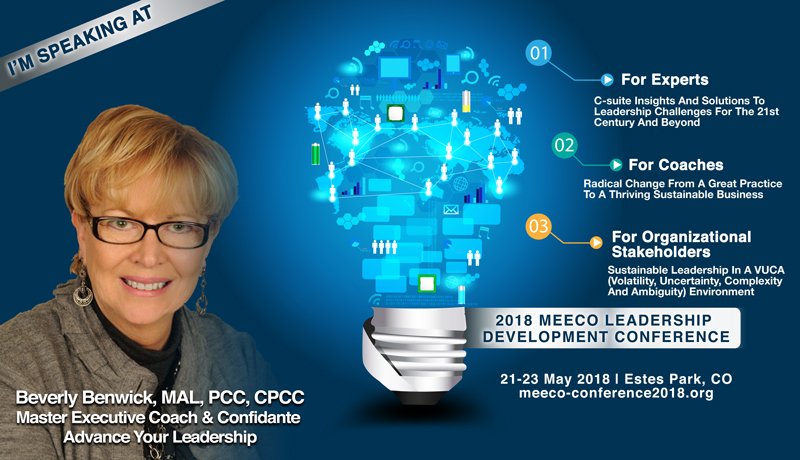
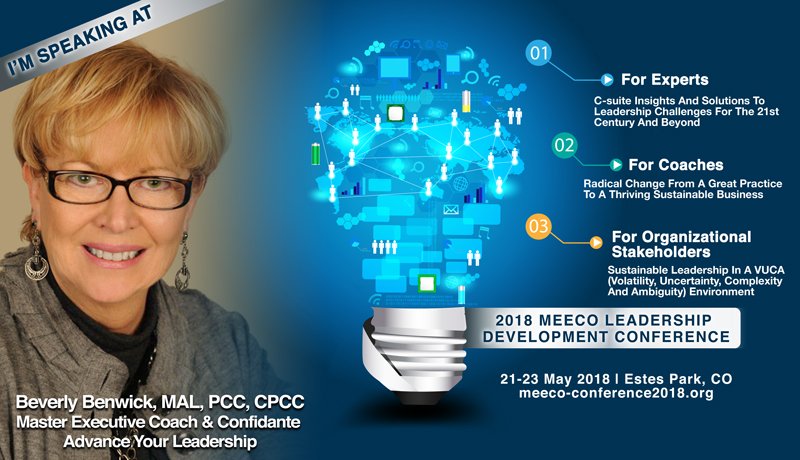
    AUTHOR: Beverly Benwick

    ABOUT BEVERLY: https://acec.mgmcsolutions.com/directory/bev-benwick-mal-pcc-cpcc/

    CONTACT INFORMATION:
    Ste. 30, 6488 – 168th Street
    Surrey, BC  V3S 8Z1 Canada

    TEL:  604.576.4970
    TOLL FREE: 1.866.95COACH or 1.866.952.6224
    E-MAIL: bev@advanceyourleadership.com
    WEBSITE: http://advanceyourleadership.com/
    LINKEDIN: www.linkedin.com/in/bevbenwick
    FACEBOOK: www.facebook.com/advanceyourleadership


  • The propensity to pursue executive coaching: …

    The propensity to pursue executive coaching: …

    The propensity to pursue executive coaching: variables of self-efficacy and transformational leadership  CEOWORLD Magazine

    www.ceoworld.biz

    Two dominate variables, which has been linked to successful, sustainable, and innovative businesses is transformational leadership and leadership self-efficacy.  However, nearly 60% of companies face leadership talent shortages (Crainer, 2011).  Leadership coaching is a strategy to address the deficit of effective leaders (Gregory, Beck, & Carr, 2011; Hannafey & Vitulano, 2013), and leaders who seek coaching indicate improved self-efficacy and  transformational leadership (Abrell, Rowold, Weibler, & Moenninghoff, 2011; Enescu & Popescue, 2012; Moen & Allgood, 2009; Mukherjee, 2012; Shanker, Bhanugopan, & Fish, 2012).  According to the research literature and theorists, leadership coaching provides a new path for learning and self-awareness to an individual’s growth and development (Kay, 2013; Moen & Federici, 2012).

    Unfortunately, a paucity of information exists about leaders who take responsibility for their own development, and McCall (2010) posited no substitutes exist for teaching evolving leaders how to take charge of their own advancement.  Therefore, the objective of this research study was to (a) enrich the substantive theory building and empirical research on self-efficacy and transformational leadership by (b) assessing the leaders’ self-efficacy and transformational leadership, and(c) to ascertain if a relationship exists between these variables and the propensity to pursue executive coaching.

    Theoretical Framework

    Coaching continues to grow faster than research and Gregory et al. recommended an integration of theory and practical application of organizing frameworks.  Control Theory (CT) posited humans take an active role or responsibility toward one’s behavior, where CT attempts to control the state of some variable, often the pursuit of accomplishing a task by controlling their behavior (Gregory et al., 2011).
    Literature Review

    Executive Coaching

    In a comprehensive literature review by Kampa-Kokesch and Anderson (2001), the history of executive coaching is noted as barely traceable and a hard date for the commencement of executive coaching does not appear to exist.  The word coach emerged in the 1500s into the English language to describe a particular horse drawn carriage.  The origin of the verbto coach refers to a highly regarded person getting from where he or she was to where they wanted to go (Witherspoon & White, 1996).  Over the centuries, the term moved through several avenues from sports coaching to academic coaching and to the evolution of executive coaching (Stern, 2004).

    Predominately, western societies implement executive coaching.  The United Kingdom reports 70% of companies  use coaching, where 44% of employees report using coaching (Sergers, Vloeberghs, Henderickx, & Inceoglu, 2011), and 93% of companies in the United States (Jowett, Kanakoglou, & Passmore, 2012).  The Coaching International Federation (CIF) reported an increase in membership from 1,500 in 1999 to 10,000 members in 2006 across 80 different countries (Jowett et al., 2012).  Van Genderen (2014) asserted executive coaching is the fastest growing profession for the development of corporate success.

    According to the CIF, coaching offers the definition as an ongoing professional relationship that helps people produce extraordinary results in their lives, careers, businesses, or organizations.  Through the process of coaching, clients deepen their learning, improve their performance, and enhance their quality of life. (Brown & Rusnak, 2010, p. 15)

    Self-Efficacy

    Bandura (1986), a social cognitive theorist, first introduced the concept of self-efficacy.  Social cognitive theory includes grounding in the conceptual understanding that human beings are vigorously committing to their development and actions (Bandura, 1986).  Bandura (1997) postulated self-efficacy refers to a judgment of one’s own ability to perform a specific task within a specific domain.  Thus, self-efficacy is the aspect of self, which refers to how sure (or how confident), the individual is that he or she can successfully perform requisite tasks in specific situations, given one’s unique, and specific capabilities. (p. 4)

    Transformational Leadership

    Transformational leadership is a leadership style, which incorporates relationships and the dynamic interplay between the followers and the leader of a group. Transformational leadership inspires followers to be the best they can be, to accomplish their goals, and values what followers need and want.  By focusing on the follower’s values and aligning those values with an organization’s value this outcome may further the mission of an organization (Givens, 2008).

    Research Design

    A quantitative study with a descriptive correlational design and linear regression analysis was used for this study with established self-efficacy and leadership instruments, which contain quantitative data to assess if a relationship exists between the variables.  Applying a correlational design approach suits the needs of this study because the purpose is to examine if significant relationships exist between three sets of identified variables.

    Population and Sample

    The target population for this research study was executives in leadership positions (CEOs, COOs, VPs, CFOs, and executive management), which was accessed through SurveyMonkey®’s database.  To avoid social and research exclusion, this study did not exclude gender or industry, but was limited to the United State.  The study used a purposive sampling of executives.  A standard email notification was used to notify respondents, that he or she had a new survey to take and the invite was a random group selected through an algorithm process. SurveyMonkey®’s solicited 186 responses with 110 of those responses being fully completed.

    Instrumentation / Measures

    The instruments used in this research study were selected because of their established reliability and validity measurements.  The new general self-efficacy scale (NGSES) and the multifactor leadership questionnaire (MLQ) are established instruments (Bass & Avolio, 1997; Chen, Gully, & Eden, 2001).  Participants received a survey, which incorporated the assessments NGSES and MLQ, to include a follow-up Likert-type scale question to ask how he or she  self-rated their self-efficacy and transformational leadership (low, neutral or high), and then how likely he or she was to  pursue executive coaching (Strongly disagree-Will not pursue executive coaching, Disagree – Might consider pursuing executive coaching within the next 3 months, Neutral, Agree, will definitely pursue executive coaching within the next 3 months, Strongly agree – will pursue executive coaching immediately).
    Data Analysis
    This quantitative correlational study used SigmaXL to run the descriptive statistics, correlations, and linear regression analysis.  Minitab software was utilized to run the Cronbach alpha scores for the reliability and normality testing to reduce the risk of Type I and Type II errors of the instruments for this research project.

    Results

    Demographics

    Male 56.76% self-reported as male (N = 63)
    Female: 43.24% respondents self-reported as female (N = 48)

    Ages:                                                   Position

    18-30 – 22.52% (N=25)                      CEOs – 47.7%  (N = 53)
    31-40 – 33.3% (N=37)                        COOs – 15.3% (N=17)
    41-50 -19.8% (N=22)                         VP – 7.2% (N=8)
    51-60 – 21.6%) (N=24)                       CFOs -7.2% (N=8)
    61-70 – 2.7% (N=3)                            Executive Management – 22.% (N=25)

    Number of Employees

    >100  –                         46.85% (N = 52)
    101 – 1,000 –               30.63% (N=34)
    1,001 – 10,000 –          19.82% (N=22)
    10,001<                       2.7% (N=3)

    RESULTS

    Research Question 1: Does a relationship exist between self-efficacy and transformational leadership?  The Pearson correlation is .691 with p <  0.000 therefore the null hypotheses was rejected and the alternative hypothesis was accepted demonstrating a significant relationship between transformational leadership and self-efficacy.  These findings support  Mesterova, Prochazka, and Vaculik (2014), which stated the two variables are positively paired, contribute to each other, and contribute significantly to effective leadership.

    Research Question 2: To what extent does self-efficacy predict the propensity to pursue coaching?

    The Pearson correlation is .167 with p <  0.08 therefore the null hypotheses must be retained and the alternative hypothesis rejected demonstrating no significant relationship  between self-efficacy  and the propensity to pursue executive coaching.
    This was a surprising result to this researcher.  A possible explanation for this finding is  the purposive sampling of just high-level executives and their self-efficacy was assessed.  The composite variable for actual self-efficacy was 4.5 (on a scale of 1-5) indicating a high-level of self-efficacy as self-reported by the respondents.  The non-significant relationship between self-efficacy and executive coaching may indicate high-level executives feel quite confident, secure in their abilities, and do not feel the need to pursue coaching to enhance or develop their already existing level of self-efficacy.  Additionally, the results of this research underpin Nease et al.’s (1999) research study where participants with robust self-efficacy would exhibit decreases in feedback acceptance.

    Research Question 3: To what extent does transformational leadership predict the propensity to pursue coaching? 

    The Pearson correlation is .362 with p <  0.0001, therefore the null hypotheses was rejected and the alternative hypothesis accepted demonstrating a positive relationship between transformational leadership and the propensity to pursue executive coaching.  The overall composite combined variable score for transformational leadership was high; therefore, transformational leaders may always feel a need to improve their abilities, promoting relationships, and enhancing their followers’ abilities despite their high scores.  Transformational leadership, in definition, is a continuous growth path and one actually never arrives at full transformational leadership.  Therefore, the results of this study support the characteristic domains of transformational leadership by demonstrating a desire to pursue executive coaching for continued growth.

    Research Question 4: What is the relationship between self-efficacy, transformational leadership, and the proclivity to pursue executive coaching? 

    A linear regression model was calculated to predict likeliness to pursue coaching based on transformational leadership and self-efficacy.  A significant regression equations was found (F = 11.8488, p < 0.000), with an R-square adjusted of 0.0905.  The alternative hypothesis was supported indicating a small, only 10%, but significant likelihood when combining transformational leadership and self-efficacy, that an individual will be inclined to pursue executive coaching.  Additionally, this result indicates transformational leadership may be a possible moderator on the variable self-efficacy, as self-efficacy as a standalone variable will not propel an individual to pursue executive coaching.

    Limitations, Assumptions, and Future Research

    A limitation to this current research study was the limitation of SurveyMonkey® to give the respondents in real-time their results of their assessed transformational leadership characteristics and scores of self-efficacy.  This known variable may or may not have a different correlational relationship on the propensity to pursue executive coaching.  Understanding the demographic variables of education, experience, or length in the executives’ current position may also help to elucidate the non-significant relationship between self-efficacy and executive coaching.  Additionally, the industry of executive coaching is an established international industry and this research study was isolated to the United States.  Replicating this same study in other geographic international locations may yield different results as well as for global companies or organizations in other countries.

    Conclusion

    First, to the industry of executive coaching when soliciting possible clients, transformational leadership is a construct, which leaders may be willing to explore, enhance, and continuously develop.  Additionally, combining the assessments of transformational leadership and self-efficacy may influence a leader to pursue executive coaching.  Furthermore, organizations, HR departments, and Board of Directors can administer the MLQ (5x) separately or combined with the NGSES and may see a willingness for the leader to pursue coaching to develop and enhance these skills on a deeper level.  Leaders do appear to want to take charge of their own development and will pursue executive coaching if given the opportunity to assess their transformational leadership and self-efficacy.
    REFERENCES
    Abrell, C., Rowold, J., Weibler, J., & Moenninghoff, M. (2011). Evaluation of a long
    term transformational leadership development program. Journal of Research Personnel, 25(3), 205-224. doi:10.1688/1862-0000
    Bandura, A. (1986). Social foundations of thought and action: A social cognitive theory. New Jersey, NY: Prentice Hall.
    Bandura, A. (1997). Self-efficacy: The exercise of control. New York: NY, Freeman.
    Brown, M., & Rusnak, C. (2010). The power of coaching. Public Manager, 39(4), 15-17.
    Coaching International Federation. (2012).  Retrieved from
    Crainer, S. (2011). Leadership special report. Business Strategy Review, 22(2), 17-22. doi:10.1111/j.1467-8616.2011.00745.x
    Enescu, C., & Popescu D. (2012). Executive coaching – instrument for implementing organizational change. Review of International Comparative Management, 13(3), 378-386.
    Givens, R. (2008). Transformational leadership: The impact on organizational and personal outcome. Emerging Leadership Journeys, 1(1), 4-24. Retrieved from http://www.regent.edu/acad/global/publications/elj/issue1/ELJ_V1Is1_Givens.pdf
    Gregory, J., Beck, J. W., & Carr, A. E. (2011). Goals, feedback, and self-regulation: Control theory as a natural framework for executive coaching. Consulting Psychology Journal: Practice & Research, 63(1), 26-38. doi:10.1037/a0023398
    Hannafey, F., & Vitulano, L. (2013). Ethics and executive coaching: An agency theory approach. Journal of Business Ethics, 115, 599-603. doi:10.1007/s10551-012-1442
    Jowett, S., Kanakoglou, K., & Passmore, J. (2012). The application of the 3+1Cs relationship model in executive coaching. Consulting Psychology Journal: Practice and Research, 64(3), 183-197. doi:10.1037/a0030316
    Kampa-Kokesch, S., & Anderson, M. Z. (2001). Executive coaching: A comprehensivereview of the literature. Consulting Psychology Journal: Practice and Research, 53(4), 205. doi:10.1037/1061-4087.53.4.205
    Kay, D. (2013). Language and behavior profile as a method to be used in a coaching
    process. Poznan University of Economics Review, 13(3), 107-129.
    McCall, M. W. (2010). Recasting leadership development. Industrial and OrganizationalPsychology, 3, 3-19. doi:10.1111/j.1754-9434.2009.01189.xMesterova, J., Prochazka, J., & Vaculik, M. (2014) Relationship between self-efficacy,transformational leadership and leader effectiveness. Journal of Advanced Management Science, 3(2), 109-122. doi:10.12720/joams.3.2.109-122
    Moen, F., & Allgood, E. (2009). Coaching and the effect on self-efficacy. Organization Development Journal, 27(4), 69-82.
    Moen, F., & Federici, R. A. (2012). Perceived leadership self-efficacy and coachcompetence: Assessing a coaching-based leadership self-efficacy scale. International Journal of Evidence Based Coaching & Mentoring, 10(2), 1-16. doi:10.5539/jel.v1n2p1
    Mukherjee, S. (2012). Does coaching transform coaches? A case study of internal coaching. International Journal of Evidence Based Coaching & Mentoring, 10(2), 76-87.
    Nease, A. A., Mudgett, B. O., & Quiñones, M. A. (1999). Relationships among feedback sign, self-efficacy, and acceptance of performance feedback. Journal of Applied Psychology, 84, 806-814. doi:10.1037/0021-9010.84.5.806
    Segers, J., Vloeberghs, D., Henderickx, E., & Inceoglu, I. (2011). Structuring andunderstanding the coaching industry: The coaching cube. Academy of Management Learning & Education, 10(2), 204-221. doi:10.5465/amle.2011.62798930
    Shanker, R., Bhanugopan, R., & Fish, A. (2012). Changing organizational climate for innovation through leadership: An exploratory review and research agenda. Review of Management Innovation & Creativity, 5(14), 105-118.
    Stern, L. R. (2004). Executive coaching: A working definition. Consulting Psychology Journal: Practice and Research, 56(3), 154-162. doi:10.1037/1065-9293.56.3.154
    Van Genderen, E. (2014). Strategic coaching’ and consulting: More similar than meetsthe eye. Middle East Journal of Business, 9(1), 3-8. doi:10.5742/mejb.2014.91368
    Witherspoon, R., & White, R. P. (1996). Executive coaching: A continuum of roles. Consulting Psychology Journal: Practice and Research, 48(2), 124-133. doi:10.1037/1061-4087.48.2.124
    ++++++
By Dr. Shauna Rossington, DBA, LMFT.
    0 Comments

    2 + 7 =
    RECOMMENDED ARTICLES

    Executive coaching is back in fashion Economic growth in the UK has led to a resurgence in businesses u