Let’s face it, we’ve become increasingly numb to the lead capture bait for email address exchange. In fact, I think it’s become so bad that while people still sign up for the free thing, they often don’t even bother to download, rarely if ever actually read it or watch it, and unfortunately, don’t represent the opportunity for marketers that they once did.
The bar for starting a relationship with a prospect has evolved, and the stakes are higher.
Today, we have to create awareness before a prospect understands they have a problem or certainly before they are seeking a transformation.
In my opinion, this is still done by offering the right content, in the right context, but with the right delivery mechanism.[tweetthis]To reach the greatest number of prospects in your market, the first contact can’t be an ask.[/tweetthis]
Creating awareness through targeted content
People still want to find answers to their challenges and will probably always seek information in many forms. Smart marketers are grouping and personalizing content by specific category or problem-solving advice and offering that content without strings in targeted advertising environments such as Facebook.
The content may be a short video or series of video, a group of blog posts or even a series of templates and checklists.
The key is that this is bite-sized, useful, easy to access and easy to consume. It’s the start of a relationship without commitment.
Building trust before the ask
So, how does totally free content create a lead? It does so by giving and giving and giving before asking anything. High-quality content without strings attached builds trust and authority – two of the primary objectives of all marketing today.
The key to making this work as lead generation tactic is something called remarketing or retargeting.
Now, you may be familiar with retargeting if you’ve ever reviewed a product you were researching online.
A few years ago I wanted to get standup desk and looked around at a variety of products before finally settling on one made by Varidesk.
I did my research one day and visited the manufacture’s site and sure enough everywhere else I went I started seeing ads for Varidesk.
In fact, even after I had purchased the desk from Amazon I continued to see the ads on many news type sites I visited.
This is retargeting not so much at its finest.
Or perhaps you downloaded a free report on a site and when you returned to get the next one in the series they already knew your name and email and automatically completed it in the form. This is another type of very useful retargeting in a way.
Essentially what retargeting involves is placing a cookie on a visitor’s browser that indicates they have come to your site. This cookie then allows ad networks to show certain ads when you visit one of their sites.
Many people dislike this technology, and you can manage it by changing your privacy settings to disable it. Of course, a lot of things you do like, such as a website you frequent remembering your settings is activated using this same approach.
One of the more effective ways to use retargeting in a gentle lead nurturing sense is by using Facebook’s retargeting tool.
You simply run sponsored ads at highly targeted, useful content or a series of content and let Facebook tell you who visits and consumes the content. Once this mechanism is in place, you can start building custom audiences of the people that visited your free content with the knowledge that they may indeed be interested in a more substantial version of the content in exchange for an email address or opt-in.
This approach, while requiring more patience, opens up a much larger potential audience and will likely make your list conversions triple or quadruple.
And, you might want to look for retargeting services outside of the Facebook walls, so take a look at PerfectAudience for a super easy approach or one of the pioneers of retargeting, AdRoll.
Hyper segmentation for relationship building
One of the beautiful things about this approach is that it not only allows you to nurture people who visit your website, but it also allows you to create segmented campaigns for people based on what they visited.
For example, I attract many small business owners who are interested in tips and tactics for growing their business, but I also serve a growing network of independent marketing consultants who are interested in ways to grow a more profitable practice and serve more customers.
Using a retargeting approach, I can create a highly personalized experience for these radically different audiences based on an understanding of the content they visited.
Now, understand that this approach is certainly not limited to Facebook – Facebook just offers a nice way to use it to build awareness and trust.
This is essentially the same technology that powers inbound marketing tools such as Hubspot or many CRM and marketing automation tools. It’s the same technology that powers many of the more sophisticated lead tracking tools such as ClickMagick or Kissmetrics.
The real lesson in this is that marketers today must understand that as brands big and small continue to take advantage of the technology to serve more personalized, useful and relevant experiences the more our prospects will come to hunger for and expect the same from any business they engage – whether they know it or not.
No matter how you plan to grow your business content has become the entry point and catalyst for effective growth in most every channel. No, content is no longer king – that’s so last decade, but more on that in a bit.
One of my core beliefs about growth is that it comes from doing less instead of more.
While that may sound a bit counterintuitive it springs from the fact that marketers today have something like sixteen channels to choose from in order to create awareness and ultimately grow their businesses. (I outline all channels in this Lead Generation System post)
Terms like social media marketing, influencer marketing, content marketing and search engine marketing entered the marketing conversation in the last decade.
While this may seem to present a golden opportunity for some businesses, it has created frustration for others. It is simply impossible to effectively create a meaningful presence everywhere and attempting to do so creates so much fragmentation that the message is often lost completely.
The key to succeeding in the current environment is to master two or three channels at the most and commit to going deeply there. In my experience, most businesses already have one or two channels that produce the bulk of their business, yet they do little to amplify that effort. (I’ve written more on this idea of Channel Leverage here)
For example, many businesses derive a significant percentage of their business through referrals and word of mouth recommendation but have no formal referral program in place.
My contention is that business should focus on building multiple referral programs and explore ways to use advertising, strategic partnering and even content to amplify their referral channel – less is more!
And now to the real point of this post (Sorry I had as one of my editors called it a lot throat clearing to do to get to the point.)
No matter what growth channels you decide to pursue, content is your ticket to entry. Now, before I go much further let me say that by content I mean, long, deep, dramatic, useful, dare I say epic, educational content.
Again, in this regard – less is more.
The days of writing 500-word wispy blog posts three times a week are over. They certainly served a purpose four or five years ago (hello SEO) but no longer.
Today you are better off writing one or two epic posts a month and using them as a tool to power every channel. (That’s good news, right?)
Your approach to content as an asset still needs to be based on an editorial calendar that serves your business, but creating that plan is even easier if you start to think about ways to use your content for multiple channels.
When we work with businesses today content development is the place we must start. There’s little hope in expanding the reach of a business without a substantial content asset to draw from. There are few channels that don’t run on content.
Let me give you an example of how this could play out.
Let’s say you commit to 12 epic blog posts per year – something in the 1500-2000 word range with lots of deep useful advice, some nice design elements, maybe a dash of data and even a bit of drama.
If you’ve done your keyword research and spent a little time using a tool like BuzzSumo to drill down into specific post ideas you have the makings of an annual editorial calendar. (Here’s a post on how I use BuzzSumo)
Now, let’s make this content pay.
In one sense you already have. Your post will most certainly help your SEO efforts the chosen topic and set the table for shares and links. (By far my most shared content is over 1,500 words)
Let’s say one of your posts describes the sixteen most awesome ways to do X. It’s long and it’s meaty and people devour it, but you know what would be cool – if you added a one-page checklist with all sixteen points.
Wow, people are actually opting-in at a pretty high rate, why don’t we see what happens if we buy some targeted Facebook ads to drive some cold traffic to the post. All of a sudden content is making our advertising pay off.
If all these new people are going to opt-in we should make sure that our email follow-up directs them to last month’s epic post so they begin to realize how glad they are that they know us.
Now, let’s amp things up a bit.
Our blog post on the sixteen most awesome ways to do X would actually make a nice presentation. We could simply promote it to our audience and hold a webinar, but why not reach out to some potential strategic partners and offer to do it free of charge for their audience instead.
This is a great way to extend the reach of your content, but more than that it’s a great way to get referred by a trusted source and potentially meet some very qualified prospects. The key to making channels pay is a commitment to producing the most useful content possible.
Content makes your advertising more effective
Content makes your selling efforts more effective
Content makes your referral outreach more effective
Content makes your SEO efforts more effective
Content makes your influencer outreach more effective
Content makes your email marketing efforts more effective
Content makes your social media efforts more effective
Content makes your PR efforts more effective
Much has been written about the need for great content, but I believe it’s more than king or queen, it’s more than a channel, it’s air – we need it survive. It is the catalyst and enabler for every other channel we use for growth.
This isn’t a call to write more, better content – it’s a suggestion that you must change your view of what content has become and what it must mean to your ability to grow.
Put epic content at the center of your marketing efforts – do less, but do better – and you’ll find that you have far greater opportunities to expand in every direction.
Five years ago on a summer day, we set
out to learn more about this thing called blogging. We made a little
survey, did a lot of outreach and eventually got 1000 bloggers to
respond.
You are now reading the 2019 Annual Blogging Survey. In it, you’ll
find a goldmine of blogging statistics, data and trends. Together, the
numbers tell the story of huge changes in blogging and content
marketing.
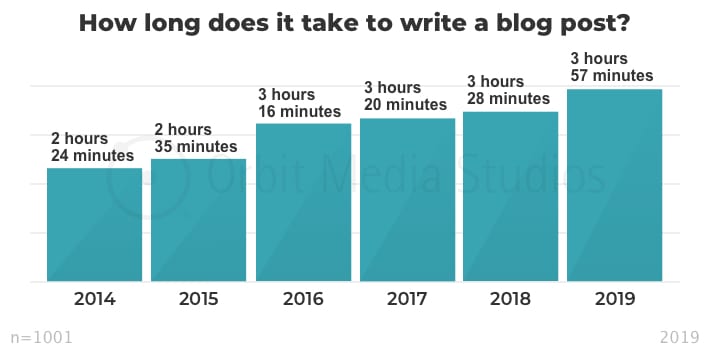
The average blog post takes 3 hours and 57 minutes to write …up 65% from 2014
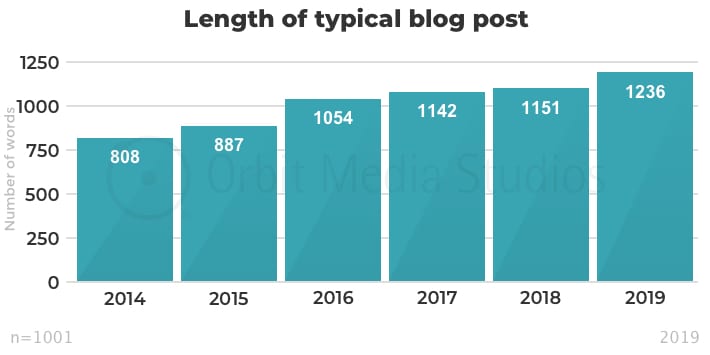
The average blog post is 1236 words long …56% longer than in 2014
52% of bloggers report that it’s getting harder to get readers to engage with their content
One of the final questions is about success, and we correlate that
answer with the other answers, we can see what’s working today. Here is
the summary, ordered by effectiveness. It shows not only shows which
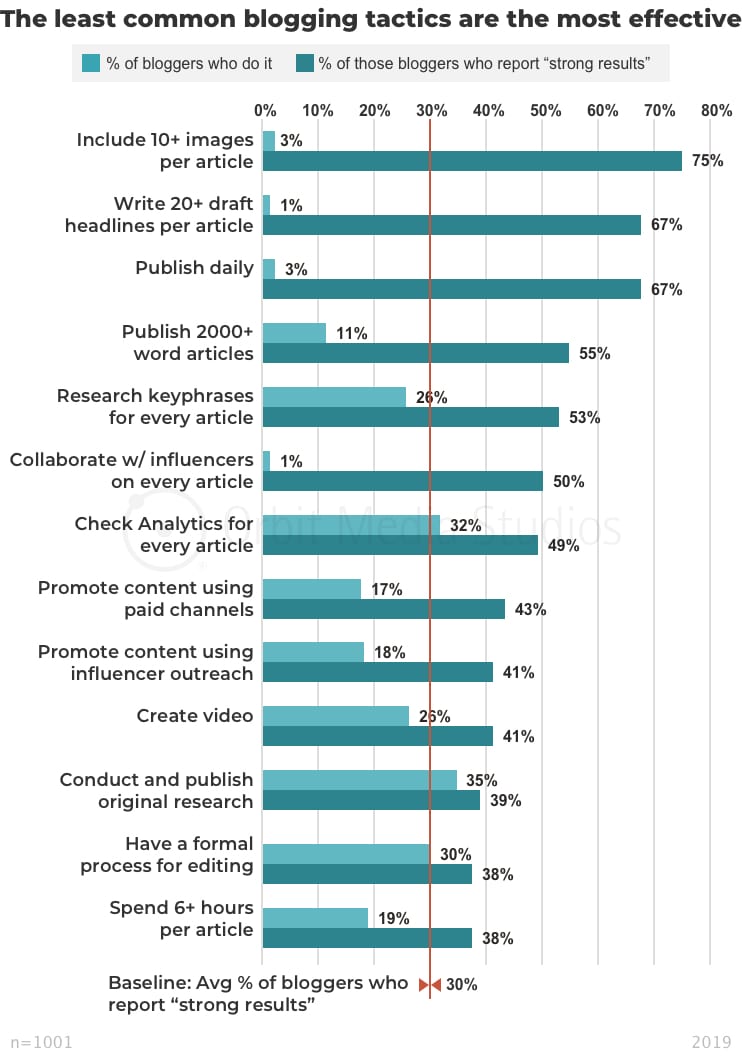
tactics are the most effective, but how few bloggers use them.
Note: “Strong results” data is self-reported and naturally
depends on the goals of each blogger. Because results such as traffic,
engagement and revenue vary widely across content programs, we did not
ask bloggers to provide Analytics or revenue data. You’ll find more info
about the methodology and data at the end of this report.
Here are the final statistics, analysis and input from blogging and content marketing experts.
1. How long does it take to write a blog post?
The average blog post takes 3 hours and 57 minutes to write.
The time invested in each article rises every year. This year the
average time spent per post jumped 30 minutes and is up 65% since 2014.
The data from 2014 to 2016 showed big drops in bloggers who spent two
hours or less per article. This year we see big jumps in the percentage
of bloggers who spend four hours or more.
Note: 30% of bloggers reported “strong results.” That’s the benchmark. We’ll discuss this in the final section.
2. How long is the typical blog post?
The average blog post is 1236 words long.
That’s 53% longer than six years ago. Articles keep getting longer,
as bloggers invest more time and effort in long-form, detailed articles.
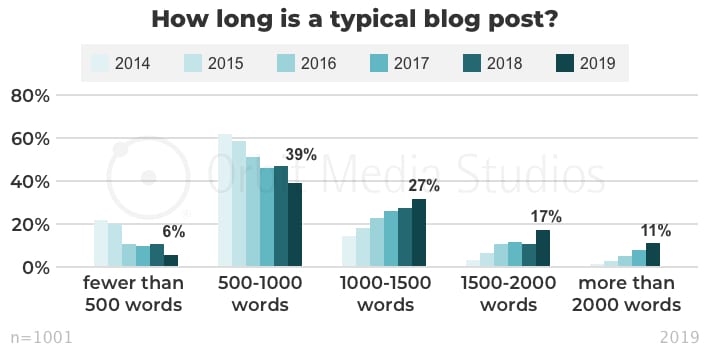
Look closer and we see the big jump is in the 1500-2000 word range.
It’s as if editors everywhere updated their guidelines for length from
1000 to 1500 words.
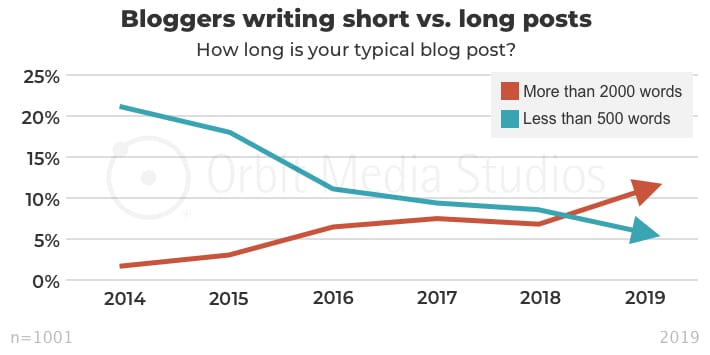
Compare the percentage of bloggers at the far ends of the spectrum. An approach that was once rare is now quite common.
Perhaps we’ve seen a tipping point in the awareness of the benefits
of big content. Lots of studies have found a correlation between
long-form content with higher rankings, greater social engagement and
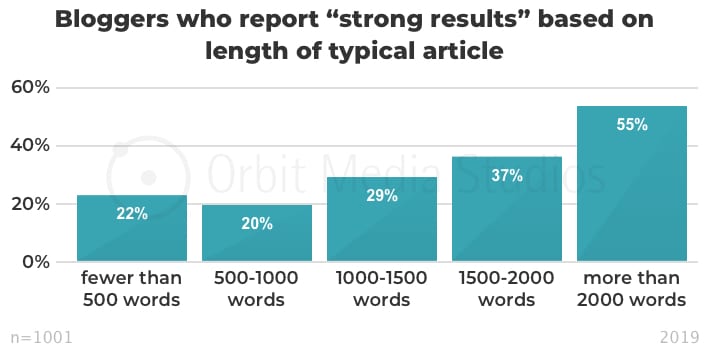
better results in general. Here’s one more: bloggers who write longer content are far more likely to report success. More than half of the bloggers who go big report “strong results” from blogging.
Joe Pulizzi, Founder, CONTENT MARKETING INSTITUTE“In looking through the data, it’s almost like going into the
past where longer, meatier articles were king, and each article took
hours of time. This gives me hope for the future of content consumption.
At least for blogging, snackable content is clearly dead. Audiences
expect more, and bloggers are giving them better researched more
advanced and well-thought-out content.”
Gill Andrews, COPYWRITER AND WEB CONSULTANT“I am surprised by how much the average blog post length has increased over time. It either means that more bloggers have finally realized that they need to try harder to get results or that the reader’s expectations increased drastically. If it’s the latter, I wonder if that means that at some point in the future, small businesses won’t be able to blog at all, because they won’t have the resources to produce the content an average online reader expects.”
Gini Dietrich, founder and author, SPINSUCKS“There are many days I complain about how I have six hours of meetings without time to pee or eat, let alone write or record a podcast. And then I read this survey that shows a significant number of bloggers now spend six hours writing one blog post. Six hours! ONE blog post. This means that kind of time, research, and collaboration results in cold, hard cash. So pack your desk drawer with protein-packed snacks and get to work!”
3. How frequently do bloggers publish?
About half of bloggers publish weekly or several times per month.
Has the increase in time and length affected how often bloggers hit
the publish button? Yes. There has been a steady decline in the “several
per week” category since 2014.
Around half of all bloggers publish 2-4 posts per month. That’s holding steady, but notice the jump in daily blogging.
Is there a relationship between publishing frequency and results? Yes. Bloggers who write more (either in length or in frequency) are more likely to report strong results.
But there seems to be a point of diminishing returns with frequency.
Bloggers who publish daily are more likely to report strong results than
bloggers who publish several times per day.
4. What content formats are bloggers using?
We’ve seen the size. Now let’s look at the shape of the content.
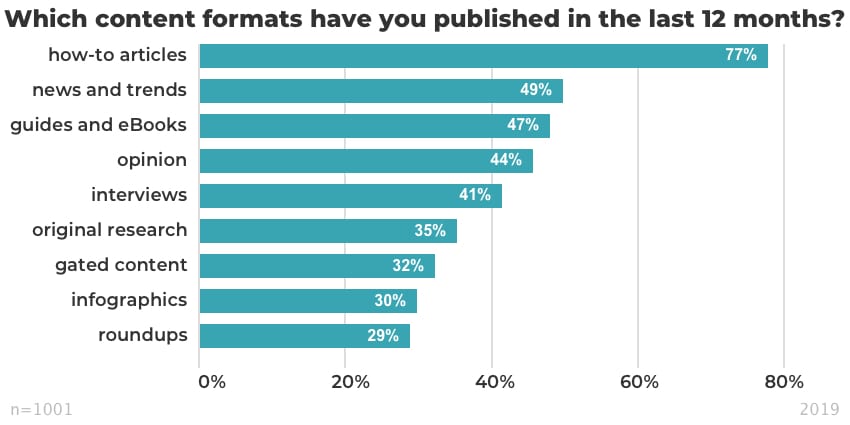
Practical, how-to content is dominant in content strategies.
About half of bloggers publish news. About half publish opinion.
Just one-third of bloggers use collaborative formats: round ups and interviews.
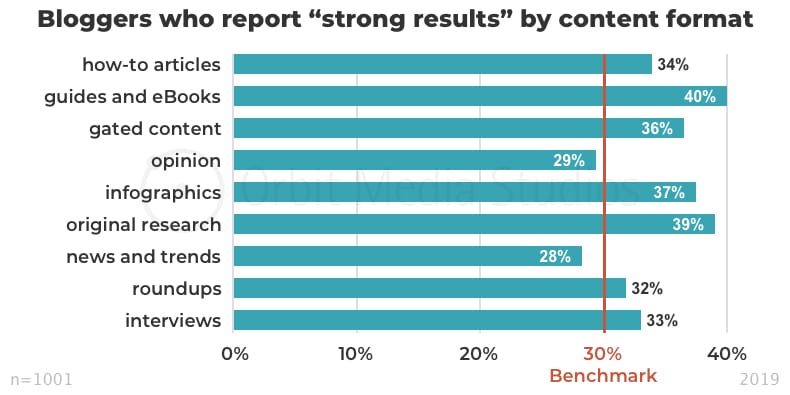
Here is the correlation between content formats and blogging
performance. This reinforces the previous findings about the value of
in-depth, visual and collaborative content.
Most likely to succeed: Bloggers who create long-form guides, ebooks and original research
Least likely to succeed: Bloggers who publish news and opinion
Mega-Trend: Research on the rise
Last year, 25% of bloggers added original research to their mix. Now
we see a big jump up in that number. More bloggers are conducting and
publishing original research as the word gets out about its
effectiveness.
35% of bloggers conduct and publish original research
85% of bloggers who publish original research report some/strong results from blogging (39% of them report strong results)
To gate or not to gate
This year we asked if bloggers are putting content behind lead gen
forms, requiring readers to give their email address prior to getting
access. About one-third of bloggers do this, even though almost half of
bloggers publish guides and ebooks.
32% of bloggers gate content
88% of bloggers who gate content report some/strong results from blogging (35% of them report strong results)
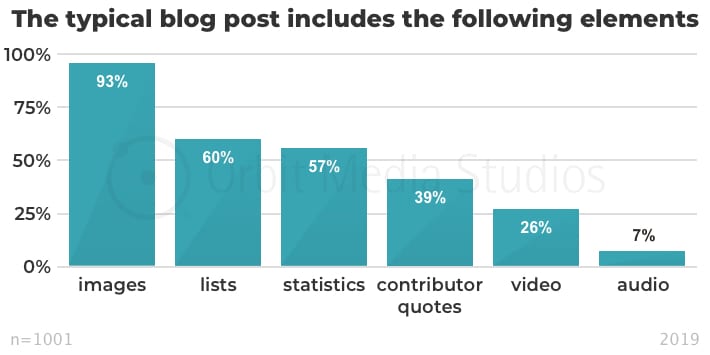
5. What does the typical blog post include?
Now let’s look at the features of specific articles, including
images, video, statistics and contributor quotes. These statistics show
how visual, scannable and collaborative blog posts are in general.
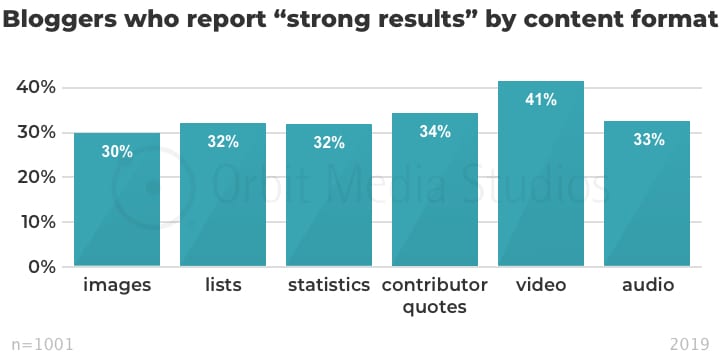
When we check the correlation data, you can see which specific elements correlate with success when included in blog content.
You can see that video makes the biggest difference. We’ve seen the correlation between video and success grow year after year.
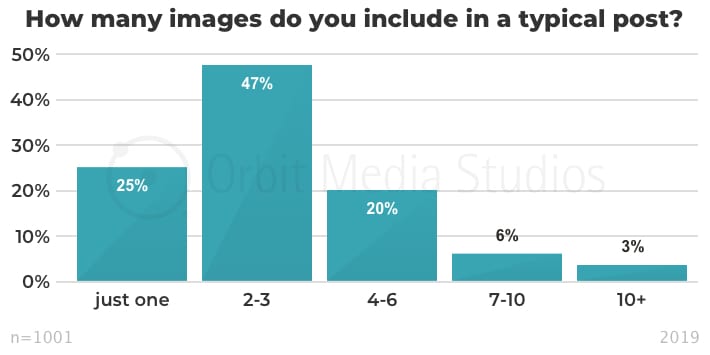
Just how visual is blog content?
Most bloggers add a few images to their content. But fewer than 10%
of bloggers are producing very visual content with 7+ images per
article. Does that sound high? The average article here on the Orbit
Media blog includes 14 images, not including the author’s picture.
There is a clear correlation between highly visual content and
success. The more images a blogger adds to a typical article, the more
likely they are to win at the content game.
Just 3% of bloggers add 10+ images per article, but they are 2.5x
more likely to report “strong results” than the average blogger.
This along with the trends in video shows the importance of visuals.
It shows just how visual blogging has become. Is blogging more about
images or words? Are blogs post written or designed? It seems the more
visual the content strategy, the more likely it is to succeed.
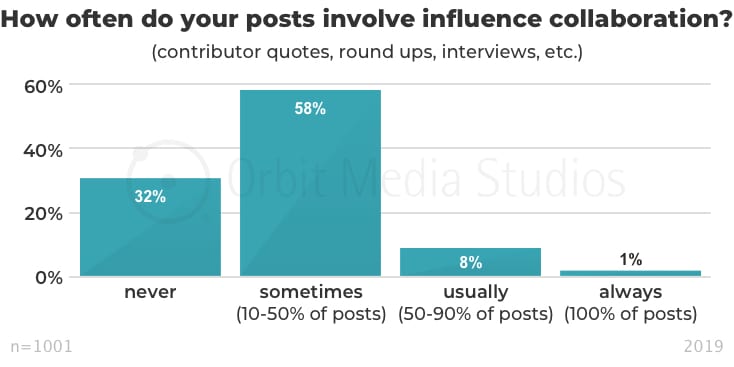
Just how collaborative is blog content?
Seeing the big trends of influencer marketing inspired us to ask
about the popularity of collaborative content, which we define as
content that includes contributor quotes, roundups or interviews. The
response indeed shows that most bloggers do collaborate.
32% of bloggers never collaborate
1% of bloggers always collaborate
Is there a correlation between collaboration and success? Yes. The
more often bloggers collaborate with influencers, the more likely they
are to report “strong results.”
Here at Orbit, as a rule, each article we write includes a
contributor quote from at least one expert. Just as a journalist
wouldn’t publish an article without a source, we would never publish an
article without an expert POV.
6. How many draft headlines are bloggers writing?
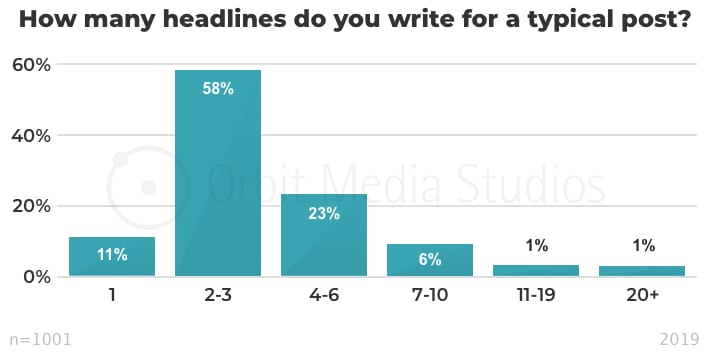
The average blogger writes four headlines before selecting one.
Everyone sweats over headlines, or so we assume. As an all-important
element for blog posts, it’s worth the extra attention. After hearing
that some content teams consider 20+ headlines before selecting one, we
decided to pose the question.
We see that most bloggers write a couple of headlines before choosing
one and a tiny percentage are writing more than ten. Fewer than 1% of
bloggers write 20+ draft headlines per article.
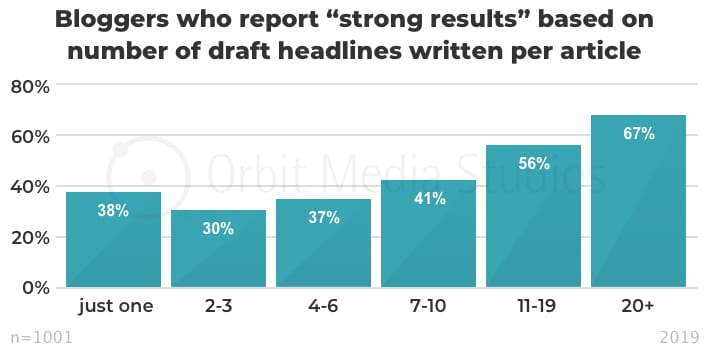
Yet bloggers who consider more headlines are far more likely to
report success. Very few bloggers are doing the thing that correlates
with results.
Ann Handley, Cheif content officer, MARKETING PROFS“We all recognize the value of a great headline. Well done, us! Now let’s spend as much time thinking about the first line of a piece. PRO TIP: Write as many first lines as you do headlines. Why? Because the headline makes a reader click. And the first line makes them actually read the piece.”
7. Are bloggers working with editors?
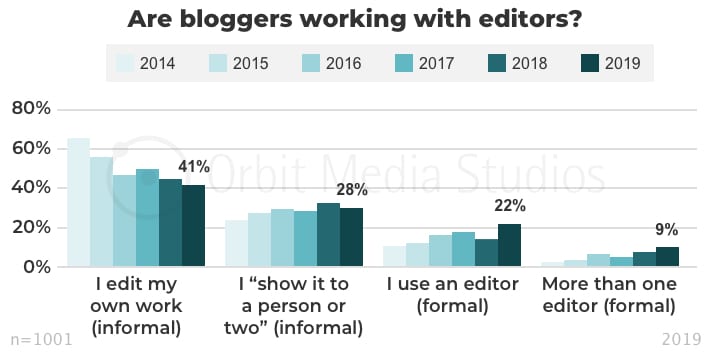
30% of bloggers have a formal process for editing.
For our final question about process, we ask about working with
editors. Most bloggers edit their own work or get “a second set of eyes”
on their content before publishing. Only 30% have a formal process for
editing. That’s way up from five years ago when just 1 in 10 bloggers
had a formal process.
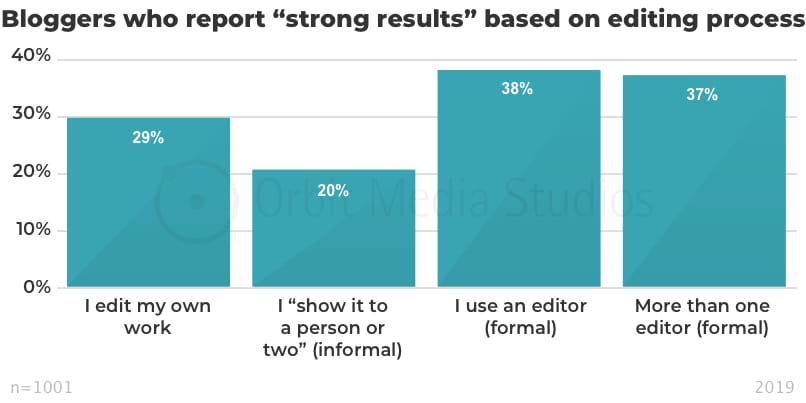
Bloggers with a formal editing process were about 50% more likely to
report strong results. Working with multiple editors doesn’t seem to
make strong outcomes more likely. And bloggers who edit their own seem
to be doing pretty well.
Another tip from Ann: “Behind every decent writer is a fantastic
editor! If you want to be a better writer… get yourself a great editor
to work with you.”
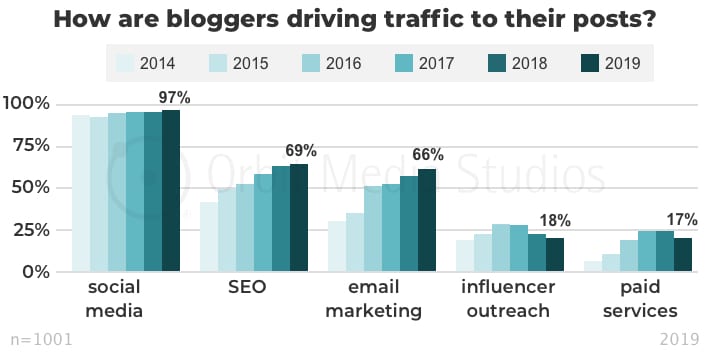
8. How is your content typically promoted?
Social media, of course. But just one in five bloggers uses influencer outreach and paid promotion.
Obviously, the fast, easy and cheap promotion channel is the most
popular. Virtually all bloggers share their content on social media.
Two-thirds use search and email, both of which have become much more
popular over the last five years.
The percentage of bloggers using email marketing has increased 2x since 2014
The percentage of bloggers using paid promotion has increased 3x since 2014
1 in 5 bloggers leverages influencers to help drive traffic (that’s down from two years ago)
1 in 5 bloggers buys traffic (that’s leveled off after a dramatic rise)
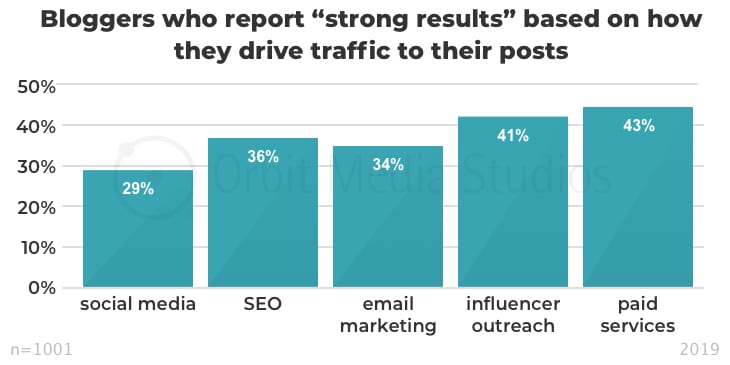
Let’s see what’s working. The less popular promotion channels are
more strongly correlated with success. This may be because they are more
difficult (or expensive) and this is another example of hard work
paying off.
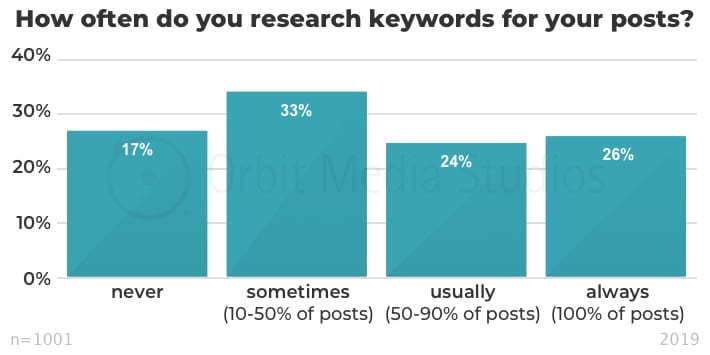
9. How often do bloggers research keywords?
Half of bloggers research keywords for the majority of their content.
As SEO has grown in popularity and importance, keyword research as a skill and practice has become more common. Most bloggers do it sometimes. Half of all bloggers do it most of the time.
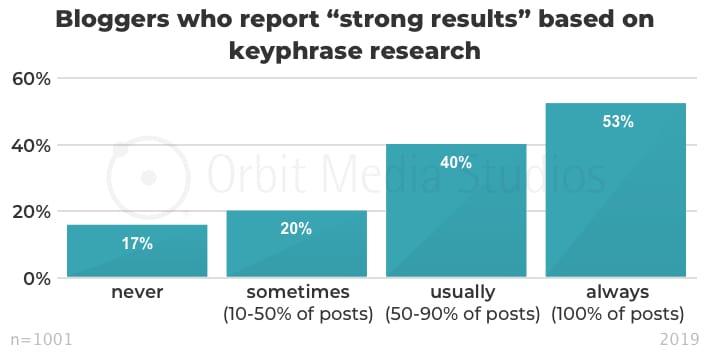
It’s work that pays off. The more the blogger researches keywords,
the more likely they are to report success. Bloggers who are also SEOs
report “strong results” at much higher than average rates.
10. Are bloggers using analytics?
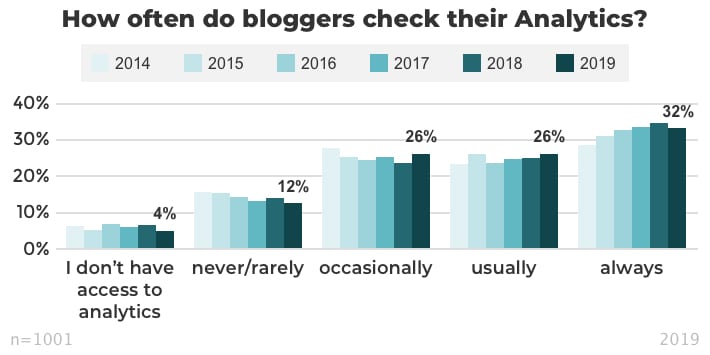
Half of bloggers usually check the analytics for a post. The other half check occasionally, rarely or never.
The trend here is mostly flat. Use of Analytics has remained steady
for years. But it remains one of the big indicators of blogging
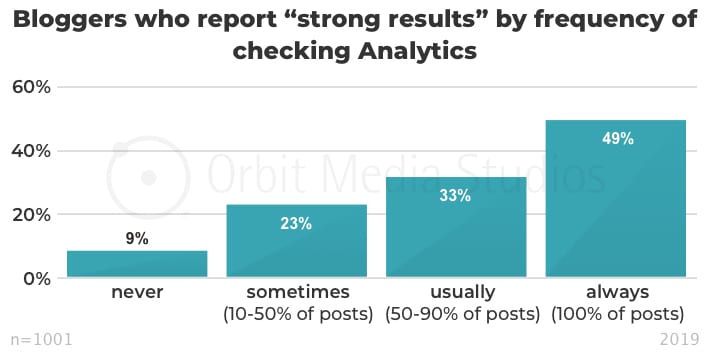
performance. Bloggers who measure the performance of every post are far
more likely to report “strong results” than the average blogger.
If they aren’t using analytics, you have to wonder how they even know if they’re getting results.
Jay Baer, luminary, CONVINCE AND CONVERT“What’s most interesting to me is the combination of expanded blog post length and corresponding time spent per post with the decline in attention paid to Analytics and keyword research. It’s remarkable to me that bloggers would spend nearly 4 hours to craft an 1800 word post, yet only 57% of them check their analytics with any degree of frequency and only about 50% of the time are they actually thinking about keywords when writing that post. If I was going to spend four hours on something, I would want to make sure that I had a measurement and success schema identified before I wrote the first of those 1800 words.”
11. Is it part of your strategy to update older blog posts?
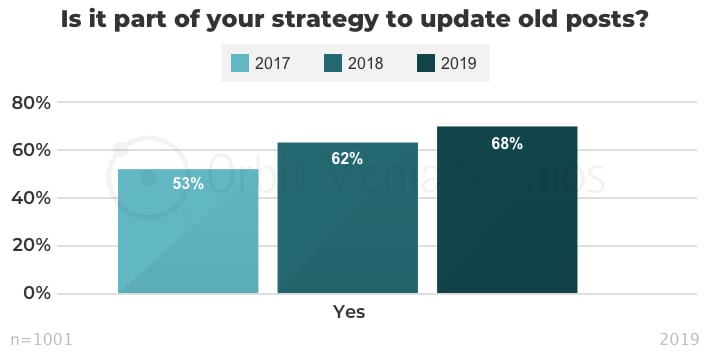
Two-thirds of bloggers update previously published blog posts.
An obvious trend has emerged since we started asking this question a
few years ago. Nearly 70% of bloggers now report going back to older
content and making updates.
ian cleary, founder, RAZOR SOCIAL“Updating old content is an essential part of any online strategy
so it’s good to see that this year the percentage of people updating
old content. It’s great for SEO, especially when combined with keyword
research, adding more media and careful internal linking.”
Ian’s right. Updating old content appears to be an SEO tactic.
Bloggers who research keywords are 3x more likely to update old posts.
It’s a powerful way
to improve rankings and search traffic quickly. Also, bloggers who
publish news and original research are more likely to update old posts.
Makes sense.
This is another of those tactics that have a very strong correlation
with success. Bloggers who update old posts are 2x more likely to report
success.
35% of bloggers who update old content report “strong results”
16% of bloggers who do not update old content report “strong results”
12. Are bloggers getting results from their content?
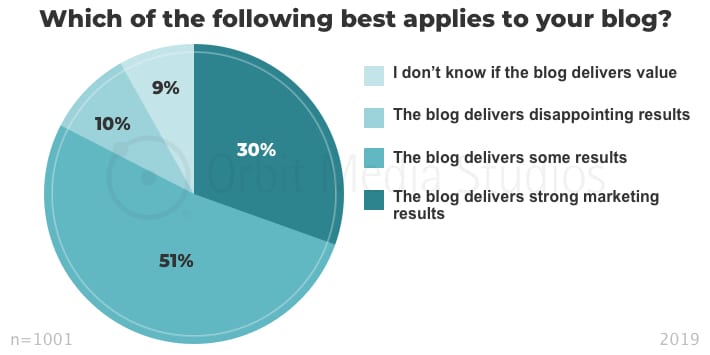
Most bloggers are getting results, but just 30% are getting strong results.
We’ve seen this correlated with other statistics throughout the
survey. Now here’s the raw data on success. Naturally, the definition of
success varies as bloggers have a wide range of goals, from rankings to
revenue, likes to leads.
If you put 10 bloggers in a room…
5 would report getting some results
3 would report strong results
1 would report disappointing results
1 wouldn’t even know if they’re getting results
Is there a trend here? No. These numbers have changed very little over the last four years.
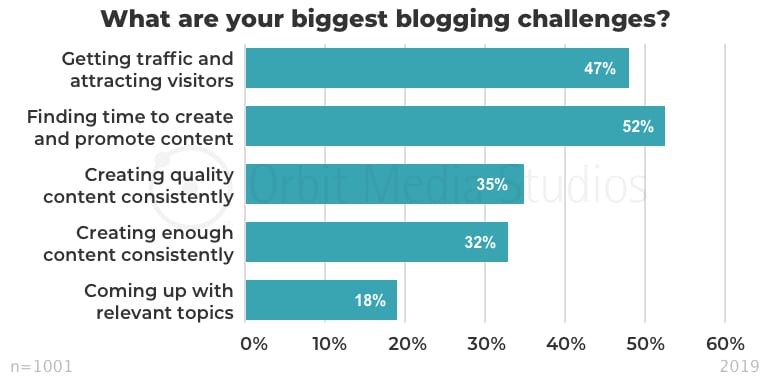
Bonus: What are the biggest blogging challenges?
This year we added a few questions about the challenges. What is the
hardest thing about blogging. The most common answer is personal: finding time.
We included an “other” category and gave respondents the opportunity
to add their own answers. The most common responses were related
specifically to business blogging: getting internal buy-in and
measurement/attribution.
The challenges are timeless, but when we ask bloggers what’s getting harder now, we see where the headwinds are coming from.
Henneke Duistermaat, ENCHANTING MARKETING“If reader engagement feels like your biggest challenge, it’s worth asking yourself whether your content strategy needs fine-tuning. Do you have a clear idea who your ideal reader is and how you can help them solve their problems, answer their questions and achieve their aims? Is the traffic to your site relevant? Are you writing to engage your reader or to impress Google? How human is your writing?”
Robert Rose, founder, THE CONTENT ADVISORY“It’s no surprise, but it’s very refreshing to see the quantity and quality challenge expressed in such contrast. Time spent on each post is up. Length and exploration of depth is up. And the biggest mentioned challenge to not only attract attention but hold it. A loud noise gets your attention – but it’s what kind of noise you’re making that determines whether people stay and listen.”
Bloggers are struggling with search and social more than email
marketing. This is probably because search and social are dominated by
digital monopolies, which control user experience. Google and Facebook
have reduced clickthrough rates to websites in order to keep visitors on
their platforms. But email isn’t owned by anyone. There’s no
intermediary between the blogger and their audience. Bloggers are
reporting an easier time.
Most bloggers (54%) are finding it harder to keep visitors engaged
with content. It’s a constant struggle. The signals that indicate that a
reader is connecting with the post aren’t looking good.
Two key takeaways
There are a few big themes here. There seem to be two main factors
that are the strongest indicators of success: depth and consistency.
Deep Content
Bloggers who do more are getting better results. These are the bloggers most likely to report success:
Bloggers who write 2000+ words
Bloggers who include 10+ images per post
Bloggers who consider 20+ headlines
Consistent Performance
Bloggers who are more consistent are getting better results. These are the bloggers most likely to report success:
Bloggers who always research keywords report strong results
Bloggers who always collaborate on content report strong results
Bloggers who always check Analytics report strong results
These tactics are so effective because bloggers are using them every time.
Methodology and Data
The respondents to this survey are self-described bloggers that we
connected with over many years on social media and at live events. The
data set is heavily populated with my network, which skews toward
LinkedIn users, B2B marketers and people in the US. Responses were
gathered from July through September 2019.
No one was incentivized to take the survey. This is a survey of
bloggers (individuals), not companies or brands (groups). Here are the
three ways we gathered responses along with our estimates for their
contribution:
Email to past respondents (30% of responses)
Social media and shares by influencers (30% of responses)
Individual outreach through messages and email (40% of responses)