Tag: Executive Coaches

  • The Habits of Highly Successful People

    Forget “The 7 Habits of Highly Effective People.” These days, gurus across the internet claim dozens of routines will put you on the path to fulfillment. In one camp, there are the evangelists of wholesome habits: Get up early, make your bed, and exercise, and you’ll inevitably encounter success. Then you have the mindfulness contingent, who says daily meditation will deliver clarity to even the most frazzled capitalists. Other habit-based programs take consistency to the extreme, suggesting eating and wearing the same things each day. If you’re skeptical of these well-intentioned suggestions, don’t kick yourself for your cynicism. It’s hard to know if any of these habits truly work for you––or anyone. That’s why we experimented on our own, surveying over 1,000 people on how successful they feel in several major life areas. We then asked them about their habits to gain a statistical view of the practices that correlate most closely with fulfillment. If you’ve wondered which habits allow other people to achieve their purpose and prosperity, you won’t want to miss our results. Read on to see how successful people consistently spend the one resource they can’t replenish: their time.

    Defining success, by demographic
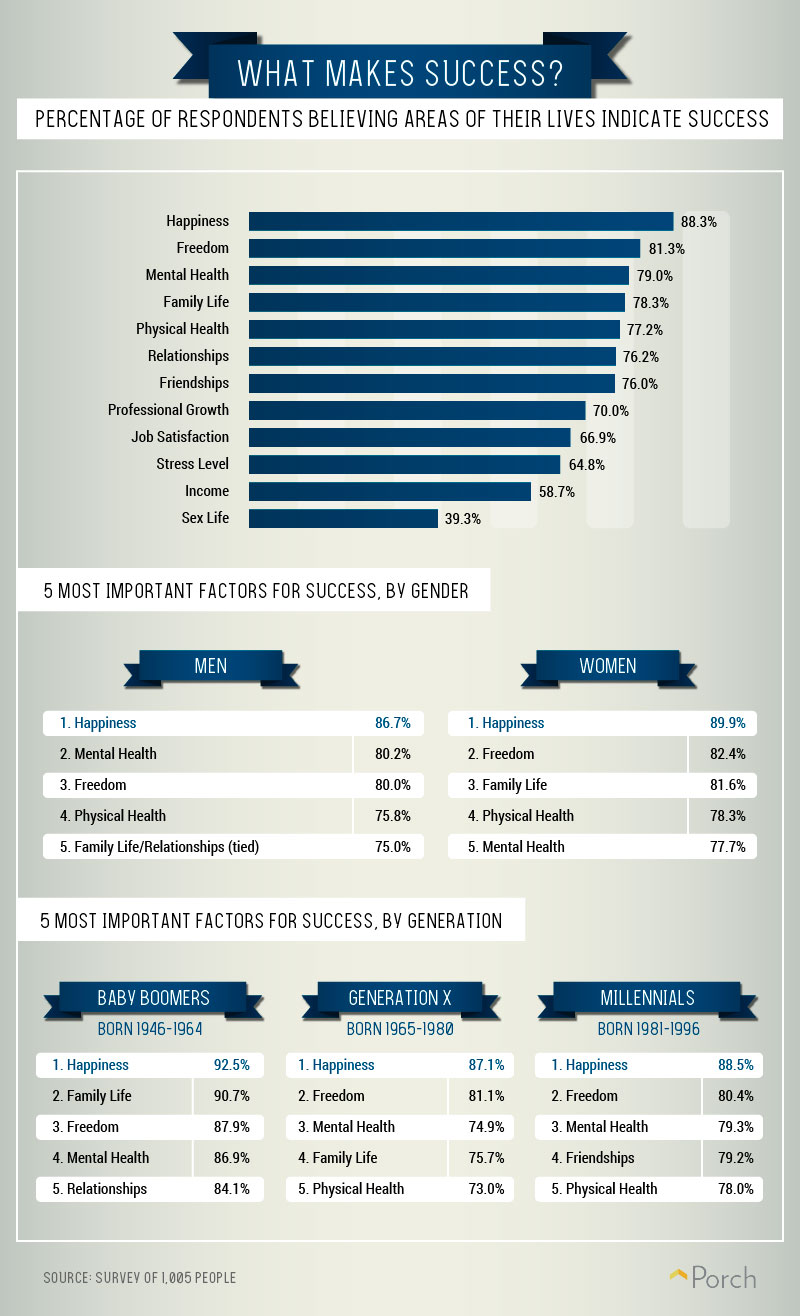
    Defining success, by demographicBefore we explore any particular habits, it’s helpful to learn how people define success more specifically. After all, it’s something of an abstract concept, although most participants agreed on its major components: More than 80 percent identified happiness and freedom as essential parts of success. Fulfilling family life and good physical and mental health were also popular selections. Interestingly, a smaller percentage said success could be defined regarding professional growth, one’s job, or one’s income. Even fewer said a great sex life was an integral part of succeeding, with less than 40 percent of respondents saying this kind of passion was a part of their vision for fulfillment. Some compelling differences cropped up among men and women, however. Women were slightly more likely to emphasize freedom, family life, and physical health. Conversely, men were more likely to associate success with mental health instead. Generational contrasts included a drop off in focus on family life with each successive generation. Over 90 percent of baby boomers said family was essential to success, whereas only 75.7 percent of Gen Xers said the same. Among millennials, family life didn’t even crack the top five success characteristics.

    Calling ourselves a success
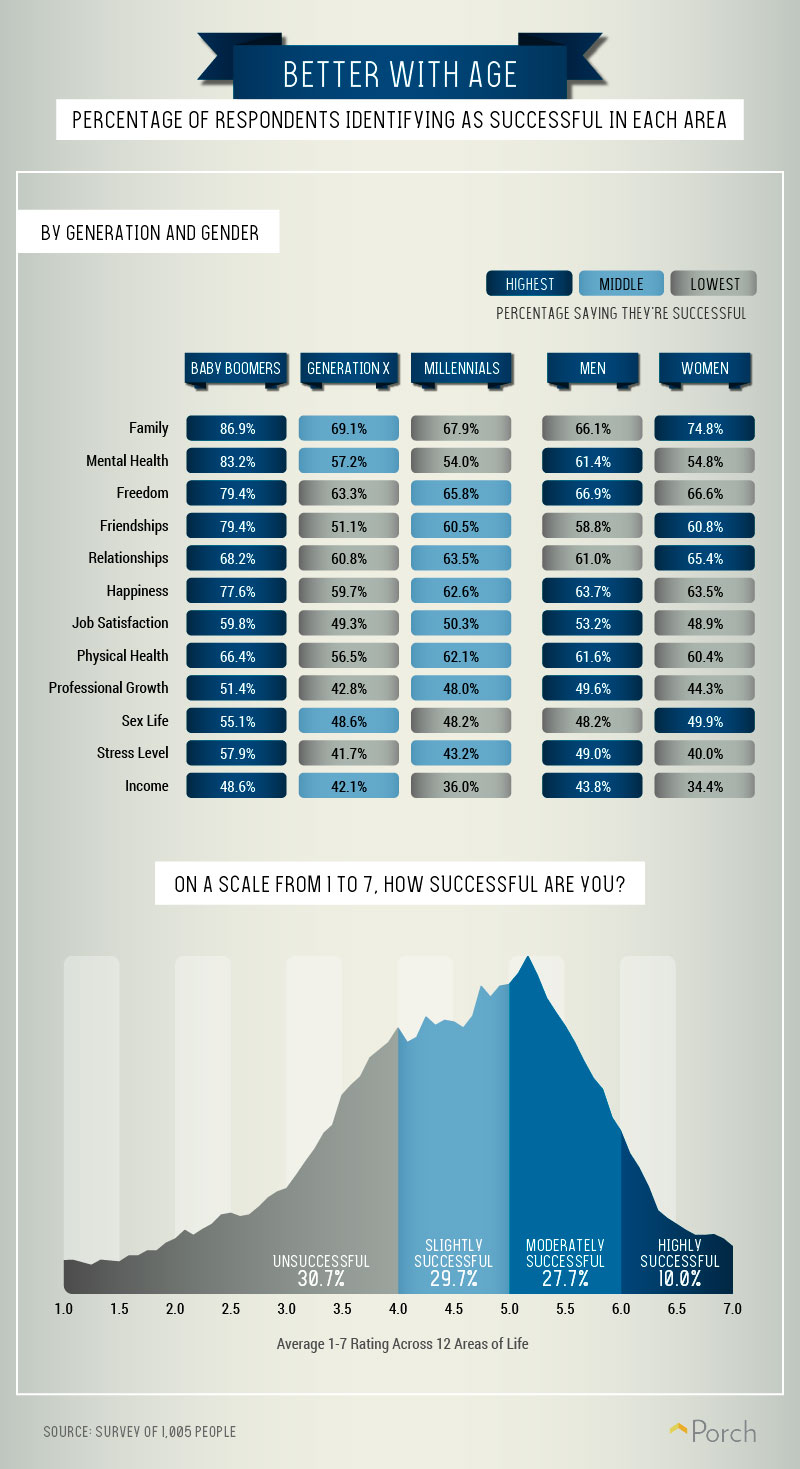
    Calling ourselves a successIn every life area we designated, baby boomers were most likely to claim success. Call them boastful, but bear in mind they’ve had more time to succeed––and appraise their experiences with more gratitude in retrospect. In many ways, younger generations were dramatically behind in self-reported success, such as in the realms of family, friendships, and mental health. Interestingly, however, millennials were more likely to call themselves successful than Gen Xers in most categories. Perhaps these findings reveal Gen Xers in the throes of a midlife crisis or the hubris of youth among the millennial crowd. Contrasts among men and women yielded interesting insights as well, with female respondents more likely to feel successful in their family lives, friendships, and relationships. Meanwhile, men had the distinct upper hand concerning mental health and stress level. In what could be interpreted as a grim indication of workplace inequalities, men were also more likely to feel successful regarding their professional growth, jobs, and incomes. Given the lingering pay gap in America, there may be good reason nearly two-thirds of women feel thwarted on the subject of earnings. Overall, however, roughly three times as many people called themselves “unsuccessful” versus “highly successful.” That statistic may speak volumes about human nature and self-esteem, but we have a more pressing question to consider: What do these folks who feel highly successful do differently?

    Habits successful people share
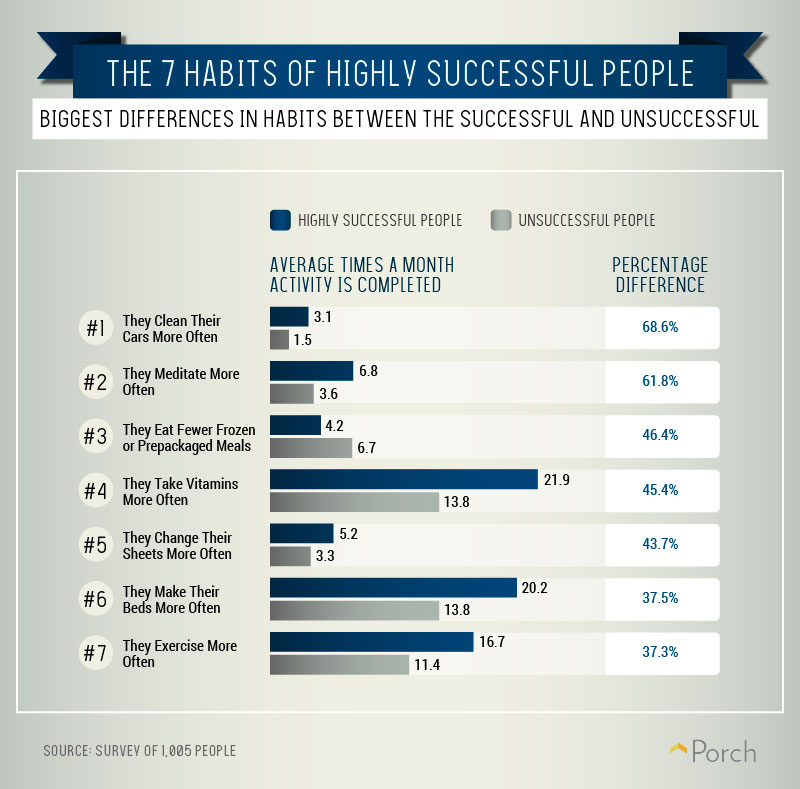
    Habits successful people shareWhen we considered which habits highly successful people practice to a much greater extent than unsuccessful individuals, two major themes emerged: cleanliness and healthy choices. In the category of tidy practices, we found highly successful people cleaning their cars, changing their sheets, and making their beds far more often. Some suggest completing these tasks can help us feel accomplished and in control, so we face the rest of our days with some momentum. The same could perhaps be said for healthy habits that highly successful cohort tended to practice, including exercise, taking vitamins, and resisting frozen or prepackaged meals. In addition to these habits, meditation was a common denominator among folks who felt highly successful, and notably absent from the routines of those who felt unsuccessful as well. In fact, meditation was the habit around which successful and unsuccessful people differed most in several key life categories: friendships, jobs, mental health, professional growth, and stress. Given these potential payoffs, it’s no wonder many companies are encouraging their employees to adopt meditation practices in the workplace.

    Sanitize for success?
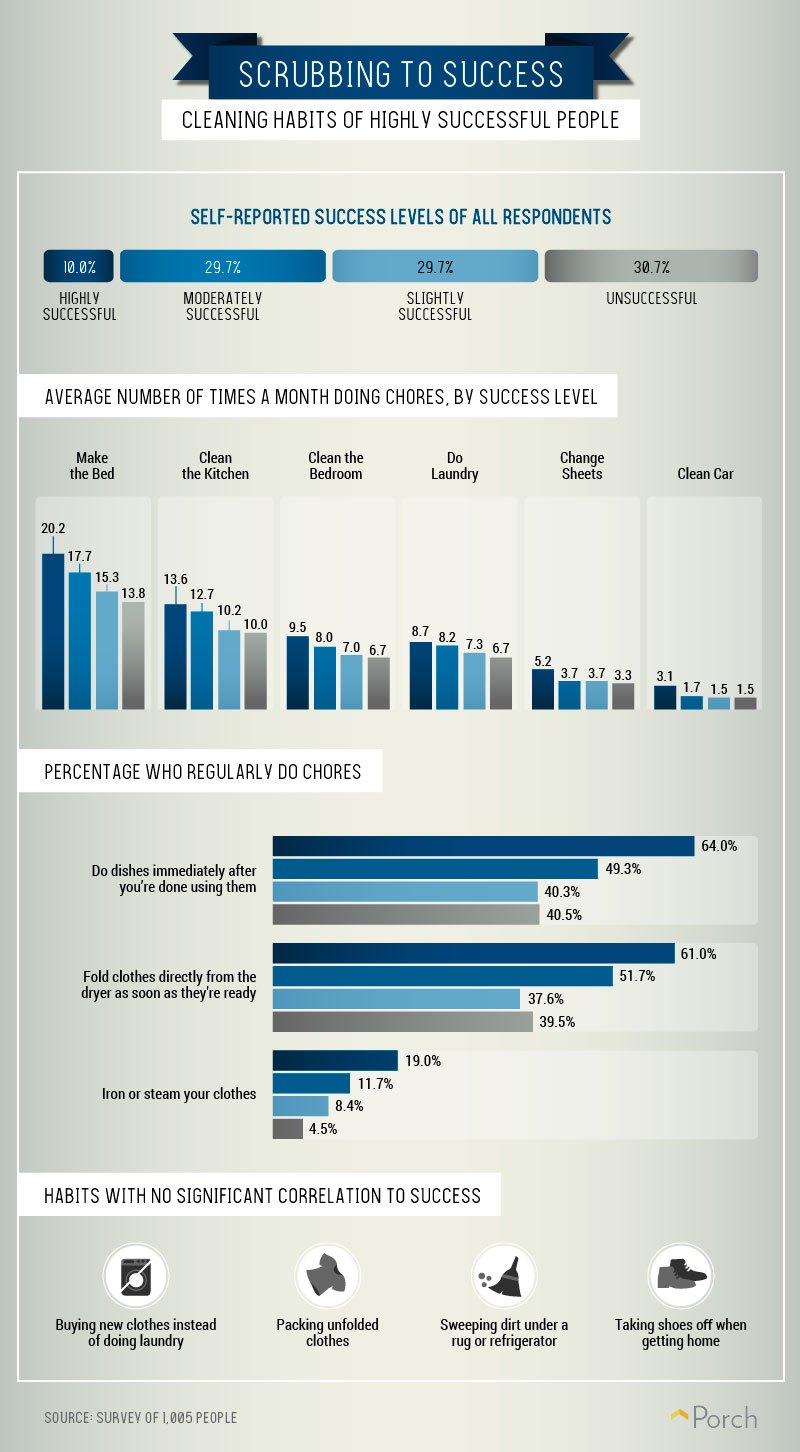
    Sanitize for success?Let’s take a closer look at how cleanliness might correlate with success, comparing the frequency with which different groups tackle household chores. In every specific cleaning activity studied, those who felt the highest degree of success tidied up most often. This positive correlation continued at every level of self-professed success: Those who felt moderately successful cleaned up more often than those who felt only slightly successful, who did so more frequently than unsuccessful respondents. Sometimes, the immediacy of cleaning seemed relevant as well. Nearly two-thirds of highly successful people did the dishes right after they were done using them. Similarly, 61 percent of highly successful people folded clean laundry as soon as the dryer was finished. Then again, some orderly habits did not correlate with success according to our data. Packing unfolded clothes in one’s suitcase or sweeping dirt out of sight rather than into the trash didn’t seem to hurt anyone in the long run, nor did buying new clothes instead of doing laundry.

    Maintaining the body and mind
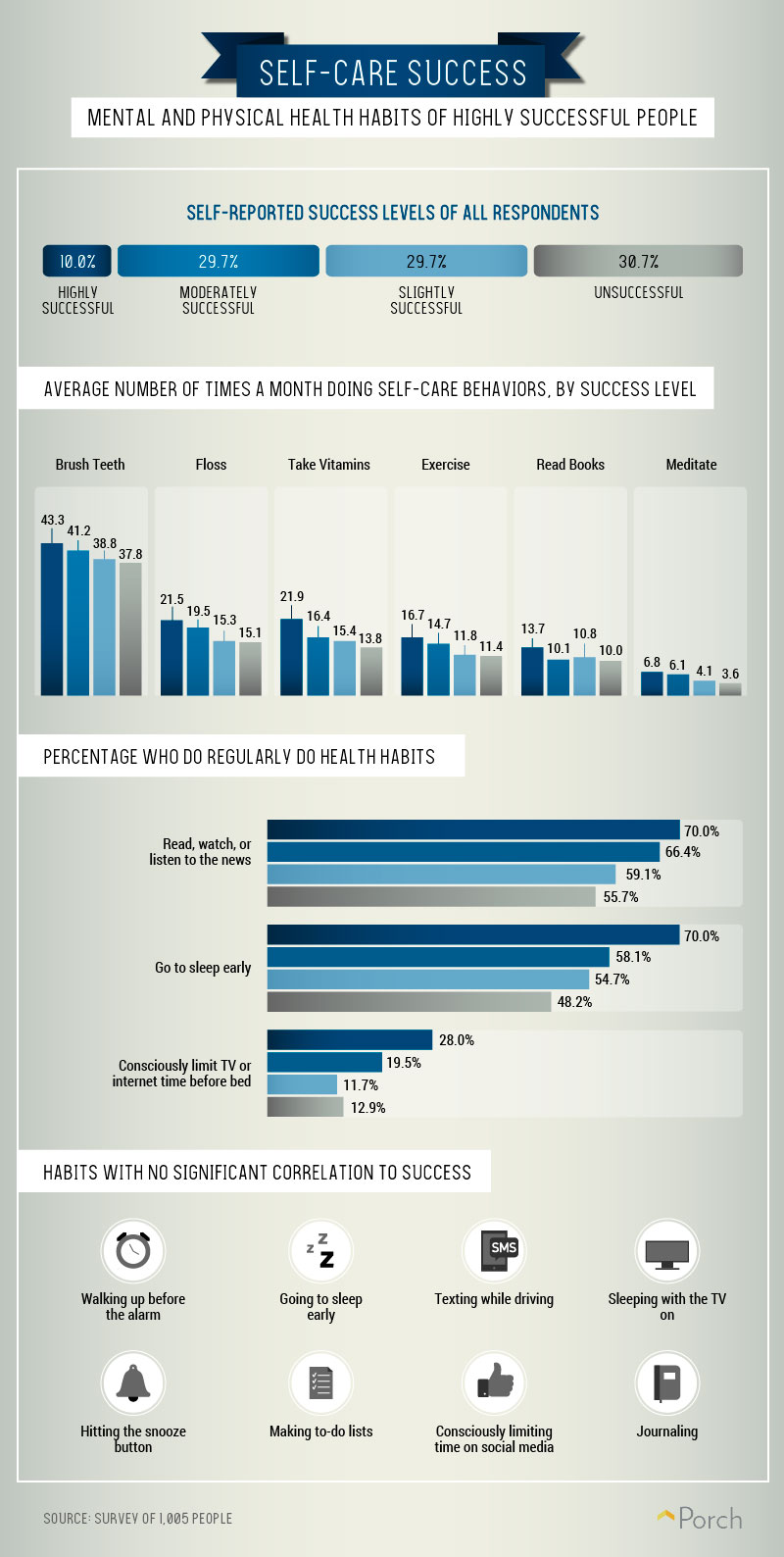
    Maintaining the body and mindSelf-care should pay off in obvious ways: You don’t need to be a dentist to understand the benefits of flossing. But our findings indicate highly successful people were quite disciplined in this regard and feelings of success were correlated with the frequency of these self-care efforts. This connection extended to measures aimed at maintaining physical health, such as exercise and dental care regimens, but highly successful people also read and practiced meditation more often, suggesting intellectual well-being is also paramount. Successful respondents were also more likely to consume news regularly, a finding that contradicts recent research suggesting staying constantly informed can actually prove harmful. Additionally, successful people were less likely to stay up late, perhaps because so many of them are early risers with busy days ahead. On the other hand, our data demonstrate no correlation between success and going to sleep early or waking up before one’s alarm. Perhaps when it comes to beauty rest, success demands a reasonable middle ground.

    Ingest for success?
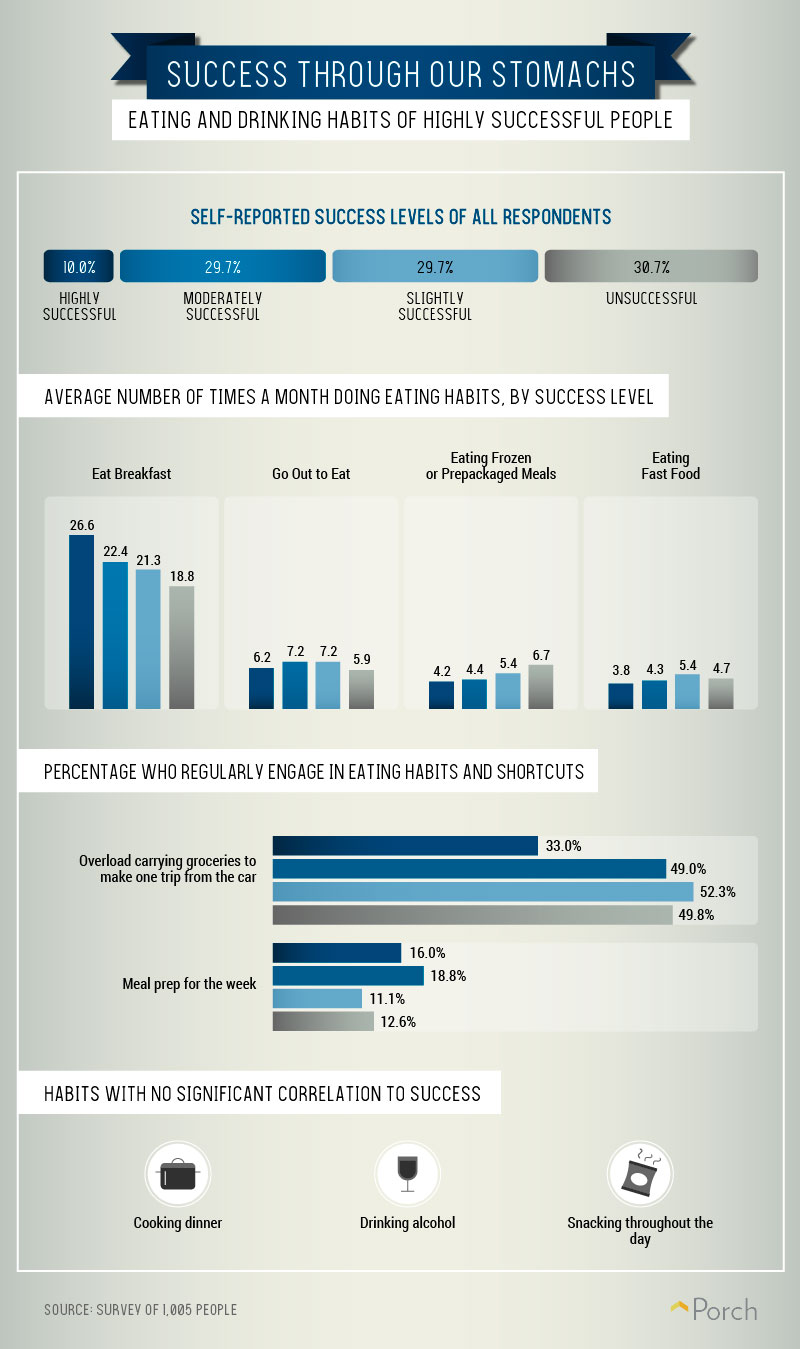
    Ingest for success?In a victory for parents everywhere, breakfast really does seem to be the most important meal of the day––or at least essential to those who feel highly successful. Conversely, frozen or prepackaged meals negatively correlated with success. On other questions of consumption, however, our results were more varied. Interestingly, highly successful participants ate out less often than moderately and slightly successful peers, although unsuccessful folks dined out least of all. Similarly, highly successful people were actually less likely to conduct meal prep than moderately successful respondents, suggesting a complex relationship between this habit and success. We did find a strong connection related to groceries, however. Only a third of highly successful people tried to take as many bags in at once as possible to avoid multiple trips. Among all other groups, about half attempted this “overload” method.

    Success means saving
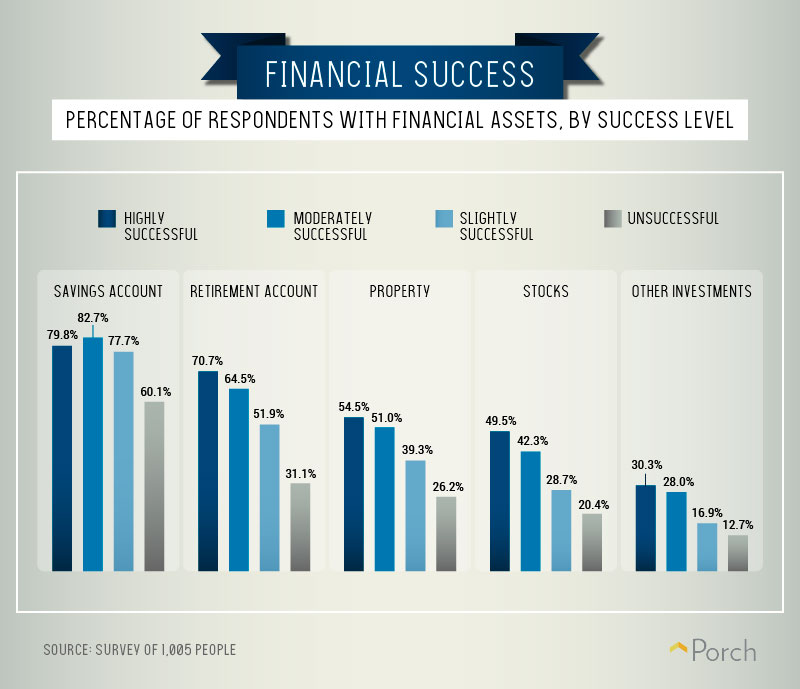
    Success means savingHowever much we resist materialism, financial concerns arise at many points in our lives and may shape our understanding of success. We found people who identified as moderately or highly successful were quite likely to have a range of investments, especially savings and retirement accounts. Conversely, less than a third of people who felt unsuccessful had a retirement account, and only a fifth were invested in stocks. These data resonate with broader concerns about Americans’ lack of retirement savings and other assets that might support them later in life. Although some have said homeownership is no longer part and parcel of the American dream, property ownership was substantially higher among people who felt highly or moderately successful. Additionally, less than a fifth of slightly successful or unsuccessful respondents had other investments, such as an ownership stake in a business.

    Healthy habits, healthy home

    Perhaps we’ll never incorporate all potentially healthy habits into our lifestyles simultaneously––incremental improvement is more attainable. If our findings have revealed habits you find admirable, establish some priorities and pursue them passionately. If our data suggest anything, it’s that small actions can have sweeping implications. So set a few manageable goals for yourself and discover achievement is possible. After all, hopeful thinking may be the most important habit successful people have in common. If you’re looking to transform your home into an orderly space conducive to good habits, you don’t have to go it alone. Whether in need of painting or pest control, Porch helps homeowners connect with trusted professionals. Letting the pros handle your home-improvement hassles––now that’s a habit we can all get used to.

    Methodology

    To compile the data above, we surveyed 1,005 people through Amazon’s Mechanical Turk. The surveys all took place in March 2018. Each person was first asked to answer how often they performed certain behaviors and later asked to evaluate their success levels on a scale of 1 to 7 in various areas of their lives. Scores across all categories were averaged to identify a respondent’s overall success level. All correlations presented relating to behavior frequency, unless otherwise stated, were found to have statistical significance through ANOVA and Chi-squared analyses. Because the information we collected relies on self-reported data, it may have issues relating to selective memory, telescoping, attribution, and exaggeration. Because “success” is a subjective term, we did not have an objective measurement for it and relied solely on a respondent’s appraisal of their success across several types of success.

    Content Originally Created by Porch.com

  • The Human Skills We Need For An Unpredictable World

    The more we rely on technology to make us efficient, the fewer skills we have to confront the unexpected, says writer and entrepreneur Margaret Heffernan. She shares why we need less tech and more messy human skills — imagination, humility, bravery — to solve problems in an unpredictable age. “We are brave enough to invent things we’ve never seen before,” she says. “We can make any future we choose.”

    Original article appears in: TED Talks Ideas worth spreading: https://www.ted.com/talks/margaret_heffernan_the_human_skills_we_need_in_an_unpredictable_world/transcript?utm_source=newsletter_weekly_2019-08-02&utm_campaign=newsletter_weekly&utm_medium=email&utm_content=top_left_button#t-4855

  • The Association of Corporate Executive Coaches elevates the value of executive coaches in the sea of organizational relationships

    by Esther LaVielle

    The Association of Corporate Executive Coaches (ACEC) is an association for master-level executive coaches who focuses on the results of the business side of coaching and who offer a Certification as a Master Corporate Executive Coach (MCEC) through their sister organization MEECO Leadership Institute.

    The association supports best practices to expand one’s executive coaching business to reach the level of an ‘Enterprise-wide Business Partner™’ with their clients. It also provides the opportunity to make valuable high-level connections with organizational leaders and colleagues. “The vision is to have corporate executive coaches be transformation catalysis for the 21st century and beyond, creating organizations of the future,” says CB Bowman, CEO of the ACEC and the MEECO Leadership Institute (the sister association to ACEC). “The mission of both associations is to elevate corporate executive coaching into a recognized critical profession in any organization’s success.” Each applicant must fulfill a list of requirements prior to acceptance into either association.

    Each ACEC member receives the following benefits:

    • Access to a network of like-minded executive coaches who share experiences, data, and provide support for client challenges
    • Discount to the annual executive coach leadership conference presented by the MEECO Leadership Institute
    • Free webinars on business and executive coaching topics and trends
    • Opportunities to source and collaborate with high-level talent within the network
    • Marketing opportunities to sell products and services to colleagues and organizations
    • Incentive programs
    • Researched and curated content
    • Publication of articles for organizations and industry
    • Ability to use the MEECO Leadership Institute™ as a lead generator
    • Increase visibility through Google ranking
    • Ability to present as a Subject Matter Expert (SME) to organizations
    • Ability to qualify for book endorsements
    • Conference speaking opportunities, etc.
    • Opportunity to be certified as a Master Corporate Executive Coach (MCEC) through the MEECO Leadership Institute.

    The benefits to membership in MEECO are similar but organization-focused, which includes the opportunity to select SME (Subject Matter Experts) to assist them through organizational challenges.

    Expansion and growth starts with data

    As the ACEC and MEECO continued to grow, they began looking for solutions to simplify the application process for new members, review and evaluate applications for the MCEC certification, attract conference sponsors, collect data to publish a book, and to ensure they were staying true to the membership base. They were also seeking a better way to collect and evaluate data for organizations who apply for a MEECO Leadership Designation™, a designation for organizations who present best-case behavior related to employee sciences™, corporate culture, and executive coaching.

    Through their membership with TechSoup, ACEC found QuestionPro to be the most viable solution to reach all four business objectives over the past year. Although it took time to learn all of the features and practical applications of the different types of data points collected, ACEC was able to significantly decrease the length of time applicants needed to complete applications. They can collect and organize critical data, and provide an easier way to compare and contrast candidate information to present designations for their sister organization (the MEECO Leadership Institute), as well as track the satisfaction level of its members. All of this is critical to their growth path.

    QuestionPro allows the ACEC and MEECO to focus on the customer experience

    After implementing QuestionPro’s solution,100% of the admissions team, the designation team, and the certification review team were delighted with the smoother process. They were able to review more applicants faster and more efficiently than before. Data collected via surveys through the MEECO Leadership Institute are discussed and shared throughout the network and are opening doors to new sponsorship opportunities. The data collected will also be the foundation for a new book on the topic of executive coaching.

    CB Bowman CEO ACEC “Our main objective for ACEC and MEECO is to be a part of the fabric of organizations and lead transformation and innovation. Without QuestionPro, we were unable to compare, contrast, organize and use data effectively. We’re pleased with the impact QuestionPro has made in our customer experience and look forward to continuing our partnership with them, as we are discovering even more ways to incorporate QuestionPro to streamline our business.”
    – CB Bowman, CEO of the ACEC and MEECO Leadership Institute.

    Original Article click here: https://www.questionpro.com/blog/questionpro-helps-acec-and-meeco-to-focus-on-customer-experience/

  • Leading with the Power of Humility

    by Dan Rockwel

    View original publication on LeadershipFreak

    The seductions of arrogance wreck leaders, demoralize teams, and destroy organizations.

    “The only thing more dangerous than ignorance is arrogance.” (Attributed to Albert Einstein.)

    Everything good in leadership begins with humility.

    Subtleties of arrogance:

    1. Taking offense at slights. A thin skin points to pride. “You deserve better.”
    2. Judging others by unspoken expectations. The “humble-arrogant” are better than others because they hold people to high standards that they don’t meet themselves.
    3. Searching for self-justification. Arrogance circles back on problems – not to find solutions – but in search of reasons it didn’t do wrong.

    The brother of arrogance is disdain.

    All you can do is coerce those you look down on.

    Practice humility:

    Humility is a practice not a destination.

    #1. Acknowledge the subtlety of arrogance.

    Humility begins when you acknowledge arrogance.

    You have puddles of humility and oceans of arrogance, but you judge yourself by the puddles. My own arrogance makes me skeptical of any other option.

    #2. Pursue growth.

    “An arrogant person considers himself perfect. This is the chief harm of arrogance. It interferes with a person’s main task in life – becoming a better person.” Leo Tolstoy

    Everyone who develops their leadership knows what they’re working on.

    What leadership behavior will you practice today?

    Practice is intentional repetition that includes reflection and course adjustment.

    #3. Pick up the trash.

    Don’t simply tell people to pick up the trash. Pick it up yourself.

    No job is menial to the humble.

    Ray Kroc, the founder of McDonald’s, was famous for picking up trash. “Every night you’d see him coming down the street, walking close to the gutter, picking up every McDonald’s wrapper and cup along the way,” former McDonald’s CEO Fred Turner told author Alan Deutschman. “He’d come into the store with both hands full of cups and wrappers.” (Daniel Coyle in the Culture Code)

    What are the subtitles of arrogance?

    How might leaders practice humility?

  • Coaching the Uncoachable Executive

    How do you help leaders who don’t want help?

    by Steve Albrecht

    View original publication on Psychology Today

    If we take the idea that you can lead a horse to water but you can’t make it drink to the business arena, how do companies help their leaders improve their performance or behavior, through coaching, when they don’t think they need it?

    I work with two types of employees when it comes to coaching; pick the one you’d rather be in the room with. One says, “I’m so glad you’re here! I know I’ve got some rough edges, some blind spots, and I need to improve the way I communicate with my staff and my boss. We have a lot to talk about and I want to get right to work.” Chance of success: high.

    The other type says, “I don’t know why you’re here or I’m here. It’s probably because one of my team got hurt feelings and complained. Maybe my style is a bit rough, but I get things done. Besides, the clients love me and I make this place a lot of money. Can we get on with whatever this is? I have a lot of work to do.” Chance of success: poor to middling.

    For help with this thorny issue, I spoke with Jordan Goldrich, COO of the San Diego-based executive coaching firm, CUSTOMatrix. He holds an LCSW license and the Master Certified Executive Coach (MCEC) designation, from the Association of Corporate Executive Coaches. Jordan is also a Talent Management Executive with Executive Core, an international Executive Coaching firm.

    When it comes to coaching the executive who doesn’t want to participate in the process, Jordan says, “Most executives who don’t want to be coached are referred by their managers for coaching for several reasons. They’re very valuable because of their technical knowledge or business expertise, but their interpersonal style creates a negative impact on their key stakeholders, direct reports, and superiors. Or, they are part of a leadership development program, where everyone must have coaching, and they don’t want it because they are legitimately too busy, don’t trust or respect the coach, or don’t believe it will be valuable for them.”

    He also sees them having either a lack of insight or a skewed view of their impact on their firm and the people in it. “They’re genuinely not aware of the impact they’re having on others,” he suggests. “Or they recognize they’re having a negative impact but can’t believe their impatience, frustration, anger, and even sarcasm with others is more of a problem than the lack of production, late deadlines, fuzzy thinking, and lack of accountability of the people who are complaining. In addition, many don’t believe they can control their behavior.”

    It’s interesting to note the mindset that Jordan Goldrich sees in these executives and senior leaders who are seen as abrasive. They believe they are like warriors, achieving a level of success in overwhelmingly complex strategic roles.  He says, “They believe they are not being recognized for their contribution. They may even feel they are being disrespected.”

    These internal challenges can manifest in significant hurdles for Jordan as a coach. He says of the abrasive leader as a coachee, “They believe that the request to change is part of a politically-correct culture where, as one executive said to me, ‘Kids are not allowed to play tag because being it will harm their self-esteem.’”

    Their coach must help them uncover their own intrinsic motivation to change. In other words, find a reason they would change this behavior even if they were not getting pressured to change. If the coaching is successful, they conclude that they should change because they want to be more consistent with their own core beliefs and values. He says, “Many I have met are sincerely religious people. Or, they may change because they recognize they want to win or achieve even greater things than they already have.”

    In many situations, Jordan finds self-assessment instruments can help coachees with their insight. He says, “Assessment instruments provide a wealth of information to coachees in an economical way. Their self-ratings on specific items deepen their understanding of their own motivations, personality style, communication style, decision style, and influence style. The assessment reports and our debriefs can combine to create new options for behavior changes. I typically use two self-assessments, plus a 360 evaluation, which may include my interviews with key stakeholders. Since I’m certified in these assessments – Myers-Briggs, FIRO-B, California Personality Inventory, Workplace Big 5, Conflict Dynamics Profile, DISC, and the Hogan Personality Inventory – they are part of my coaching tool kit as well.”

    So, with serious internal and external obstacles in the coachee’s path, how does he prove success? Coaching, like other soft-skills improvements, may not have an obvious immediate benefit, but more of a behavioral and performance shift, which could appear over a span of weeks or months. Obviously, business owners and C-level executives don’t always have a lot of patience for the slow-and-steady route to the improvement approach. Jordan uses subjective evaluations, like feedback from internal customers, peers, superiors and other stakeholders; if the coachee is achieving goals and meeting deadlines; and even employee turnover is a measure.

    Poorly-performing employees sometimes leave under the coachee’s “new and improved” leadership approach because they can no longer hide behind the formerly abrasive behavior of their manager.

    The coaching process is going to benefit those who participate fully. The challenge in all behavior and performance change is getting coachees to leverage their own intrinsic motivations to change. Then they are able to see the wisdom of good ideas, positive suggestions, and the need to embrace them, whether they initially like the coaching intervention or not.

    Dr. Steve Albrecht is a keynote speaker, author, podcaster, and trainer. He focuses on high-risk employee issues, threat assessments, and school and workplace violence prevention. In 1994, he co-wrote Ticking Bombs, one of the first business books on workplace violence. He holds a doctorate in Business Administration (DBA); an M.A. in Security Management; a B.S. in Psychology; and a B.A. in English. He is board certified in HR, security, coaching, and threat management. He worked for the San Diego Police Department for 15 years and has written 17 books on business, HR, and criminal justice subjects.

  • The Surprising Value of Being Unattached

    The Surprising Value of Being Unattached

    Some people are naturally blessed with the powers of persuasion. Maybe you’ve seen them in action. They ask and they receive, and they make it look effortless, painless—even fun. For the rest of us, trying to persuade someone can be a maddening experience, and one that is definitely not fun. Maybe we’re trying to make a sale, recruit a partner or get the support we need to pursue a new idea—whatever our goal, and no matter our tactics, the other person stays resolute in “no.” We can push, beg and even manipulate, but he won’t budge. It soon becomes clear that if we keep pushing we might make things worse.

    In those moments, if we can step back and stop pushing, the situation is more likely to work out in our favor—perhaps with a result perhaps better than the one we sought. It seems counterintuitive, but something happens when we stop trying to force an outcome. And if we understand why this happens, we can use it to get the results we want.

    This is not a new idea. In the 14th century Japan it was shibui, while in 16th century Italy, it was called sprezzatura. Chinese Daoists call it wu-wei, and Hindu philosophers know it as ahamkara.

    In the North America, we think of it simply as cool. And if we remember anything we learned in junior high, it was that life was infinitely better for the people who were cool.

    It’s All About Attachment

    In New Age circles, people sometimes speak of a concept called attachment—which means when we’re caught up in something, we get attached to it. That’s when we lose sight of the big picture. We get tunnel vision on the outcome we want, so we don’t notice all that’s happening
    around us. We are blind to what’s really going on, and we are equally incapable of seeing the situation from another person’s perspective.

    This is when the Law of Attraction kicks in, according to New Age Thought. When we’re attached to the outcome, we’re afraid that the thing we want won’t happen. We become attached to that negative thought pattern and then, under the Law of Attraction, we begin attracting more of that negativity. In other words, we begin to imagine the person saying no to us, and eventually he really does say “no.”

    In the Western paradigm—inherited from the thinking of Dr. Sigmund Freud—we end up clinging to our egos. This ego-centered way of related to the world (and to ourselves) traps us in behaviour patterns that don’t meet our needs but which, maddeningly, are hard to see in the moment.

    Effortlessness + Effectiveness = Success

    All of this happens because we’re merely repeating old patterns. We’re like a car that’s stuck in the mud. The harder we try, the more we spin our wheels and make our situation worse.

    Over years of repetition, we have unintentionally trained ourselves to react this way. Just like an athlete who uses repetition to instill muscle memory, we’ve trained our mind to immediately apply that approach. When we become frustrated or desperate, we instinctively revert to these ways. It’s an unconscious, knee-jerk response. If we want to avoid it, we have to consciously change how we react.

    Early Chinese philosophers believed the ideal state of being was when a person was not actively thinking and was not exerting effort. They believed that this is the state in which the person is most able to achieve his goals.

    But retraining yourself so that you can get to that state most definitely requires conscious effort.

    The first step is simply to be aware of your patterns. Catch yourself in that moment; try to talk yourself out of pushing harder. And it’s a paradox, but trying too hard to stop trying too hard is not going to help you break the habit. Mencius, a Chinese philosopher in the fourth century B.C., advocated an approach similar to gardening: Do the planting and monitor the progress, but mostly just sit back and let the plants grow.

    Mencius’ approach isn’t much different from what New Age thought leaders call “the mindset of the witness.” They argue that, when we find ourselves caught up in these frustrating ineffective patterns, we should try to think like a witness. Because a witness is watching the event, not participating and not invested in the outcome.

    Consider the detective shows you’ve watched on TV: A witness comes in and impassively tells the detective what she saw. She wasn’t harmed by the crime and wasn’t involved in the action. She simply watched it all go down. Taking on the mindset of the witness means not getting emotionally engaged in what is taking place.

    As the witness, we notice what is happening but have no expectations about what will happen. We may intend a certain result, but we are not attached to it.

    Still not convinced? Think about insomnia. The harder you try to fall asleep, the less likely it is to happen. Stop trying and…zzz.

    Non-attachment feels unnatural to us in the West. It’s a hard practice to follow. From birth, we’re trained to desire, act and expect positive results, and we’re taught that the harder we work, the greater our reward. It feels strange to let go of an outcome in order to succeed. It’s especially difficult to practice in the moment, when we are trying to persuade someone and our stress levels begin to rise.

    But, by consciously practicing a more passive approach, we can establish new patterns and get our cars unstuck from the mud. We can train ourselves to let go. Whether we call it sprezzatura, shibui, wu-wei, ahamkara or just cool, we’ll be able to remove the tension from the interaction, tension that is keeping the other person from saying “yes.” With that tension gone, we may find ourselves getting a bigger “yes” than the one we imagined.

    AUTHOR: Beverly Benwick

    ABOUT BEVERLY: https://acec.mgmcsolutions.com/directory/bev-benwick-mal-pcc-cpcc/

    CONTACT INFORMATION:
    Ste. 30, 6488 – 168th Street
    Surrey, BC  V3S 8Z1 Canada

    TEL:  604.576.4970
    TOLL FREE: 1.866.95COACH or 1.866.952.6224
    E-MAIL: bev@advanceyourleadership.com
    WEBSITE: http://advanceyourleadership.com/
    LINKEDIN: www.linkedin.com/in/bevbenwick
    FACEBOOK: www.facebook.com/advanceyourleadership


  • The propensity to pursue executive coaching: …

    The propensity to pursue executive coaching: …

    The propensity to pursue executive coaching: variables of self-efficacy and transformational leadership  CEOWORLD Magazine

    www.ceoworld.biz

    Two dominate variables, which has been linked to successful, sustainable, and innovative businesses is transformational leadership and leadership self-efficacy.  However, nearly 60% of companies face leadership talent shortages (Crainer, 2011).  Leadership coaching is a strategy to address the deficit of effective leaders (Gregory, Beck, & Carr, 2011; Hannafey & Vitulano, 2013), and leaders who seek coaching indicate improved self-efficacy and  transformational leadership (Abrell, Rowold, Weibler, & Moenninghoff, 2011; Enescu & Popescue, 2012; Moen & Allgood, 2009; Mukherjee, 2012; Shanker, Bhanugopan, & Fish, 2012).  According to the research literature and theorists, leadership coaching provides a new path for learning and self-awareness to an individual’s growth and development (Kay, 2013; Moen & Federici, 2012).

    Unfortunately, a paucity of information exists about leaders who take responsibility for their own development, and McCall (2010) posited no substitutes exist for teaching evolving leaders how to take charge of their own advancement.  Therefore, the objective of this research study was to (a) enrich the substantive theory building and empirical research on self-efficacy and transformational leadership by (b) assessing the leaders’ self-efficacy and transformational leadership, and(c) to ascertain if a relationship exists between these variables and the propensity to pursue executive coaching.

    Theoretical Framework

    Coaching continues to grow faster than research and Gregory et al. recommended an integration of theory and practical application of organizing frameworks.  Control Theory (CT) posited humans take an active role or responsibility toward one’s behavior, where CT attempts to control the state of some variable, often the pursuit of accomplishing a task by controlling their behavior (Gregory et al., 2011).
    Literature Review

    Executive Coaching

    In a comprehensive literature review by Kampa-Kokesch and Anderson (2001), the history of executive coaching is noted as barely traceable and a hard date for the commencement of executive coaching does not appear to exist.  The word coach emerged in the 1500s into the English language to describe a particular horse drawn carriage.  The origin of the verbto coach refers to a highly regarded person getting from where he or she was to where they wanted to go (Witherspoon & White, 1996).  Over the centuries, the term moved through several avenues from sports coaching to academic coaching and to the evolution of executive coaching (Stern, 2004).

    Predominately, western societies implement executive coaching.  The United Kingdom reports 70% of companies  use coaching, where 44% of employees report using coaching (Sergers, Vloeberghs, Henderickx, & Inceoglu, 2011), and 93% of companies in the United States (Jowett, Kanakoglou, & Passmore, 2012).  The Coaching International Federation (CIF) reported an increase in membership from 1,500 in 1999 to 10,000 members in 2006 across 80 different countries (Jowett et al., 2012).  Van Genderen (2014) asserted executive coaching is the fastest growing profession for the development of corporate success.

    According to the CIF, coaching offers the definition as an ongoing professional relationship that helps people produce extraordinary results in their lives, careers, businesses, or organizations.  Through the process of coaching, clients deepen their learning, improve their performance, and enhance their quality of life. (Brown & Rusnak, 2010, p. 15)

    Self-Efficacy

    Bandura (1986), a social cognitive theorist, first introduced the concept of self-efficacy.  Social cognitive theory includes grounding in the conceptual understanding that human beings are vigorously committing to their development and actions (Bandura, 1986).  Bandura (1997) postulated self-efficacy refers to a judgment of one’s own ability to perform a specific task within a specific domain.  Thus, self-efficacy is the aspect of self, which refers to how sure (or how confident), the individual is that he or she can successfully perform requisite tasks in specific situations, given one’s unique, and specific capabilities. (p. 4)

    Transformational Leadership

    Transformational leadership is a leadership style, which incorporates relationships and the dynamic interplay between the followers and the leader of a group. Transformational leadership inspires followers to be the best they can be, to accomplish their goals, and values what followers need and want.  By focusing on the follower’s values and aligning those values with an organization’s value this outcome may further the mission of an organization (Givens, 2008).

    Research Design

    A quantitative study with a descriptive correlational design and linear regression analysis was used for this study with established self-efficacy and leadership instruments, which contain quantitative data to assess if a relationship exists between the variables.  Applying a correlational design approach suits the needs of this study because the purpose is to examine if significant relationships exist between three sets of identified variables.

    Population and Sample

    The target population for this research study was executives in leadership positions (CEOs, COOs, VPs, CFOs, and executive management), which was accessed through SurveyMonkey®’s database.  To avoid social and research exclusion, this study did not exclude gender or industry, but was limited to the United State.  The study used a purposive sampling of executives.  A standard email notification was used to notify respondents, that he or she had a new survey to take and the invite was a random group selected through an algorithm process. SurveyMonkey®’s solicited 186 responses with 110 of those responses being fully completed.

    Instrumentation / Measures

    The instruments used in this research study were selected because of their established reliability and validity measurements.  The new general self-efficacy scale (NGSES) and the multifactor leadership questionnaire (MLQ) are established instruments (Bass & Avolio, 1997; Chen, Gully, & Eden, 2001).  Participants received a survey, which incorporated the assessments NGSES and MLQ, to include a follow-up Likert-type scale question to ask how he or she  self-rated their self-efficacy and transformational leadership (low, neutral or high), and then how likely he or she was to  pursue executive coaching (Strongly disagree-Will not pursue executive coaching, Disagree – Might consider pursuing executive coaching within the next 3 months, Neutral, Agree, will definitely pursue executive coaching within the next 3 months, Strongly agree – will pursue executive coaching immediately).
    Data Analysis
    This quantitative correlational study used SigmaXL to run the descriptive statistics, correlations, and linear regression analysis.  Minitab software was utilized to run the Cronbach alpha scores for the reliability and normality testing to reduce the risk of Type I and Type II errors of the instruments for this research project.

    Results

    Demographics

    Male 56.76% self-reported as male (N = 63)
    Female: 43.24% respondents self-reported as female (N = 48)

    Ages:                                                   Position

    18-30 – 22.52% (N=25)                      CEOs – 47.7%  (N = 53)
    31-40 – 33.3% (N=37)                        COOs – 15.3% (N=17)
    41-50 -19.8% (N=22)                         VP – 7.2% (N=8)
    51-60 – 21.6%) (N=24)                       CFOs -7.2% (N=8)
    61-70 – 2.7% (N=3)                            Executive Management – 22.% (N=25)

    Number of Employees

    >100  –                         46.85% (N = 52)
    101 – 1,000 –               30.63% (N=34)
    1,001 – 10,000 –          19.82% (N=22)
    10,001<                       2.7% (N=3)

    RESULTS

    Research Question 1: Does a relationship exist between self-efficacy and transformational leadership?  The Pearson correlation is .691 with p <  0.000 therefore the null hypotheses was rejected and the alternative hypothesis was accepted demonstrating a significant relationship between transformational leadership and self-efficacy.  These findings support  Mesterova, Prochazka, and Vaculik (2014), which stated the two variables are positively paired, contribute to each other, and contribute significantly to effective leadership.

    Research Question 2: To what extent does self-efficacy predict the propensity to pursue coaching?

    The Pearson correlation is .167 with p <  0.08 therefore the null hypotheses must be retained and the alternative hypothesis rejected demonstrating no significant relationship  between self-efficacy  and the propensity to pursue executive coaching.
    This was a surprising result to this researcher.  A possible explanation for this finding is  the purposive sampling of just high-level executives and their self-efficacy was assessed.  The composite variable for actual self-efficacy was 4.5 (on a scale of 1-5) indicating a high-level of self-efficacy as self-reported by the respondents.  The non-significant relationship between self-efficacy and executive coaching may indicate high-level executives feel quite confident, secure in their abilities, and do not feel the need to pursue coaching to enhance or develop their already existing level of self-efficacy.  Additionally, the results of this research underpin Nease et al.’s (1999) research study where participants with robust self-efficacy would exhibit decreases in feedback acceptance.

    Research Question 3: To what extent does transformational leadership predict the propensity to pursue coaching? 

    The Pearson correlation is .362 with p <  0.0001, therefore the null hypotheses was rejected and the alternative hypothesis accepted demonstrating a positive relationship between transformational leadership and the propensity to pursue executive coaching.  The overall composite combined variable score for transformational leadership was high; therefore, transformational leaders may always feel a need to improve their abilities, promoting relationships, and enhancing their followers’ abilities despite their high scores.  Transformational leadership, in definition, is a continuous growth path and one actually never arrives at full transformational leadership.  Therefore, the results of this study support the characteristic domains of transformational leadership by demonstrating a desire to pursue executive coaching for continued growth.

    Research Question 4: What is the relationship between self-efficacy, transformational leadership, and the proclivity to pursue executive coaching? 

    A linear regression model was calculated to predict likeliness to pursue coaching based on transformational leadership and self-efficacy.  A significant regression equations was found (F = 11.8488, p < 0.000), with an R-square adjusted of 0.0905.  The alternative hypothesis was supported indicating a small, only 10%, but significant likelihood when combining transformational leadership and self-efficacy, that an individual will be inclined to pursue executive coaching.  Additionally, this result indicates transformational leadership may be a possible moderator on the variable self-efficacy, as self-efficacy as a standalone variable will not propel an individual to pursue executive coaching.

    Limitations, Assumptions, and Future Research

    A limitation to this current research study was the limitation of SurveyMonkey® to give the respondents in real-time their results of their assessed transformational leadership characteristics and scores of self-efficacy.  This known variable may or may not have a different correlational relationship on the propensity to pursue executive coaching.  Understanding the demographic variables of education, experience, or length in the executives’ current position may also help to elucidate the non-significant relationship between self-efficacy and executive coaching.  Additionally, the industry of executive coaching is an established international industry and this research study was isolated to the United States.  Replicating this same study in other geographic international locations may yield different results as well as for global companies or organizations in other countries.

    Conclusion

    First, to the industry of executive coaching when soliciting possible clients, transformational leadership is a construct, which leaders may be willing to explore, enhance, and continuously develop.  Additionally, combining the assessments of transformational leadership and self-efficacy may influence a leader to pursue executive coaching.  Furthermore, organizations, HR departments, and Board of Directors can administer the MLQ (5x) separately or combined with the NGSES and may see a willingness for the leader to pursue coaching to develop and enhance these skills on a deeper level.  Leaders do appear to want to take charge of their own development and will pursue executive coaching if given the opportunity to assess their transformational leadership and self-efficacy.
    REFERENCES
    Abrell, C., Rowold, J., Weibler, J., & Moenninghoff, M. (2011). Evaluation of a long
    term transformational leadership development program. Journal of Research Personnel, 25(3), 205-224. doi:10.1688/1862-0000
    Bandura, A. (1986). Social foundations of thought and action: A social cognitive theory. New Jersey, NY: Prentice Hall.
    Bandura, A. (1997). Self-efficacy: The exercise of control. New York: NY, Freeman.
    Brown, M., & Rusnak, C. (2010). The power of coaching. Public Manager, 39(4), 15-17.
    Coaching International Federation. (2012).  Retrieved from
    Crainer, S. (2011). Leadership special report. Business Strategy Review, 22(2), 17-22. doi:10.1111/j.1467-8616.2011.00745.x
    Enescu, C., & Popescu D. (2012). Executive coaching – instrument for implementing organizational change. Review of International Comparative Management, 13(3), 378-386.
    Givens, R. (2008). Transformational leadership: The impact on organizational and personal outcome. Emerging Leadership Journeys, 1(1), 4-24. Retrieved from http://www.regent.edu/acad/global/publications/elj/issue1/ELJ_V1Is1_Givens.pdf
    Gregory, J., Beck, J. W., & Carr, A. E. (2011). Goals, feedback, and self-regulation: Control theory as a natural framework for executive coaching. Consulting Psychology Journal: Practice & Research, 63(1), 26-38. doi:10.1037/a0023398
    Hannafey, F., & Vitulano, L. (2013). Ethics and executive coaching: An agency theory approach. Journal of Business Ethics, 115, 599-603. doi:10.1007/s10551-012-1442
    Jowett, S., Kanakoglou, K., & Passmore, J. (2012). The application of the 3+1Cs relationship model in executive coaching. Consulting Psychology Journal: Practice and Research, 64(3), 183-197. doi:10.1037/a0030316
    Kampa-Kokesch, S., & Anderson, M. Z. (2001). Executive coaching: A comprehensivereview of the literature. Consulting Psychology Journal: Practice and Research, 53(4), 205. doi:10.1037/1061-4087.53.4.205
    Kay, D. (2013). Language and behavior profile as a method to be used in a coaching
    process. Poznan University of Economics Review, 13(3), 107-129.
    McCall, M. W. (2010). Recasting leadership development. Industrial and OrganizationalPsychology, 3, 3-19. doi:10.1111/j.1754-9434.2009.01189.xMesterova, J., Prochazka, J., & Vaculik, M. (2014) Relationship between self-efficacy,transformational leadership and leader effectiveness. Journal of Advanced Management Science, 3(2), 109-122. doi:10.12720/joams.3.2.109-122
    Moen, F., & Allgood, E. (2009). Coaching and the effect on self-efficacy. Organization Development Journal, 27(4), 69-82.
    Moen, F., & Federici, R. A. (2012). Perceived leadership self-efficacy and coachcompetence: Assessing a coaching-based leadership self-efficacy scale. International Journal of Evidence Based Coaching & Mentoring, 10(2), 1-16. doi:10.5539/jel.v1n2p1
    Mukherjee, S. (2012). Does coaching transform coaches? A case study of internal coaching. International Journal of Evidence Based Coaching & Mentoring, 10(2), 76-87.
    Nease, A. A., Mudgett, B. O., & Quiñones, M. A. (1999). Relationships among feedback sign, self-efficacy, and acceptance of performance feedback. Journal of Applied Psychology, 84, 806-814. doi:10.1037/0021-9010.84.5.806
    Segers, J., Vloeberghs, D., Henderickx, E., & Inceoglu, I. (2011). Structuring andunderstanding the coaching industry: The coaching cube. Academy of Management Learning & Education, 10(2), 204-221. doi:10.5465/amle.2011.62798930
    Shanker, R., Bhanugopan, R., & Fish, A. (2012). Changing organizational climate for innovation through leadership: An exploratory review and research agenda. Review of Management Innovation & Creativity, 5(14), 105-118.
    Stern, L. R. (2004). Executive coaching: A working definition. Consulting Psychology Journal: Practice and Research, 56(3), 154-162. doi:10.1037/1065-9293.56.3.154
    Van Genderen, E. (2014). Strategic coaching’ and consulting: More similar than meetsthe eye. Middle East Journal of Business, 9(1), 3-8. doi:10.5742/mejb.2014.91368
    Witherspoon, R., & White, R. P. (1996). Executive coaching: A continuum of roles. Consulting Psychology Journal: Practice and Research, 48(2), 124-133. doi:10.1037/1061-4087.48.2.124
    ++++++
By Dr. Shauna Rossington, DBA, LMFT.
    0 Comments

    2 + 7 =
    RECOMMENDED ARTICLES

    Executive coaching is back in fashion Economic growth in the UK has led to a resurgence in businesses u

  • MEECO™ (Measuring Excellence in the use of Corporate Executive Coaching in Organizations)

    MEECO™ (Measuring Excellence in the use of Corporate Executive Coaching in Organizations) is a designation that distinguishes organizations that have achieved excellence through weaving executive coaching into the fabric of their culture.

    Our goal is to recognize organizations that provide a benchmark and role model for other organizations that want to increase stockholder and stakeholder value, while experiencing overall success through utilizing mastery level executive coaches who understand how organizations work, and are determined to make a meaningful difference as “enterprise-wide business partners™”.

    www.meeco-institue.org

  • A Great Opportunity for Corporate Executive Coaches to be seen as “Enterprise Wide Business Partners™.”

    A Great Opportunity for Corporate Executive Coaches to be seen as “Enterprise Wide Business Partners™.”

    This presents a great opportunity for Corporate Executive Coaches to be seen as “enterprise wide business partners™.” By identifying and presenting solutions to your client early on creates an image of being proactive and solutions focused:

    Are Retirements About to Hit Your Organization Hard?

    Valued older workers are thinking seriously about retirement again. Here’s why—and what your organization can do about it.
    By William C. Byham, Ph.D.

    Are Retirements About to Hit Your Organization Hard?
    Late in the last decade, many valued older workers were getting ready to head for the doors and into the golden years of retirement. Most organizations weren’t prepared—they didn’t have qualified people ready to step into soon-to-be-vacated critical roles, and they had no viable retirement management strategy. What happened next—a deep recession, declining stock portfolio values, soaring health care costs—reset the retirement clock for many, allowing organizations to delay facing a potentially major talent crisis. But now, retirement is again poised to become a serious problem for many organizations in the U.S.

    As economic conditions have improved to the point where a greater number of older workers are again finding retirement both appealing and viable, the question to consider is whether or not your organization has “ready-now” replacements. If your organization is like most, the answer is no.

    There are steps you can take, however, to manage the loss of valued people to retirement and buy more time to find or develop replacements for key positions.

    What’s changed?

    Consider the plight of those who were at or near retirement age during the recession: They watched helplessly as the value of their stock portfolios dropped 30 percent or more in a matter of weeks. They did the math and quickly determined their lifestyle in retirement wasn’t going to be what they’d hoped.

    Rising health care costs also gave them pause. Workers who didn’t have a company-paid health care plan that would carry over into retirement were scared of what might happen if they got sick. They knew personally, or had heard of, people with illnesses whose medical bills were financially crippling, and how even the best health care plans didn’t cover all of the costs.

    For many, though, especially those in good health, the decision to postpone retirement wasn’t just an economic one. Many liked their work and their colleagues, so they decided to continue working.

    Now, however, there are five factors that stand to create dramatic increases in the number of retirements:

    The stock market has rebounded. The Dow Jones Industrial Average hit record highs in 2014, finally reclaiming the valuation that was lost during the recession. Other markets, including the NASDAQ, also have bounced back. As many investment portfolios are healthy again, many older workers feel that they can be financially secure in retirement.

    Inflation remains low. At the end of 2014, the U.S. inflation rate was below 1.5 percent. It has hovered at about two percent or lower since 2012. This adds further to older workers’ confidence that they will have a sufficient retirement nest egg.

    The new health care regulations. The Affordable Care Act, which provides for coverage in case of catastrophic health events and ensures the availability of insurance for people of any age, regardless of pre-existing illnesses, is giving older workers peace of mind that health care won’t be a financial drain on them in retirement.

    Those who delayed retirement are older now. People who were age 65 when the recession hit are now in their early 70s and may see retirement as a more attractive option than they did before.
    Part-time employment options are plentiful. The unemployment rate is at its lowest level since the recession, and there seems to be a multitude of available jobs for highly trained, highly skilled people who may want to continue working—but not full-time. There also are options for older workers wishing to work full-time but to do something different from the job they currently hold.
    The risk for employers

    When valued workers retire, a great deal of talent, knowledge, and experience walks out the door. But organizations don’t have to just stand by and watch it happen. What’s needed is a sound, systematic approach—a retirement management system—that anticipates retirements, prepares people to step into key roles, and, where needed, makes accommodations to keep specific people in the fold (e.g., in part-time or modified roles) until replacements can be developed.

    Retirements aren’t bad for an organization, of course. When workers retire, more opportunities are created within the organization for younger employees to step up and grow. It also provides the chance to bring in fresh thinking. Retirements are only bad when organizations are unprepared and must fill critical roles with people who either aren’t ready or aren’t a good fit.

    Get ready to manage retirement!

    “Retirements are only bad when organizations are unprepared.”

    A retirement management system is the best approach to guard against the huge potential consequences of losing valued workers with unique skills, knowledge, or connections that are important to the organization—and not having appropriate replacements. Many organizations try their hand at retirement management at the very top levels, but few organizations have a systematic retirement management program targeting those few people at all levels whose retirements will cause the greatest disruption.

    Such a system covers the following steps:

    • Identifying the jobs where there’s the greatest risk. While the departure of senior managers or executives may have the most visible impact, the retirement of valued lower-level workers is also a concern. These valued workers may have scientific, technical, or specialized skillsets that make them difficult to quickly replace. You need to identify these people, assess the risk and time associated with replacing them, and then be willing to work with them to buy more time for replacements to be hired or developed. This typically won’t be a large number of people; just the few whose departures would create the greatest headaches for the organization.
    • Find ways to postpone or redefine retirement for key workers. Once you have identified the workers you want to keep, you need to open a line of communication with them about their future. These conversations are critical because not everyone will have the same plans or needs. While some may be determined to retire and stop working, others may prefer to be part-time. Still others may wish to keep working full-time for a while longer, but have their jobs change to incorporate new tasks or responsibilities.

    It’s the individuals who want to continue working that you will want to engage to see if you can make a deal that is mutually beneficial to them and to the organization. As you are striving to buy more time for the organization to identify or prepare replacements, you might need to get creative in what you are offering these older workers.

    Some ideas might include:

    • Offering additional vacation time.
    • Allowing them to work remotely.
    • Creating a new role in a different part of the company where they can apply their experience and skills to new challenges and with new clients.
    • Paying for them to attend professional conferences or other work-related events that would provide travel opportunities.
    • Establishing a formal mentoring relationship, where the workers take an active role in training their replacements.
    • Special accommodations such as these may run up against existing HR policies, as they would only be offered to a select few individuals. But these are special people whose potential loss poses a significant risk to the organization. And while discretion is warranted in making these arrangements, the fact that a few individuals would be singled out for special treatment shouldn’t be a reason not to consider creative options.

    Review and revisit regularly. Special arrangements you make with retirement-age workers should be short-term deals—no more than two to three years—as you are applying a temporary “patch” rather than fixing the problem permanently. You’ll want to review these arrangements regularly to make sure the organization is holding up its end of the bargain and also to confirm the older workers are performing as expected (these workers should continue to be covered by your performance management process).

    Despite the logic of identifying and finding creative ways to keep valued older workers, too few organizations in the U.S. have an effective retirement management system. There are a few that are seeing the problems and possibilities of a surge of retirements and are being proactive, but these organizations are few and far between. For everyone else, the time to get serious about retirement management—to know the extent of the risk and to take action—is right now. The clock is ticking!

    William C. Byham, Ph.D., is DDI’s chairman and the author of 23 books, including 70: The New 50: Retirement Management: Retaining the Energy and Expertise of Experienced Employees.

    http://www.ddiworld.com/go/archive/go-magazine-2015-issue-1/are-retirements-about-to-hit-your-organization