
Tag: Master Corporate Executive Coach
-
The Association of Corporate Executive Coaches elevates the value of executive coaches in the sea of organizational relationships
The Association of Corporate Executive Coaches (ACEC) is an association for master-level executive coaches who focuses on the results of the business side of coaching and who offer a Certification as a Master Corporate Executive Coach (MCEC) through their sister organization MEECO Leadership Institute.
The association supports best practices to expand one’s executive coaching business to reach the level of an ‘Enterprise-wide Business Partner™’ with their clients. It also provides the opportunity to make valuable high-level connections with organizational leaders and colleagues. “The vision is to have corporate executive coaches be transformation catalysis for the 21st century and beyond, creating organizations of the future,” says CB Bowman, CEO of the ACEC and the MEECO Leadership Institute (the sister association to ACEC). “The mission of both associations is to elevate corporate executive coaching into a recognized critical profession in any organization’s success.” Each applicant must fulfill a list of requirements prior to acceptance into either association.
Each ACEC member receives the following benefits:
- Access to a network of like-minded executive coaches who share experiences, data, and provide support for client challenges
- Discount to the annual executive coach leadership conference presented by the MEECO Leadership Institute
- Free webinars on business and executive coaching topics and trends
- Opportunities to source and collaborate with high-level talent within the network
- Marketing opportunities to sell products and services to colleagues and organizations
- Incentive programs
- Researched and curated content
- Publication of articles for organizations and industry
- Ability to use the MEECO Leadership Institute™ as a lead generator
- Increase visibility through Google ranking
- Ability to present as a Subject Matter Expert (SME) to organizations
- Ability to qualify for book endorsements
- Conference speaking opportunities, etc.
- Opportunity to be certified as a Master Corporate Executive Coach (MCEC) through the MEECO Leadership Institute.
The benefits to membership in MEECO are similar but organization-focused, which includes the opportunity to select SME (Subject Matter Experts) to assist them through organizational challenges.
Expansion and growth starts with data
As the ACEC and MEECO continued to grow, they began looking for solutions to simplify the application process for new members, review and evaluate applications for the MCEC certification, attract conference sponsors, collect data to publish a book, and to ensure they were staying true to the membership base. They were also seeking a better way to collect and evaluate data for organizations who apply for a MEECO Leadership Designation™, a designation for organizations who present best-case behavior related to employee sciences™, corporate culture, and executive coaching.
Through their membership with TechSoup, ACEC found QuestionPro to be the most viable solution to reach all four business objectives over the past year. Although it took time to learn all of the features and practical applications of the different types of data points collected, ACEC was able to significantly decrease the length of time applicants needed to complete applications. They can collect and organize critical data, and provide an easier way to compare and contrast candidate information to present designations for their sister organization (the MEECO Leadership Institute), as well as track the satisfaction level of its members. All of this is critical to their growth path.
QuestionPro allows the ACEC and MEECO to focus on the customer experience
After implementing QuestionPro’s solution,100% of the admissions team, the designation team, and the certification review team were delighted with the smoother process. They were able to review more applicants faster and more efficiently than before. Data collected via surveys through the MEECO Leadership Institute are discussed and shared throughout the network and are opening doors to new sponsorship opportunities. The data collected will also be the foundation for a new book on the topic of executive coaching.
 “Our main objective for ACEC and MEECO is to be a part of the fabric of organizations and lead transformation and innovation. Without QuestionPro, we were unable to compare, contrast, organize and use data effectively. We’re pleased with the impact QuestionPro has made in our customer experience and look forward to continuing our partnership with them, as we are discovering even more ways to incorporate QuestionPro to streamline our business.”
– CB Bowman, CEO of the ACEC and MEECO Leadership Institute.
Original Article click here: https://www.questionpro.com/blog/questionpro-helps-acec-and-meeco-to-focus-on-customer-experience/
-
4 Signs an Executive Isn’t Ready for Coaching
The stigma of asking for or being assigned an executive coach is vanishing quickly. The growth of the industry tells us so. In the U.S. alone, $1 billion was spent on business, personal and relationship coaches last year, according to IbisWorld, up about 20% from five years earlier. And the number of business coaches worldwide has zoomed more than 60% since 2007, according to one coaching association. But while executive coaches have improved the performance of many already-good managers and sanded the rough edges off many less effective ones, they aren’t a miracle cure. In fact, we have seen many companies waste considerable sums by assigning coaches to managers who just aren’t ready to be coached, no matter how effective the coaches may be.
So how do those who control the coaching purse strings — HR, talent managers, and other buyers — avoid throwing money away on uncoachable executives? Considering that a year’s engagement with a top executive coach can cost more than $100,000, it’s an important question.
From nearly 35 years of coaching hundreds of executives, our firm has noticed a pattern of red flags that indicate when a coaching investment will be wasted. Here are four things to watch out for:
1. They blame external factors for their problems.
When things go wrong, does this person always have an excuse? Maybe they point a finger at the quality of their team, a lack of resources, or even their boss.
When leaders argue about the validity of your reasons for offering coaching, or offer excuses or defenses for poor results, it can be a sign that they lack self-awareness. Before any coaching can be effective, they need to wake up to the ways their actions affect others.
One CEO we worked with was known for his smart turnarounds of a large media company. But he was struggling to get along with his executive team. Finally, several board directors suggested he should seek out a coach. After multiple sessions, he had shared little information about himself, and we were no closer to figuring out the root of the problem. Stymied, we suggested that we observe the next executive team meeting.
Suddenly, all was clear. We were shocked by how he controlled the conversation in the room. He simply spoke over other people with a volume of words that was unfathomable. When he left the room to take a call, his team members erupted with frustration. It was obvious that this CEO was completely out of touch — something that became even more apparent later on, when he asked us to tell the board how positively he was responding to coaching.
Leaders like this often ignore criticism if it doesn’t jibe with their view of themselves — and such feedback is easy to ignore if it’s buried in a performance review or mentioned briefly in a larger conversation. Conducting a non-judgmental, just-the-facts 360-degree review could help them see the reality of their situation. Until they can see what others see and why it matters, they won’t examine their behavior, and coaching will be useless.
2. You can’t get on their calendar.
Some leaders claim to be receptive to coaching but just can’t find the time. They may cancel sessions at the last minute, constantly reschedule, or, when they do show up, be visibly distracted. They lack space for coaching both in their calendar, and in their mind.
Unlike the oblivious leader, the too-busy leader is often quite likable. They will apologize for being hard to pin down, and be very direct about how busy they are. Don’t be surprised if they’re flattered to be offered coaching. But coaching can’t be crammed into the schedule of a leader who wears their busy-ness as a badge of honor. Their inability to prioritize is a sign they need coaching, but their unwillingness to make room for it suggests they won’t be a good coaching investment.
A brilliant engineer we know had been promoted three times in four years, and by the time he was nearly 30 he was a group president at a U.S. manufacturing company. Diligent, humble, and smart, he could hold a room spellbound with only a marker and a whiteboard as he worked out solutions to highly technical problems. However, as adept as he was at the technical aspects of his job, he now had 20 people reporting to him whom he had no idea how to manage.
After three months of coaching, his superiors could see it was going nowhere. The executive often rescheduled his sessions, telling his coach he didn’t have the time. He believed he couldn’t set aside the time to improve himself. That made him uncoachable.
HR managers should do some reality testing to ensure the too-busy leader is willing to make room for coaching. To benefit from coaching, too-busy leaders must make the space to be fully present, both during the coaching sessions and after, doing the difficult work of developing new mindsets, skills, and habits. Ask this person what tasks or responsibilities they’d be willing to give up or delegate, even temporarily, to make time for coaching. If they struggle to think of any, give them a gentle but firm ultimatum as part of a career planning conversation: that they have plateaued at the company and won’t go to the next level until they make time for self-development.
3. They focus too much on tips and tactics.
Some leaders eagerly agree to coaching, but then avoid the deeper inquiries required for meaningful transformation. They’re willing to modify behaviors, but not beliefs. They view coaching as medicine that, if taken regularly, will help them get ahead.
The quick-fix leader becomes frustrated when their coach asks questions that require self-reflection. They want answers, not questions. “You’re the expert, you tell me,” they’ll say in response to questions from the coach, or “What if I did this?” Everything comes back to tactics. (A related warning sign is if a leader asks how quickly the coaching can be finished — especially if they demand that the cycle be compressed.)
Although coaches sometimes offer suggestions, their real job is to help executives uncover the assumptions driving their behavior. Only then can a coach help them challenge self-limiting beliefs that block their development. However, the quick-fix leader has little interest in this process.
One CEO we worked with was leading a family business that had recently been sold to a large company. He was told by a leader in the new parent company (who himself had benefitted from coaching) that coaching would help him make the transition. The CEO gladly accepted, wanting to be seen as a peer.
However, it wasn’t long into the first coaching session that he showed his entire focus was on “doing whatever other successful people did.” The coach worked tirelessly to shift the conversation to the CEO’s purpose and goals. Each time, however, he shifted the discussion back to the “secrets of success” of other organizational leaders he wanted to emulate. Ultimately, he was passed over for a permanent role on the parent company’s leadership team, and left the organization.
To prompt this kind of leader to be open to self-reflection, remind them of all the other times they vowed to change but were unsuccessful. They then might realize they need to work on more than just changing their game plan. Or, introduce them into a preliminary mentoring conversation with one of the leaders they admire. Tell the mentor to share their experience of struggling to develop.
4. They delay getting started with a coach to “do more research” or “find the right person.”
To be sure, it’s important to have a good fit between a leader and his coach. But a continual rejection of qualified coaches should give you pause. A related red flag is if the person is acting confused, and asking repeatedly why coaching has been suggested. Assuming you’ve clearly explained why coaching is necessary, this could be a defense mechanism and a signal that the person is not ready to confront their shortcomings. It usually stems from insecurity.
Being coached can be daunting, and not everyone is ready to take it on. We remember a physician leader who was hired to turn around a business unit of a large medical center. When his staff challenged him, he became emotional. Told by his boss that he needed a coach to help him control his emotions, he was hurt and angrily asked “Why?” — failing again to control his emotions. He was too full of hidden fears for the coaching to be useful. His boss eventually reassigned him, and ultimately he left the organization.
Reframe coaching as an investment the organization is making in their development rather than a personal fix. Tell them your firm provides this resource for high-potential, top performers to accelerate their success. If this leader can view coaching as something positive to help them achieve their goals, they may warm up to the process.
When Going Coach-Less Is Not Viable
After hearing us say that a certain leader is not a good candidate for coaching, an executive who brought us in will often say a variant of this: “Well, he must be coached. We can’t let him continue to manage others the way he has, but we can’t fire him easily either because we need his skills badly.” But imposing coaching on someone who just can’t handle it at the moment isn’t going to help anyone. Companies are better off directing their people development investments elsewhere — skills training or academic programs are often better options.
Invest your coaching budget in people who have shown the willingness and the capacity to change, and you’ll get a much better return on your investment.
Source: https://hbr.org/2018/07/4-signs-an-executive-isnt-ready-for-coaching
By:
July 09, 2018 -
High-Performing Teams Need Psychological Safety. Here’s How to Create It
“There’s no team without trust,” (….”and no tribe without trust and direct feedback” cb) says Paul Santagata, Head of Industry at Google. He knows the results of the tech giant’s massive two-year study on team performance, which revealed that the highest-performing teams have one thing in common: psychological safety, the belief that you won’t be punished when you make a mistake ...”or speak your truth”…cb). Studies show that psychological safety allows for moderate risk-taking, speaking your mind, creativity, and sticking your neck out without fear of having it cut off — just the types of behavior that lead to market breakthroughs.
Ancient evolutionary adaptations explain why psychological safety is both fragile and vital to success in uncertain, interdependent environments. The brain processes a provocation by a boss, competitive coworker, or dismissive subordinate as a life-or-death threat. The amygdala, the alarm bell in the brain, ignites the fight-or-flight response, hijacking higher brain centers. This “act first, think later” brain structure shuts down perspective and analytical reasoning. Quite literally, just when we need it most, we lose our minds. While that fight-or-flight reaction may save us in life-or-death situations, it handicaps the strategic thinking needed in today’s workplace.
Twenty-first-century success depends on another system — the broaden-and-build mode of positive emotion, which allows us to solve complex problems and foster cooperative relationships. Barbara Fredrickson at the University of North Carolina has found that positive emotions like trust, curiosity, confidence, and inspiration broaden the mind and help us build psychological, social, and physical resources. We become more open-minded, resilient, motivated, and persistent when we feel safe. Humor increases, as does solution-finding and divergent thinking — the cognitive process underlying creativity.
When the workplace feels challenging but not threatening, teams can sustain the broaden-and-build mode. Oxytocin levels in our brains rise, eliciting trust and trust-making behavior. This is a huge factor in team success, as Santagata attests: “In Google’s fast-paced, highly demanding environment, our success hinges on the ability to take risks and be vulnerable in front of peers.”
So how can you increase psychological safety on your own team? Try replicating the steps that Santagata took with his:
1. Approach conflict as a collaborator, not an adversary. We humans hate losing even more than we love winning. A perceived loss triggers attempts to reestablish fairness through competition, criticism, or disengagement, which is a form of workplace-learned helplessness. Santagata knows that true success is a win-win outcome, so when conflicts come up, he avoids triggering a fight-or-flight reaction by asking, “How could we achieve a mutually desirable outcome?”
2. Speak human to human. Underlying every team’s who-did-what confrontation are universal needs such as respect, competence, social status, and autonomy. Recognizing these deeper needs naturally elicits trust and promotes positive language and behaviors. Santagata reminded his team that even in the most contentious negotiations, the other party is just like them and aims to walk away happy. He led them through a reflection called “Just Like Me,” which asks you to consider:
- This person has beliefs, perspectives, and opinions, just like me.
- This person has hopes, anxieties, and vulnerabilities, just like me.
- This person has friends, family, and perhaps children who love them, just like me.
- This person wants to feel respected, appreciated, and competent, just like me.
- This person wishes for peace, joy, and happiness, just like me.
3. Anticipate reactions and plan countermoves. “Thinking through in advance how your audience will react to your messaging helps ensure your content will be heard, versus your audience hearing an attack on their identity or ego,” explains Santagata.
Skillfully confront difficult conversations head-on by preparing for likely reactions. For example, you may need to gather concrete evidence to counter defensiveness when discussing hot-button issues. Santagata asks himself, “If I position my point in this manner, what are the possible objections, and how would I respond to those counterarguments?” He says, “Looking at the discussion from this third-party perspective exposes weaknesses in my positions and encourages me to rethink my argument.”
Specifically, he asks:
- What are my main points?
- What are three ways my listeners are likely to respond?
- How will I respond to each of those scenarios?
4. Replace blame with curiosity. If team members sense that you’re trying to blame them for something, you become their saber-toothed tiger. John Gottman’s research at the University of Washington shows that blame and criticism reliably escalate conflict, leading to defensiveness and — eventually — to disengagement. The alternative to blame is curiosity. If you believe you already know what the other person is thinking, then you’re not ready to have a conversation. Instead, adopt a learning mindset, knowing you don’t have all the facts. Here’s how:
- State the problematic behavior or outcome as an observation, and use factual, neutral language. For example, “In the past two months there’s been a noticeable drop in your participation during meetings and progress appears to be slowing on your project.”
- Engage them in an exploration. For example, “I imagine there are multiple factors at play. Perhaps we could uncover what they are together?”
- Ask for solutions. The people who are responsible for creating a problem often hold the keys to solving it. That’s why a positive outcome typically depends on their input and buy-in. Ask directly, “What do you think needs to happen here?” Or, “What would be your ideal scenario?” Another question leading to solutions is: “How could I support you?”
5. Ask for feedback on delivery. Asking for feedback on how you delivered your message disarms your opponent, illuminates blind spots in communication skills, and models fallibility, which increases trust in leaders. Santagata closes difficult conversations with these questions:
- What worked and what didn’t work in my delivery?
- How did it feel to hear this message?
- How could I have presented it more effectively?
For example, Santagata asked about his delivery after giving his senior manager tough feedback. His manager replied, “This could have felt like a punch in the stomach, but you presented reasonable evidence and that made me want to hear more. You were also eager to discuss the challenges I had, which led to solutions.”
6. Measure psychological safety. Santagata periodically asks his team how safe they feel and what could enhance their feeling of safety. In addition, his team routinely takes surveys on psychological safety and other team dynamics. Some teams at Google include questions such as, “How confident are you that you won’t receive retaliation or criticism if you admit an error or make a mistake?”
If you create this sense of psychological safety on your own team starting now, you can expect to see higher levels of engagement, increased motivation to tackle difficult problems, more learning and development opportunities, and better performance.
-
Coaching the Uncoachable Executive
How do you help leaders who don’t want help?
by Steve Albrecht
View original publication on Psychology Today
If we take the idea that you can lead a horse to water but you can’t make it drink to the business arena, how do companies help their leaders improve their performance or behavior, through coaching, when they don’t think they need it?
I work with two types of employees when it comes to coaching; pick the one you’d rather be in the room with. One says, “I’m so glad you’re here! I know I’ve got some rough edges, some blind spots, and I need to improve the way I communicate with my staff and my boss. We have a lot to talk about and I want to get right to work.” Chance of success: high.
The other type says, “I don’t know why you’re here or I’m here. It’s probably because one of my team got hurt feelings and complained. Maybe my style is a bit rough, but I get things done. Besides, the clients love me and I make this place a lot of money. Can we get on with whatever this is? I have a lot of work to do.” Chance of success: poor to middling.
For help with this thorny issue, I spoke with Jordan Goldrich, COO of the San Diego-based executive coaching firm, CUSTOMatrix. He holds an LCSW license and the Master Certified Executive Coach (MCEC) designation, from the Association of Corporate Executive Coaches. Jordan is also a Talent Management Executive with Executive Core, an international Executive Coaching firm.
When it comes to coaching the executive who doesn’t want to participate in the process, Jordan says, “Most executives who don’t want to be coached are referred by their managers for coaching for several reasons. They’re very valuable because of their technical knowledge or business expertise, but their interpersonal style creates a negative impact on their key stakeholders, direct reports, and superiors. Or, they are part of a leadership development program, where everyone must have coaching, and they don’t want it because they are legitimately too busy, don’t trust or respect the coach, or don’t believe it will be valuable for them.”
He also sees them having either a lack of insight or a skewed view of their impact on their firm and the people in it. “They’re genuinely not aware of the impact they’re having on others,” he suggests. “Or they recognize they’re having a negative impact but can’t believe their impatience, frustration, anger, and even sarcasm with others is more of a problem than the lack of production, late deadlines, fuzzy thinking, and lack of accountability of the people who are complaining. In addition, many don’t believe they can control their behavior.”
It’s interesting to note the mindset that Jordan Goldrich sees in these executives and senior leaders who are seen as abrasive. They believe they are like warriors, achieving a level of success in overwhelmingly complex strategic roles. He says, “They believe they are not being recognized for their contribution. They may even feel they are being disrespected.”
These internal challenges can manifest in significant hurdles for Jordan as a coach. He says of the abrasive leader as a coachee, “They believe that the request to change is part of a politically-correct culture where, as one executive said to me, ‘Kids are not allowed to play tag because being it will harm their self-esteem.’”
Their coach must help them uncover their own intrinsic motivation to change. In other words, find a reason they would change this behavior even if they were not getting pressured to change. If the coaching is successful, they conclude that they should change because they want to be more consistent with their own core beliefs and values. He says, “Many I have met are sincerely religious people. Or, they may change because they recognize they want to win or achieve even greater things than they already have.”
In many situations, Jordan finds self-assessment instruments can help coachees with their insight. He says, “Assessment instruments provide a wealth of information to coachees in an economical way. Their self-ratings on specific items deepen their understanding of their own motivations, personality style, communication style, decision style, and influence style. The assessment reports and our debriefs can combine to create new options for behavior changes. I typically use two self-assessments, plus a 360 evaluation, which may include my interviews with key stakeholders. Since I’m certified in these assessments – Myers-Briggs, FIRO-B, California Personality Inventory, Workplace Big 5, Conflict Dynamics Profile, DISC, and the Hogan Personality Inventory – they are part of my coaching tool kit as well.”
So, with serious internal and external obstacles in the coachee’s path, how does he prove success? Coaching, like other soft-skills improvements, may not have an obvious immediate benefit, but more of a behavioral and performance shift, which could appear over a span of weeks or months. Obviously, business owners and C-level executives don’t always have a lot of patience for the slow-and-steady route to the improvement approach. Jordan uses subjective evaluations, like feedback from internal customers, peers, superiors and other stakeholders; if the coachee is achieving goals and meeting deadlines; and even employee turnover is a measure.
Poorly-performing employees sometimes leave under the coachee’s “new and improved” leadership approach because they can no longer hide behind the formerly abrasive behavior of their manager.
The coaching process is going to benefit those who participate fully. The challenge in all behavior and performance change is getting coachees to leverage their own intrinsic motivations to change. Then they are able to see the wisdom of good ideas, positive suggestions, and the need to embrace them, whether they initially like the coaching intervention or not.
Dr. Steve Albrecht is a keynote speaker, author, podcaster, and trainer. He focuses on high-risk employee issues, threat assessments, and school and workplace violence prevention. In 1994, he co-wrote Ticking Bombs, one of the first business books on workplace violence. He holds a doctorate in Business Administration (DBA); an M.A. in Security Management; a B.S. in Psychology; and a B.A. in English. He is board certified in HR, security, coaching, and threat management. He worked for the San Diego Police Department for 15 years and has written 17 books on business, HR, and criminal justice subjects.
-
How new CEOs can boost their odds of success
By Michael Birshan, Thomas Meakin, and Kurt Strovink
View original publication on Mckinsey
A data-driven look at the link between the strategic moves of new CEOs and the performance of their companies highlights the importance of quick action and of adopting an outsider’s perspective.
The success of CEOs is deeply linked to the success of the companies they lead, but the vast body of popular literature on the topic explores this relationship largely in qualitative terms. The dangers of these approaches are well known: it’s easy to be misled by outliers or to conclude, mistakenly, that prominent actions which seem correlated with success were responsible for it.
We tried to sidestep some of these difficulties by systematically reviewing the major strategic moves (from management reshuffles to cost-reduction efforts to new-business launches to geographic expansion) that nearly 600 CEOs made during their first two years in office. Using annualized total returns to shareholders (TRS), we assessed their companies’ performance over the CEOs’ tenure in office. Finally, we analyzed how the moves they made—at least those visible to external observers1 —and the health of their companies when they joined them influenced the performance of those companies.2
The results of this analysis, bolstered by nearly 250 case studies, show that the number and nature of the strategic moves made by CEOs who join well- and poorly performing companies are surprisingly similar. The efficacy of certain moves appears to vary significantly across different groups of companies, however. What’s more, the sheer number of moves seems to make a difference, at least for CEOs who join poorly performing companies. Also, external hires appear to have a greater propensity to act.
These findings have important practical implications for new CEOs and the boards that hire them: focus early on a few bold moves well suited to the context of your company, and recognize the value of the outsider’s perspective—whether or not you are one.
Surprising similarities
The starting point for analysis was a group of nearly 600 CEOs who left S&P 500 companies from 2004 to 2014 (identified in the annual CEO Transitions report produced by Spencer Stuart, the global executive-search and leadership-consulting firm).3 For each CEO’s first two years, we gathered information—from a range of sources, including company reports, investor presentations, press searches, and McKinsey knowledge assets—on nine strategic moves that chief executives commonly make.
We expected that CEOs taking the helm at poorly performing companies, feeling compelled to do something to improve results, would have a greater propensity to make strategic moves than those who joined well-performing organizations. To learn whether this idea was true, we looked at how each company had been performing relative to its industry counterparts prior to the new CEO’s arrival and then subdivided the results into three categories: well-performing, poorly performing, and stable companies.4 When we reviewed the moves by companies in each of these categories, we found that new CEOs act in similar ways, with a similar frequency, whether they had joined well- or poorly performing organizations. CEOs in different contexts made bold moves—such as M&A, changing the management team, and launching new businesses and products—at roughly the same rate.
Contextual contrasts
Although new CEOs transitioning into companies that have been performing well and CEOs transitioning into companies that have been performing poorly make similar moves with a similar frequency, that doesn’t mean those moves are equally effective. We measured the performance of companies by excess TRS over a CEO’s tenure. At companies where chief executives made strategic moves early on, we found striking contrasts between organizations that had been performing well when the new CEO took charge and those that had been performing poorly:
- Organizational redesign was correlated with significant excess TRS (+1.9 percent) for well-performing companies, but not for low performers.
- Strategic reviews were correlated with significant excess TRS (+4.3 percent) for poorly performing companies but were less helpful for companies that had been performing well.
- Poorly performing companies enjoyed +0.8 percent TRS when they reshuffled their management teams. But when well-performing companies did so, they destroyed value.5
We recognize that excess TRS CAGR does not prove a causal link; too many other variables, some beyond a CEO’s control, have an influence. But we do find the differences that emerged quite plausible. It stands to reason that troubled companies would enjoy special benefits from major overhauls of management or strategy. Organizational redesigns are challenging for all companies and may, in some cases, be premature for organizations in significant flux.6 Also plausible was the finding that cost-reduction programs appear to improve a company’s TRS relative to those of its counterparts for both well- and poorly performing organizations, though the effect is strongest for weak ones.
A final point on context is that the bar for top performance varies significantly by sector. In some, such as investment services and automotive, the TRS CAGRs of top-performing organizations with new CEOs are more than 16 percent above those of their industry counterparts. In other sectors, such as media and telecommunications, a CEO’s company must outperform the market by only a few percentage points to be classed in the top quintile. The implication is that new CEOs seeking to calibrate their starting points and to prioritize strategic moves should look beyond top-level performance metrics to understand what it will really take to beat the market.
Bold bouncebacks
We also sought to compare the number of major moves that new CEOs made in parallel at well- and poorly performing companies. Well-performing companies had no discernible pattern. But in poorly performing ones, CEOs who made four or more strategic moves at the same time during their first two years achieved an average of 3.6 percent excess annual TRS growth over their tenures. Their less bold counterparts in similarly bad situations could claim just 0.4 percent excess annual TRS growth.
These findings are in line with earlier McKinsey research7 showing how difficult it is to reach higher levels of economic profit without making substantial strategic or operational shifts. That has also been our own experience working with new CEOs on turnarounds.
Outside views
When the time comes to appoint a new CEO, corporate boards face a difficult question: promote an executive from within or choose an outsider? We turned our own lens to this issue and found that the performance of outsiders and insiders differed significantly. Externally appointed CEOs have a greater propensity to act: they were more likely to make six out of the nine strategic moves we examined. The size of the gap in frequency—in other words, the chance an external CEO would make a particular move minus the chance an internal CEO would do the same thing—was much greater for the moves external CEOs opted to make.
External CEOs almost certainly have a leg up when it comes to bold action. They are generally less encumbered by organizational politics or inertia than their internal counterparts. They may also be more likely to take an outside view of their companies. It’s no coincidence, in our view, that the strategic moves that have the largest gaps in the propensity to act include some of the most far-reaching ones: organizational redesign, for example, or geographic contraction.
Poorly performing companies are more likely to appoint external CEOs, and corporate performance tends to revert to the mean. But the TRS edge of outside hires was substantial: over their tenure, they outperformed their internally promoted counterparts by a margin of more than five to one—on average, a 2.2 percent excess TRS CAGR, compared with 0.4 percent.
Clearly, this performance differential is the result of multiple factors, and it’s important to note that new CEOs need not come from outside companies to cultivate an outsider’s mind-set—or to be successful in their role.8
While our results are averages across multiple organizations and industries, they do suggest a few principles for new CEOs:
- Adopt an outsider’s mind-set. On average, external hires appear to make more moves during their early years. This doesn’t mean that insiders are the wrong choice for boards. But it does suggest that it’s critical for insiders to resist legacies or relationships which might slow them down and that approaches which help insiders adopt an outsider’s mind-set have great potential. Equally, there is value in having outsiders who can lean into the boldness that their status naturally encourages. Some executives have done so by creating new ways to assess a company’s performance objectively—for example, by taking the view of a potential acquirer or activist investor9 looking for weak spots that require immediate attention. Others have reset expectations for the annual allocation of resources, changed the leadership model and executive compensation, established an innovation bank, and looked for additional ways to bring an external perspective to the heart of the leadership approach.
- Don’t follow the herd. On average, new CEOs make many of the same moves, regardless of starting point. They will do better, however, by carefully considering the context of their companies and leveraging more scientific ways to assess their starting points. For instance, some new CEOs take stock of the economic-profit performance of companies relative to that of their peers and, in light of the starting position, assess the odds that potential moves will pay off.10
- When you’re behind, look at the whole playbook. On average, CEOs taking the helm at underperforming companies do better when they make more major strategic moves, not fewer. That doesn’t mean they should try to do everything at once, but it does suggest a bias toward boldness and action. Plan a comprehensive set of moves that will significantly improve your company’s performance, and make sure that you aim high enough.11
New CEOs take the helm with a singular opportunity to shape the companies they lead. The best ones artfully use their own transition into the CEO role to transform their companies. But this window of opportunity doesn’t last long. On average, an inflection point arrives during year three of a CEO’s tenure. At that point, a CEO whose company is underperforming is roughly twice as likely to depart as the CEO of an outperforming one—by far the highest level at any time in a chief executive’s tenure. During this relatively short window, fortune favors the bold.
-
The Surprising Value of Being Unattached
 Some people are naturally blessed with the powers of persuasion. Maybe you’ve seen them in action. They ask and they receive, and they make it look effortless, painless—even fun. For the rest of us, trying to persuade someone can be a maddening experience, and one that is definitely not fun. Maybe we’re trying to make a sale, recruit a partner or get the support we need to pursue a new idea—whatever our goal, and no matter our tactics, the other person stays resolute in “no.” We can push, beg and even manipulate, but he won’t budge. It soon becomes clear that if we keep pushing we might make things worse.
In those moments, if we can step back and stop pushing, the situation is more likely to work out in our favor—perhaps with a result perhaps better than the one we sought. It seems counterintuitive, but something happens when we stop trying to force an outcome. And if we understand why this happens, we can use it to get the results we want.
This is not a new idea. In the 14th century Japan it was shibui, while in 16th century Italy, it was called sprezzatura. Chinese Daoists call it wu-wei, and Hindu philosophers know it as ahamkara.
In the North America, we think of it simply as cool. And if we remember anything we learned in junior high, it was that life was infinitely better for the people who were cool.
It’s All About Attachment
In New Age circles, people sometimes speak of a concept called attachment—which means when we’re caught up in something, we get attached to it. That’s when we lose sight of the big picture. We get tunnel vision on the outcome we want, so we don’t notice all that’s happening
around us. We are blind to what’s really going on, and we are equally incapable of seeing the situation from another person’s perspective.This is when the Law of Attraction kicks in, according to New Age Thought. When we’re attached to the outcome, we’re afraid that the thing we want won’t happen. We become attached to that negative thought pattern and then, under the Law of Attraction, we begin attracting more of that negativity. In other words, we begin to imagine the person saying no to us, and eventually he really does say “no.”
In the Western paradigm—inherited from the thinking of Dr. Sigmund Freud—we end up clinging to our egos. This ego-centered way of related to the world (and to ourselves) traps us in behaviour patterns that don’t meet our needs but which, maddeningly, are hard to see in the moment.
Effortlessness + Effectiveness = Success
All of this happens because we’re merely repeating old patterns. We’re like a car that’s stuck in the mud. The harder we try, the more we spin our wheels and make our situation worse.
Over years of repetition, we have unintentionally trained ourselves to react this way. Just like an athlete who uses repetition to instill muscle memory, we’ve trained our mind to immediately apply that approach. When we become frustrated or desperate, we instinctively revert to these ways. It’s an unconscious, knee-jerk response. If we want to avoid it, we have to consciously change how we react.
Early Chinese philosophers believed the ideal state of being was when a person was not actively thinking and was not exerting effort. They believed that this is the state in which the person is most able to achieve his goals.
But retraining yourself so that you can get to that state most definitely requires conscious effort.
The first step is simply to be aware of your patterns. Catch yourself in that moment; try to talk yourself out of pushing harder. And it’s a paradox, but trying too hard to stop trying too hard is not going to help you break the habit. Mencius, a Chinese philosopher in the fourth century B.C., advocated an approach similar to gardening: Do the planting and monitor the progress, but mostly just sit back and let the plants grow.
Mencius’ approach isn’t much different from what New Age thought leaders call “the mindset of the witness.” They argue that, when we find ourselves caught up in these frustrating ineffective patterns, we should try to think like a witness. Because a witness is watching the event, not participating and not invested in the outcome.
Consider the detective shows you’ve watched on TV: A witness comes in and impassively tells the detective what she saw. She wasn’t harmed by the crime and wasn’t involved in the action. She simply watched it all go down. Taking on the mindset of the witness means not getting emotionally engaged in what is taking place.
As the witness, we notice what is happening but have no expectations about what will happen. We may intend a certain result, but we are not attached to it.
Still not convinced? Think about insomnia. The harder you try to fall asleep, the less likely it is to happen. Stop trying and…zzz.
Non-attachment feels unnatural to us in the West. It’s a hard practice to follow. From birth, we’re trained to desire, act and expect positive results, and we’re taught that the harder we work, the greater our reward. It feels strange to let go of an outcome in order to succeed. It’s especially difficult to practice in the moment, when we are trying to persuade someone and our stress levels begin to rise.
But, by consciously practicing a more passive approach, we can establish new patterns and get our cars unstuck from the mud. We can train ourselves to let go. Whether we call it sprezzatura, shibui, wu-wei, ahamkara or just cool, we’ll be able to remove the tension from the interaction, tension that is keeping the other person from saying “yes.” With that tension gone, we may find ourselves getting a bigger “yes” than the one we imagined.
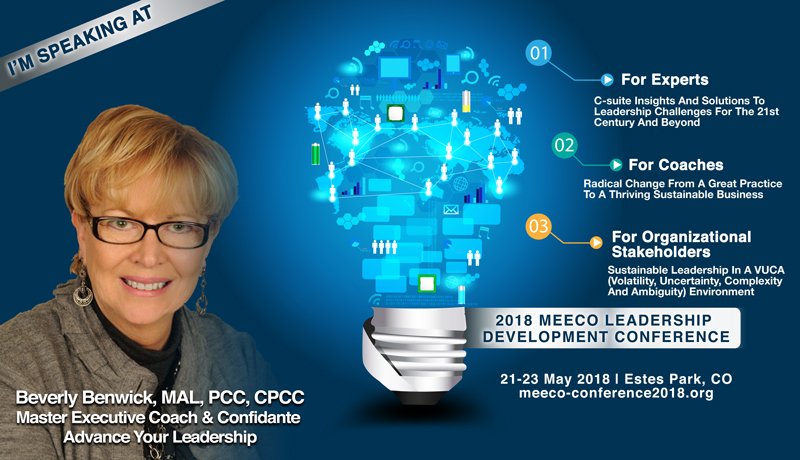
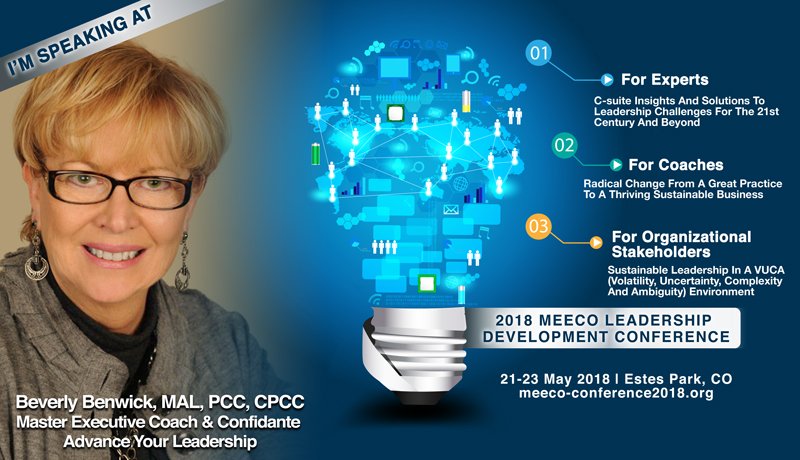
AUTHOR: Beverly Benwick
ABOUT BEVERLY: https://acec.mgmcsolutions.com/directory/bev-benwick-mal-pcc-cpcc/
CONTACT INFORMATION:
Ste. 30, 6488 – 168th Street
Surrey, BC V3S 8Z1 CanadaTEL: 604.576.4970
TOLL FREE: 1.866.95COACH or 1.866.952.6224
E-MAIL: bev@advanceyourleadership.com
WEBSITE: http://advanceyourleadership.com/
LINKEDIN: www.linkedin.com/in/bevbenwick
FACEBOOK: www.facebook.com/advanceyourleadership