Tag: talent management

  • There’s only one way to truly understand another person’s mind

    It’s often said that we should put ourselves in another person’s shoes in order to better understand their point of view. But psychological research suggests this directive leaves something to be desired: When we imagine the inner lives of others, we don’t necessarily gain real insight into other people’s minds.

    Instead of imagining ourselves in another person’s position, we need to actually get their perspective, according to a recent study (pdf) in the Journal of Personality and Psychology. Researchers from the University of Chicago and Northeastern University in the US and Ben Gurion University in Israel conducted 25 different experiments with strangers, friends, couples, and spouses to assess the accuracy of insights onto other’s thoughts, feelings, attitudes, and mental states.

    Their conclusion, as psychologist Tal Eyal tells Quartz: “We assume that another person thinks or feels about things as we do, when in fact they often do not. So we often use our own perspective to understand other people, but our perspective is often very different from the other person’s perspective.” This “egocentric bias” leads to inaccurate predictions about other people’s feelings and preferences. When we imagine how a friend feels after getting fired, or how they’ll react to an off-color joke or political position, we’re really just thinking of how we would feel in their situation, according to the study.

    In 15 computer-based experiments, each with a minimum of 30 participants, the psychologists asked subjects to guess people’s emotions based on an image, their posture, or a facial expression, for example. Some subjects were instructed to “consult their own feelings,” while others were given no instructions, and some were told to “think hard” or mimic the expressions to better understand. People told to rely on their own feelings as a guide most often provided inaccurate responses. They were unable to guess the correct emotion being displayed.

    The second set of experiments asked subjects to make predictions about the feelings of strangers, friends, and partners. (Strangers interacted briefly to get to know one another before hazarding guesses about the preferences of they had just person they met.) The researchers wanted to see if people who had some meaningful information about each other—like spouses—could make accurate judgments about the other’s reactions to jokes, opinions, videos, and more. It turned out that neither spouses nor strangers nor friends tended to make accurate judgments when “taking another’s perspective.”

     Imagining another person’s perspective doesn’t actually improve our ability to judge how another person thinks or feels. “Our experiments found no evidence that the cognitive effort of imagining oneself in another person’s shoes, studied so widely in the psychological literature, increases a person’s ability to accurately understand another’s mind,” the researchers write. “If anything, perspective taking decreased accuracy overall while occasionally increasing confidence in judgment.” Basically, imagining another person’s perspective may give us the impression that we’re making more accurate judgments. But it doesn’t actually improve our ability to judge how another person thinks or feels.

    There were no gender differences in the results. Across the board, men and women tended not to guess another’s perspective very accurately when putting themselves in the other’s position. But this did increase self-confidence in the accuracy of their predictions—even when their insights were off.

    The good news, however, is that researchers found a simple, concrete way we can all confidently and correctly improve the accuracy of our insights into others’ lives. When people are given a chance to talk to the other person about their opinions before making predictions about them—Eyal calls this “perspective getting” as opposed to perspective taking—they are much more accurate in predicting how others might feel than those instructed to take another’s perspective or given no instructions.

    In the final test, researchers asked subjects both to try putting themselves in another’s shoes, on the one hand, and to talk directly with test partners about their positions on a given topic. The final experiment confirmed that getting another person’s perspective directly, through conversation, increased the accuracy of subjects’ predictions, while simply “taking” another’s perspective did not. This was true for partners, friends, and strangers alike.

    “Increasing interpersonal accuracy seems to require gaining new information rather than utilizing existing knowledge about another person,” the study concludes. “Understanding the mind of another person,” as the researchers put it, is only possible when we actually probe them about what they think, rather than assuming we already know.

    The psychologists believe their study has applications in legal mediation, diplomacy, psychology, and our everyday lives. Whether we’re negotiating at a conference table, fighting with a spouse, or debating the political motivations of voters, we simply can’t rely on intuition for insight, according to Eyal. Only listening will do the trick.

    “Perspective getting allows gaining new information rather than utilizing existing, sometimes biased, information about another person,” Eyal explains to Quartz. “In order to understand what your spouse prefers—don’t try to guess, ask.”


    https://qz.com/1319441

  • 10 Small Things Successful People Do Every Day

    Image Designed by Freepik

    By Lolly Daskal
    View original Publication on LollyDaskal.com

    Every day, we’re surrounded by life lessons–little self-contained bits of truth that can help each of us to be a more successful manager, a greater boss, a superior leader, a better person.

    It’s easy to dismiss these ideas because they’re packaged in such small bites, but they can be a great way to positively connect with some of the world’s great wisdom.

    Here are 10 of my favorites:

    1. You have to start somewhere. The first step to getting anywhere is deciding you’re not willing to stay where you are. The least helpful thing you can do is to wait for perfection before taking action. Start where you are, use what you have and do what you can to succeed.

    2. There is always a demand for your supply of respect. Base your attitude in life on how you want to be treated and show respect even to people who don’t deserve it. How you treat others is not a reflection of their character but of yours.

    3. You win when everybody wins. Prepare to win and expect to win, but remember that to be a real winner you must also make winners of those around you.

    4. If your presence doesn’t add value, your absence won’t be felt. The secret to success is no secret at all–it’s finding ways to add value to people’s lives. If you want to be rich in the truest sense of the world, it cannot be about you–it has to include adding value to the lives of those around you.

    5. Focus your attention on what is important. Learn to be disciplined about what you respond to and react to. Not everyone and everything deserves your time, energy and attention. Make conscious choices about what you want to pay attention to and what you want to let go.

    6. All the confidence you will ever need comes from the capabilities you’ve honed. Here’s something I always tell my clients: Confidence comes from believing you are able but competence knows you’re able. Believe in yourself and your possibilities, but know what you are already a master of.

    7. Love what you do or find something else. If you don’t love what you do, you’ll spend the rest of your life being miserable. It’s really that simple. Love what you do and it will never feel like work.

    8. Identify your limits and leverage your fortitude. You will never know your limits unless you push yourself beyond them. The only way to change yourself is to challenge yourself–if you never push, you have direction but no destination.

    9. Know when to forge ahead and when to slow down. The faster we live, the busier we get–but the slower we take things, the deeper we can go. We need both action and reflection in the right balance.

    10. To learn the best, learn from the best. Everyone you meet knows something you don’t. Learning is a treasure, so connect with the expertise of those around you at every opportunity,

    The biggest difference between successful people and not successful people, are the successful people know that taking small daily actions will lead to big results.

  • Decoding leadership

    What skills and behaviors make a good leader effective? Here are the traits that matter.

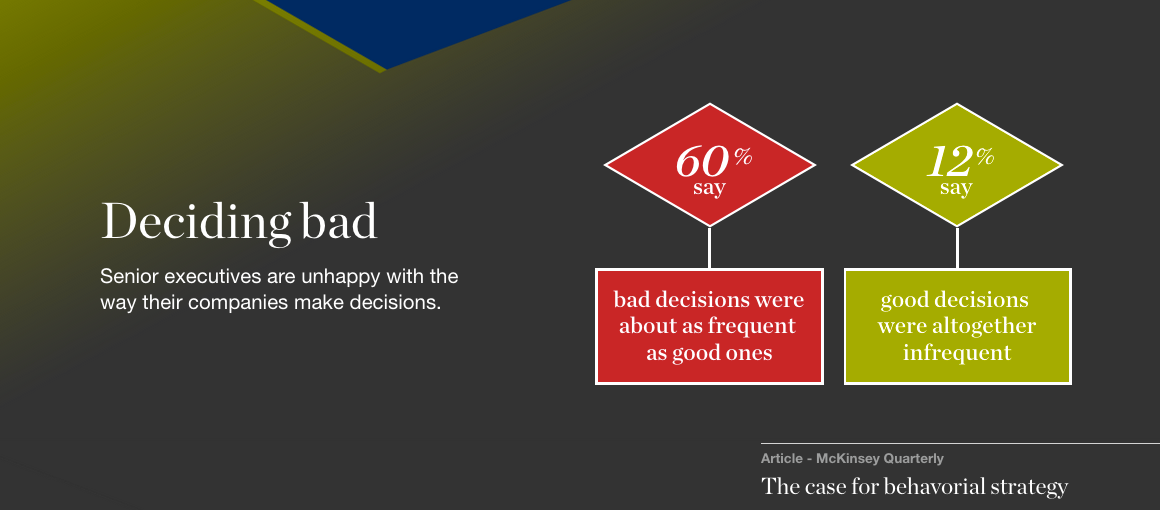
    Jeffrey Pfeffer, Stanford Graduate School of Business says that “This consuming interest in leadership has spawned a plethora of books, blogs, TED talks and commentary [that] are often wonderfully disconnected from organizational reality, and as a consequence, useless for sparking improvement”.

    McKinsey found that 4 out of 20 behaviors explain 89% of the variance between strong and weak leaders.Here are the traits that matter

    Click here to view on Mckinsey

  • Defy Gravity

    Defy Gravity

    How to break from convention and lead in an ambiguous business world

    by Susan Gilell-Stuy, Executive Coach, Trusted Leadership Advisor and Host of Lead With IT podcast

    A reliance on conventional wisdom limits your ability to act in an ambiguous business world. A new generation of employees has redefined their expectations for top leaders and global organizations. And I’m going to tell you something your employees won’t: if you aren’t meeting their needs, they’ve already decided to jump ship and find a new team or company that will.

    Their lack of loyalty is a sign of your neglect. It’s a clear message that you can’t continue to tackle today’s challenges and opportunities with yesterday’s approach. You’ve got to change or lose them.

    It’s time you defy the gravitational pull for doing for what’s conventional: after all the only other option is staying stuck in the past.

    Here are 4 ways you can defy gravity:

    Raise the Bar for Everyone

    Everyone you add to the team should raise the bar for everyone else. That includes you. Only hire people you could see yourself working for one day. The goal is to constantly boost the talent pool, create ongoing intellectual diversity, and learn from each team member’s knowledge and ability.

    Give Up “Kitchen Sink” Meetings

    Stop holding catch-all weekly team meetings. Instead, switch to meetings driven by subject matter. For example: Mondays are project meetings, Wednesdays are budget meetings, and so on. Invite only the key players to keep things simple. A focused meeting makes for quicker and better decision-making.

    Think Big and Let Them Call the Cadence

    As the leader, paint the big picture for your team. Share with them where you’re heading, tell them that you expect them to get there the quickest way possible, and assure them that you’ll clear the speed bumps if need be. Then step back and let your trusted team members call the cadence, approach, and path they’re going to take to get there.

    Kill the Annual Review

    Only one thing matters when it comes to connecting with your people: putting them first. Spend more time focused on them and less time worrying about technical aspects of the business. Don’t wait for an annual review to share what you’re thinking; coach and develop them in real-time. Your investment in them will pay big dividends over the long-term.

    Once you’ve chosen to defy gravity and finish your transformational journey the organization and those around you have no option but to transform too. Fostering real change in those you lead and the organization itself makes you an unstoppable force as a leader.

    Susan Gilell-Stuy, Executive Coach, Trusted Leaderhip Advisor and Host of “Lead With IT” podcast

    Susan is a top-tier corporate executive coach, leadership strategist and speaker who helps millennial leaders and executives tap their genius by discovering the distinct skills and abilities that empower them to map out a plan for success – one that is perfectly suited to them. She is an executive coach for The Wharton School – University of Pennsylvania, a member of the Association of Corporate Executive Coaches and host of the Lead With IT™ podcast. If you’re wondering what your sweet spot is as a leader get your free copy of Susan’s Lead With IT Kit© at susangilellstuy.com and find out what you lead with.

  • The Surprising Value of Being Unattached

    The Surprising Value of Being Unattached

    Some people are naturally blessed with the powers of persuasion. Maybe you’ve seen them in action. They ask and they receive, and they make it look effortless, painless—even fun. For the rest of us, trying to persuade someone can be a maddening experience, and one that is definitely not fun. Maybe we’re trying to make a sale, recruit a partner or get the support we need to pursue a new idea—whatever our goal, and no matter our tactics, the other person stays resolute in “no.” We can push, beg and even manipulate, but he won’t budge. It soon becomes clear that if we keep pushing we might make things worse.

    In those moments, if we can step back and stop pushing, the situation is more likely to work out in our favor—perhaps with a result perhaps better than the one we sought. It seems counterintuitive, but something happens when we stop trying to force an outcome. And if we understand why this happens, we can use it to get the results we want.

    This is not a new idea. In the 14th century Japan it was shibui, while in 16th century Italy, it was called sprezzatura. Chinese Daoists call it wu-wei, and Hindu philosophers know it as ahamkara.

    In the North America, we think of it simply as cool. And if we remember anything we learned in junior high, it was that life was infinitely better for the people who were cool.

    It’s All About Attachment

    In New Age circles, people sometimes speak of a concept called attachment—which means when we’re caught up in something, we get attached to it. That’s when we lose sight of the big picture. We get tunnel vision on the outcome we want, so we don’t notice all that’s happening
    around us. We are blind to what’s really going on, and we are equally incapable of seeing the situation from another person’s perspective.

    This is when the Law of Attraction kicks in, according to New Age Thought. When we’re attached to the outcome, we’re afraid that the thing we want won’t happen. We become attached to that negative thought pattern and then, under the Law of Attraction, we begin attracting more of that negativity. In other words, we begin to imagine the person saying no to us, and eventually he really does say “no.”

    In the Western paradigm—inherited from the thinking of Dr. Sigmund Freud—we end up clinging to our egos. This ego-centered way of related to the world (and to ourselves) traps us in behaviour patterns that don’t meet our needs but which, maddeningly, are hard to see in the moment.

    Effortlessness + Effectiveness = Success

    All of this happens because we’re merely repeating old patterns. We’re like a car that’s stuck in the mud. The harder we try, the more we spin our wheels and make our situation worse.

    Over years of repetition, we have unintentionally trained ourselves to react this way. Just like an athlete who uses repetition to instill muscle memory, we’ve trained our mind to immediately apply that approach. When we become frustrated or desperate, we instinctively revert to these ways. It’s an unconscious, knee-jerk response. If we want to avoid it, we have to consciously change how we react.

    Early Chinese philosophers believed the ideal state of being was when a person was not actively thinking and was not exerting effort. They believed that this is the state in which the person is most able to achieve his goals.

    But retraining yourself so that you can get to that state most definitely requires conscious effort.

    The first step is simply to be aware of your patterns. Catch yourself in that moment; try to talk yourself out of pushing harder. And it’s a paradox, but trying too hard to stop trying too hard is not going to help you break the habit. Mencius, a Chinese philosopher in the fourth century B.C., advocated an approach similar to gardening: Do the planting and monitor the progress, but mostly just sit back and let the plants grow.

    Mencius’ approach isn’t much different from what New Age thought leaders call “the mindset of the witness.” They argue that, when we find ourselves caught up in these frustrating ineffective patterns, we should try to think like a witness. Because a witness is watching the event, not participating and not invested in the outcome.

    Consider the detective shows you’ve watched on TV: A witness comes in and impassively tells the detective what she saw. She wasn’t harmed by the crime and wasn’t involved in the action. She simply watched it all go down. Taking on the mindset of the witness means not getting emotionally engaged in what is taking place.

    As the witness, we notice what is happening but have no expectations about what will happen. We may intend a certain result, but we are not attached to it.

    Still not convinced? Think about insomnia. The harder you try to fall asleep, the less likely it is to happen. Stop trying and…zzz.

    Non-attachment feels unnatural to us in the West. It’s a hard practice to follow. From birth, we’re trained to desire, act and expect positive results, and we’re taught that the harder we work, the greater our reward. It feels strange to let go of an outcome in order to succeed. It’s especially difficult to practice in the moment, when we are trying to persuade someone and our stress levels begin to rise.

    But, by consciously practicing a more passive approach, we can establish new patterns and get our cars unstuck from the mud. We can train ourselves to let go. Whether we call it sprezzatura, shibui, wu-wei, ahamkara or just cool, we’ll be able to remove the tension from the interaction, tension that is keeping the other person from saying “yes.” With that tension gone, we may find ourselves getting a bigger “yes” than the one we imagined.

    AUTHOR: Beverly Benwick

    ABOUT BEVERLY: https://acec.mgmcsolutions.com/directory/bev-benwick-mal-pcc-cpcc/

    CONTACT INFORMATION:
    Ste. 30, 6488 – 168th Street
    Surrey, BC  V3S 8Z1 Canada

    TEL:  604.576.4970
    TOLL FREE: 1.866.95COACH or 1.866.952.6224
    E-MAIL: bev@advanceyourleadership.com
    WEBSITE: http://advanceyourleadership.com/
    LINKEDIN: www.linkedin.com/in/bevbenwick
    FACEBOOK: www.facebook.com/advanceyourleadership


  • On the Lighter side: Fantastic Job Titles for Your Business Card

    On the Lighter side: Fantastic Job Titles for Your Business Card

    Photo credit: getty images

    inc.com
    Please Steal One of These Fantastic Job Titles for Your Business Card. Your job title says a lot about you.

    Sadly, many of us use titles that sound like we’re boring or not that creative. HR manager? Really? There must be a better way. Here are a few creative options.

    1. Chief people officer

    What does this job entail? Who cares? It sounds awesome. It’s the name for the HR officer at Opportunity Network, a company that links CEOs to financial institutions.

    2. Culture operations manager

    Here’s another HR-related title, this one from When I Work. The scheduling app helps managers know when employees are at work.

    3. Chief robot whisperer

    This is a title from the startup Savioke, a company that provides robots to the service industry. It’s an apt description because it relays a sense of wonder and excitement.

    4. Director of bean-counting

    The creative agency Bidlack in Ann Arbor, Michigan, uses this title for the main accountant. It’s a nod to the fact that the role tends to be meticulous (in a good way).

    5. Software ninjaneer

    At a startup called TSheets, they don’t mess around with boring titles. This one nails it because, in many ways, software development is a mysterious and ancient art form.

    6. Director of first impressions

    At publishing house Houghton Mifflin Harcourt, the receptionist has this title. It’s perfect because it is exactly this person’s role at the company.

    7. Digital overlord

    If you have ever worked on a website, you know this term is fitting for the role. They use it at Composites Media, a company that works in the engineering field.

    8. Director of storytelling

    This role creates social media campaigns and strategies for companies. They use it at Eyespeak, a website development company.

    9. Money maestro

    At Delivering Happiness, this is the title for the accounting manager. It is definitely a role of orchestration, especially with pay scales, budgets, and expenses.

    10. Wizard of light bulb moments

    This title, popular on LinkedIn, describes the role of a marketing director. It works because, in a pure sense, marketing is the act of inspiring people to action.